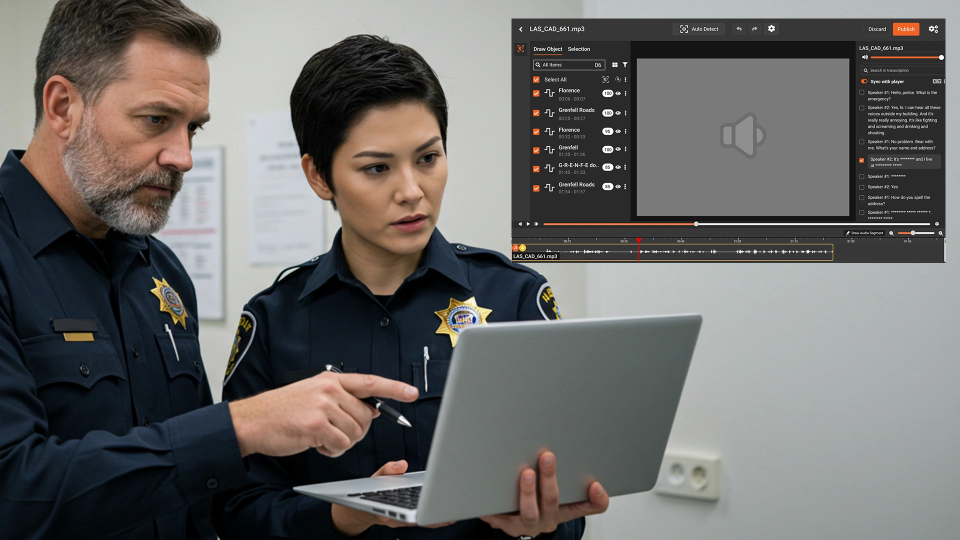
Digital evidence is now central to nearly every police investigation from routine traffic stops to major narcotics, and violent crime cases. But as the volume of video and audio recordings grows, so does the burden of redaction.
Traditionally, this work has been performed manually inside video editing tools such as Adobe Premiere or audio waveform editors. For years, this was the only option. But with the rise of AI, police agencies now have an alternative: automated redaction capable of identifying and masking sensitive data in a fraction of the time.
This article breaks down the key differences between manual redaction and AI-powered redaction, helping agencies evaluate not just the cost, but the operational impact, risk mitigation, and scalability.
The Manual Redaction Process: Slow, Labor-Intensive, and Error-Prone
For many agencies, manual redaction remains the default approach especially when using legacy workflows or consumer-grade editing software. While familiar, the process carries significant drawbacks.
Time Consumption:
Manual redaction requires analysts to:
- watch entire videos frame-by-frame,
- draw masks over faces or objects,
- constantly adjust those masks as subjects move,
- scrub through audio tracks to isolate sensitive words or phrases.
Police body camera footage continues to overwhelm departments, with big city departments generating more than 10,000 hours of footage weekly, creating labor and storage burdens for agencies Interviews with record units often reveal even longer times when footage is complex or contains large crowds.
High Cognitive Burden
Manually tracking faces, children, bystanders, screens, and license plates especially in fast-moving body-worn camera footage, places enormous pressure on staff. One missed frame can compromise privacy, violate public records laws, or damage public trust.
Redacting audio presents similar challenges. Teams must listen to entire 911 calls or interview recordings to ensure no name, address, or sensitive detail slips through. With FOIA deadlines tightening nationwide, this workload can overwhelm teams that were never staffed for digital era demands.
Inconsistent Output
Different analysts may apply masks differently. Some may blur widely, while others mask too narrowly. The lack of standardized approaches means:
- inconsistent redaction quality,
- uneven privacy protection,
- increased risk of PII leakage.
Moreover, manual redaction introduces unavoidable human variability, especially under time pressure or heavy caseloads.
Limited Scalability
Body-worn camera adoption has grown substantially. According to Bureau of Justice Statistics surveys, by 2016 nearly half of U.S. law enforcement agencies had equipped officers with BWCs, and adoption continues rising. This proliferation of cameras translates into massive amounts of digital evidence that agencies must manage, store, and review — a workload that far outpaces manual editing and review capabilities.
Even small agencies face growing backlogs, especially when FOIA requests surge or prosecutors require rapid turnaround.
Manual redaction cannot be scaled without increasing staffing and hiring skilled staff is increasingly difficult.
AI Redaction: Faster, More Accurate, and Built for Modern Caseloads
AI-powered redaction offers an alternative that directly addresses the weaknesses of manual workflows. Rather than relying entirely on human labor, AI detects and tracks sensitive elements automatically.
Below are the key advantages that AI brings to police digital evidence workflows.
-
Automatic Detection of Faces, People, License Plates, Screens, and More
Modern AI models can identify:
- faces (adults and children),
- full-body persons,
- license plates,
- computer or phone screens,
- documents,
- weapons (when enabled),
- text visible in the scene (OCR).
Instead of drawing masks manually, users simply confirm detections. The AI applies redaction across the entire clip.
This eliminates hours of repetitive work and dramatically reduces missed frames.
-
Multi-Object Tracking in Complex Scenes
High-movement scenarios like foot chases, crowds, or dynamic body-worn camera footage are where manual redaction breaks down. AI solves this with auto-tracking, ensuring masks follow subjects smoothly even when they move unpredictably.
This feature is indispensable for:
- gang units,
- narcotics task forces,
- surveillance teams,
- patrol BWC review.
It replaces the tedious frame-by-frame corrections that staff previously performed.
-
Transcript-Based Audio Redaction
AI-transcribed audio allows analysts to search for sensitive terms directly:
- names,
- addresses,
- medical information,
- phone numbers,
- dates of birth,
- or any custom keyword.
Clicking a term automatically highlights the corresponding audio segment, allowing users to redact it instantly. This workflow reduces audio redaction time by50–80%, based on internal agency pilots and VIDIZMO customer data.

-
Greater Accuracy and Standardization
AI applies consistent rules across all footage ensuring uniform blur levels, mask sizes, and redaction types. Instead of relying on the skill or speed of individual analysts, agencies maintain consistent privacy protection across cases and units.
Automated approaches also reduce cognitive load, making it less likely that staff will overlook a sensitive detail due to fatigue.
-
Scales With Evidence Volume
As digital evidence grows - videos, audio, mobile device extraction data dumps, surveillance feeds, AI workflows scale effortlessly. Agencies can process:
- multiple files simultaneously,
- long-form videos without manual intervention,
- bulk batches scheduled automatically on upload.
Rather than adding staff to keep up with bandwidth, agencies can process more evidence with the teams they already have.
Manual Redaction vs. AI Redaction: A Side-by-Side Comparison
|
Factor |
Manual Redaction |
AI Redaction |
|
Speed |
3–5 hours per hour of video |
Up to 90% faster |
|
Accuracy |
Human variability; easy to miss frames |
Consistent detection across entire video |
|
Audio Redaction |
Must listen to entire file |
Transcript search + one-click audio masking |
|
Scalability |
Limited by staff availability |
Scales automatically with evidence volume |
|
Complex Scenes |
Extremely time-consuming |
Auto-tracking handles movement and crowds |
|
Risk of PII Leakage |
High if staff is rushed |
Lower through standardized automation |
|
Training Required |
High; complex editing tools |
Minimal; intuitive interface |
|
Cost |
High labor cost |
Lower long-term operational cost |
Which Approach Protects Agencies Better?
While manual redaction may work for small agencies with minimal video workloads, it struggles as soon as evidence volume increases. AI redaction offers not only speed and accuracy, but also reduced liability, greater compliance assurance, and more predictable turnaround times.
In the era of mandatory transparency, FOIA deadlines, and rising public expectations, agencies cannot afford redaction errors. AI provides a practical and responsible way to modernize this essential function.
Conclusion: AI Doesn’t Replace Analysts, It Amplifies Them
Manual redaction has served law enforcement for years, but the increasing load of digital evidence makes it unsustainable. AI doesn’t eliminate the need for human oversight, it simply removes the repetitive, mechanical work that slows down investigations and drains staff time.
With the right AI-powered tools, agencies can:
- process cases faster,
- improve accuracy,
- reduce backlog,

- strengthen transparency, and
- redeploy staff to higher-priority tasks.
The result is not only operational efficiency, but also stronger, cleaner, and more defensible case files.
Want to See AI Redaction in Action?
Experience how your agency can complete redaction in minutes instead of hours. And discover why agencies nationwide are upgrading from manual workflows to AI-powered automation.
FAQ
Frequently Asked Questions
How long does it take to manually redact police video footage?
Manual redaction can take several hours for every hour of footage, especially when videos contain multiple people, movement, or background audio. Longer recordings, body-worn camera footage, and crowded scenes often increase review and redaction time significantly.
Why is manual redaction so slow for police agencies?
Manual redaction requires reviewers to watch footage frame by frame, track faces or objects as they move, and listen carefully for sensitive audio. Any missed detail can create legal or privacy risks, which forces reviewers to work cautiously and repeatedly recheck their work.
What problems do police agencies face when redacting evidence manually?
Agencies often struggle with backlogs, inconsistent redaction quality, staff burnout, delayed public records responses, and increased legal exposure when redaction is rushed or incomplete.
How does AI redaction help police departments handle more evidence?
AI-assisted redaction can automatically detect faces, people, license plates, and sensitive audio, allowing reviewers to focus on validation instead of starting from scratch. This reduces review time while improving consistency across cases.
Is AI redaction accurate enough for law enforcement use?
AI redaction tools are designed to assist, not replace, human reviewers. Agencies still review and approve redactions, but AI significantly reduces the manual workload by identifying sensitive content faster and more consistently.
TopicsRedaction
About the author
Hassaan Mazhar is a B2B SaaS content strategist at VIDIZMO specializing in AI redaction, compliance technology, and enterprise content marketing. He builds trust-driven narratives for legal, public sector, and enterprise audiences navigating data privacy and video intelligence challenges.
You may also like
Video Redaction Best Practices: Motion, Frame Rates, Tracking and Failing Safe
I led our video redaction project for a county public safety agency where two people handled every disclosure, and ...
Redacting Dash Cam, Body Cam and Drone Footage From a Moving Camera
A fleet claims manager preparing crash footage for an insurer and defense counsel is doing a different job from a ...

Why Frame-Rate Headers Lie: Redacting Variable Frame Rate Video
A video file keeps time frame by frame, and the frames-per-second figure a player displays is a summary of that timing, ...