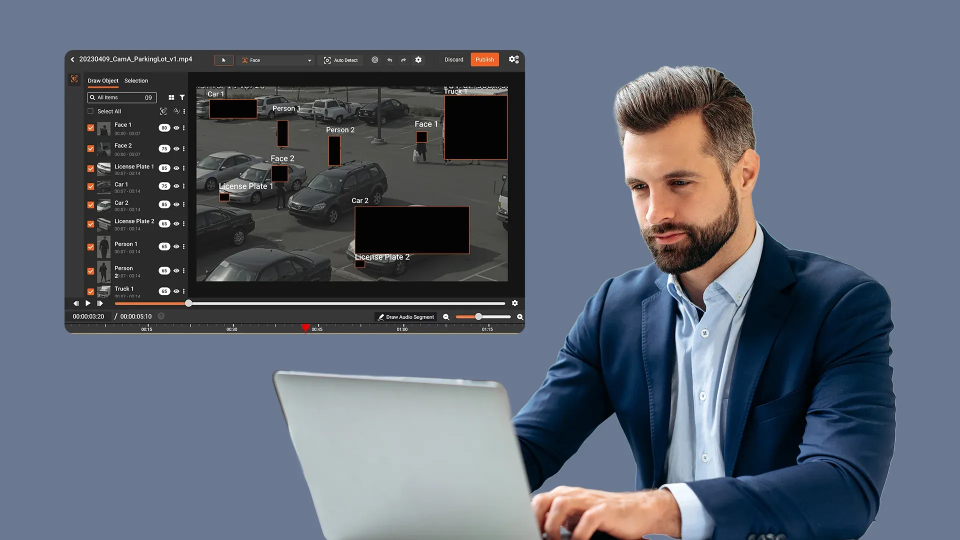
Video redaction is one of the most time-consuming tasks in evidence processing. Every body-worn camera recording, surveillance clip, and interview video that needs to be released under public records laws must first have personally identifiable information (PII) removed. Faces, license plates, bystanders, and other sensitive elements must be obscured before disclosure.
But how long does video redaction actually take? The answer depends entirely on whether your team is doing the work manually or using AI-powered automation, and the gap between those two approaches is larger than most agencies expect.
For mid-to-large law enforcement agencies, understanding that gap is an operational decision, not just a technology question. Every hour spent on manual video redaction is an hour not spent clearing the next FOIA request, processing the next case file, or meeting the next statutory deadline.
This article breaks down real processing time benchmarks for both manual and AI-powered video redaction, compares the two approaches across key criteria, and outlines what evidence and records managers should look for when evaluating automated redaction tools.
What Determines Video Redaction Processing Time?
Several factors influence how long video redaction takes, regardless of the method used:
- Number of PII elements: A crowded public scene with dozens of faces, license plates, and bystanders takes significantly longer than a controlled interview with two people in a room.
- Video length: Longer recordings compound every other variable. A 30-minute body-worn camera clip with multiple scene changes demands more time than a static 30-minute interview.
- Redaction type required: Visual redaction (faces, plates, objects) requires frame-by-frame accuracy. Adding spoken PII redaction in the audio track introduces a separate processing layer.
- Quality and accuracy standards: Agencies with strict evidentiary requirements may mandate frame-by-frame human review, adding time per file.
- File format complexity: Proprietary CCTV formats often require transcoding before redaction can begin, adding preprocessing time.
Both manual and automated approaches face the same underlying complexity. They just handle it differently.
Manual Video Redaction: The Time Reality
Manual video redaction requires an analyst to watch footage frame by frame, identify every instance of PII, draw redaction boxes around each element, track those elements across frames as subjects move, and then review the output for missed elements. It is labor-intensive by nature.
Typical Time Benchmarks by Scene Type
For body-worn camera footage, the most common redaction workload in law enforcement, manual redaction of one hour of footage takes four to eight analyst hours. That ratio shifts based on scene complexity.
Static and Controlled Environments
Low-complexity footage such as one-on-one interviews or controlled settings like offices and holding cells typically requires 2 to 5 analyst hours per hour of footage. Subject count is limited and movement is minimal, reducing tracking overhead.
Dynamic Scenes
Traffic stops, public areas, and outdoor encounters push the ratio to 5 to 8 analyst hours per hour of footage. Multiple subjects, moving vehicles, and changing backgrounds all require additional tracking effort.
High-Density Scenes
Crowd events, protests, and public gatherings are the most demanding. Analysts can expect 8 to 12 or more hours of work per hour of footage, as every frame may contain dozens of faces, license plates, and bystanders requiring individual redaction.
These figures account for the full manual workflow: scrubbing through footage, identifying each PII element, drawing and adjusting redaction boxes, tracking objects across frames, and reviewing the final output for anything missed.
The Compounding Problem
The ratio becomes unsustainable at scale. An agency processing 500 hours of BWC footage per month faces 2,000 to 4,000 analyst hours of redaction work before accounting for audio PII, documents, or images attached to the same cases. Staffing this workload manually requires dedicated redaction teams, and backlogs build quickly when request volumes spike.
Manual video redaction also introduces consistency risk. Different analysts may apply different standards, miss PII elements in complex scenes, or use exemption codes inconsistently. All of these create compliance exposure when redacted recordings are challenged.
AI-Powered Video Redaction: How Automation Changes the Math
AI-powered video redaction software uses machine learning models to detect and track PII elements automatically. The AI identifies faces, license plates, persons, and other sensitive objects across every frame, then applies redaction effects without requiring an analyst to manually draw boxes or track objects through the timeline.
How AI Redaction Processes Video
- Ingestion: Video files are uploaded individually or in bulk. Proprietary formats like H.264 CCTV files are automatically rewrapped to standard MP4.
- AI detection: Machine learning models scan every frame for configured PII types: faces, license plates, persons, screens, weapons, and other objects.
- Tracking: Detected elements are tracked across frames automatically, maintaining consistent redaction as subjects move through the scene.
- Redaction application: Blur, pixelate, or black box effects are applied to all detected elements.
- Output generation: A redacted copy is produced, preserving the original unredacted evidence for chain-of-custody requirements.
AI Processing Time Benchmarks by Detection Scope
Standard Detection (Faces and License Plates)
With detection limited to faces and plates, AI processes one hour of footage in approximately 15 to 45 minutes. This is the fastest configuration for agencies with focused redaction requirements.
Extended Detection (Faces, Plates, Persons, and Objects)
Enabling additional detection types such as persons, vehicles, and screens increases processing time to 30 to 60 minutes per hour of footage, while covering a broader range of PII elements common in BWC recordings.
Full Detection with Spoken PII Audio Redaction
The most comprehensive configuration combines visual detection with automated audio redaction of spoken names, addresses, and other sensitive information. This runs 45 to 90 minutes per hour of footage.
These benchmarks reflect automated processing time, the period when the system runs without analyst intervention. For agencies using a semi-automated workflow where analysts review AI detections before final output, add approximately 15 to 30 minutes of review time per hour of footage.
Even in the semi-automated model, total processing time drops to roughly one to two hours per hour of footage, a fraction of the four-to-eight-hour manual baseline.
Manual vs. AI Video Redaction: Key Differences
Processing Speed
Manual redaction takes 4 to 8 analyst hours per hour of footage. AI-powered redaction completes the same work in 0.25 to 1.5 hours in fully automated mode, with semi-automated review adding another 15 to 30 minutes.
Scalability
Manual workflows scale linearly, meaning more footage requires proportionally more staff. AI processing is parallelized, allowing agencies to process hundreds of files simultaneously without adding headcount. For teams handling multiple recordings at once, see how batch video redaction standardizes output across large workloads.
Consistency
Manual output varies by analyst skill, attention, and fatigue. AI applies uniform detection rules across every file, reducing the risk of missed PII and inconsistent exemption coding.
Overnight Processing
Manual redaction requires staffed shifts for after-hours work. AI-powered systems run unattended queue-based processing, delivering completed files by the next business day without additional staffing.
Accuracy Controls
Manual accuracy depends on individual analyst judgment. AI tools offer configurable confidence thresholds, typically ranging from 25% to 90%, allowing managers to tune detection sensitivity and reduce false positives to match agency standards.
Audit Trail
Manual workflows rely on informal or inconsistent logging. AI platforms automatically document every redaction decision with user ID, timestamp, and exemption code, producing a defensible record for legal and compliance purposes.
Multi-Format and Spoken PII Support
Manual workflows are typically limited to video. AI platforms support unified processing across video, audio, images, and documents, including automated detection and muting of spoken PII in audio tracks.
The difference is most pronounced at scale. An agency processing 500 hours of footage per month could reduce workload from thousands of analyst hours to a fraction, freeing staff for case-related work rather than repetitive redaction.
What to Look for in an AI Video Redaction Tool
Not all AI-powered redaction tools deliver the same time savings. When evaluating options, evidence and records managers should assess:
- Workflow flexibility: Does the tool support fully automated, semi-automated, and manual modes? Different cases may require different levels of human oversight.
- Bulk processing capability: Can the system handle batch uploads and queue-based processing for high-volume workloads, including unattended overnight runs?
- Detection breadth: Does the AI detect faces, license plates, persons, vehicles, screens, and weapons, or just faces? Body-worn camera footage contains a wide range of PII types.
- Accuracy controls: Are confidence thresholds configurable so managers can balance detection sensitivity against false positive rates?
- Audit trail: Does every redaction generate a timestamped, documented record with user ID and exemption codes for legal defensibility?
- Deployment options: Can the tool run on-premises or in a government cloud for agencies with data residency or CJIS compliance requirements?
- Format support: Does the platform handle proprietary CCTV formats, audio files, documents, and images, or is it limited to standard video?
For a detailed breakdown of what to prioritize when selecting a tool for body-worn camera footage specifically, see this guide on choosing the right BWC redaction solution.
How VIDIZMO Redactor Accelerates Video Redaction
VIDIZMO Redactor is an AI-powered redaction platform built for high-volume environments. It supports all three workflow modes (fully automated, semi-automated, and manual) across 255+ file formats including video, audio, images, documents, and PDFs.
For law enforcement evidence and records units, Redactor addresses the core bottleneck: processing time. The platform's AI detects and tracks faces, license plates, persons, screens, weapons, and other objects automatically, while spoken PII redaction handles sensitive information in audio tracks. Configurable confidence thresholds (25% to 90%) let managers set accuracy standards per use case, and frame-by-frame tracking validation reduces false positives without manual frame-by-frame review.
Bulk redaction capabilities support queue-based processing for unattended overnight runs, tested at scale with two million recordings. Every redaction decision is logged with user ID, timestamp, and exemption code, producing the defensible audit trail that FOIA and public records compliance demands.
Deployment options include SaaS, government cloud, on-premises, and hybrid configurations for agencies with strict data residency or CJIS-compliant infrastructure requirements.
Stop losing analyst hours to manual redaction. Book a demo and see how Redactor processes your footage in minutes, not days.

Key Takeaways
- Manual video redaction takes 4 to 8 analyst hours per hour of footage, rising to 12 or more hours for high-density scenes like crowds and protests.
- AI-powered redaction processes the same footage in 15 to 90 minutes depending on detection scope, with semi-automated review adding 15 to 30 minutes.
- Agencies processing 500 or more hours of BWC footage per month can reduce thousands of analyst hours to a fraction using automated workflows.
- AI redaction applies uniform detection rules across every file, eliminating the consistency risk that comes with analyst fatigue and varying standards.
- Fully automated, queue-based processing allows overnight runs without staffing, delivering completed files ready for review the next business day.
- Every redaction decision is logged with user ID, timestamp, and exemption code, creating the defensible audit trail that FOIA compliance requires.
- Deployment options including on-premises, government cloud, and hybrid configurations make AI redaction viable for agencies with strict CJIS requirements.
Manual Redaction Is a Bottleneck You Can Solve
Video redaction timelines have a direct impact on FOIA compliance, case processing efficiency, and resource allocation. Manual methods consume four to eight analyst hours per hour of footage, a ratio that becomes unsustainable as body-worn camera programs expand and public records request volumes increase. AI-powered video redaction compresses that timeline to a fraction of the manual baseline while improving consistency and creating defensible audit trails.
For evidence and records managers weighing the operational cost of manual workflows against the investment in automation, the benchmark comparison is clear: AI-powered video redaction does not just save time. It changes the operational math entirely.
FAQ
Frequently Asked Questions
How long does manual video redaction take?
Manual video redaction typically takes four to eight analyst hours per hour of body-worn camera footage. Complex scenes with crowds, multiple vehicles, or public areas can push that ratio to eight to 12 or more hours per hour of footage.
How fast is AI-powered video redaction?
AI-powered video redaction processes one hour of footage in approximately 15 to 90 minutes depending on the number of PII detection types enabled and whether spoken PII audio redaction is included. Semi-automated workflows with human review add 15 to 30 minutes per hour.
Can AI video redaction run overnight without an analyst?
Yes. Fully automated bulk redaction systems use queue-based processing to run unattended during off-hours. Files are submitted to a processing queue and completed sequentially, ready for review the next business day.
What types of PII can AI detect in video?
AI-powered redaction tools can detect faces, license plates, persons, vehicles, screens, weapons, signatures, and other configurable objects in video. Audio AI can detect and mute spoken names, addresses, Social Security numbers, credit card numbers, and other sensitive information.
Does AI video redaction replace human review entirely?
Not necessarily. Many agencies use a semi-automated workflow where AI handles detection and initial redaction, and a human analyst reviews the output before release. This hybrid approach captures the speed benefit of automation while maintaining human oversight for high-stakes recordings.
TopicsRedactionVideo Redaction

About the author
Ali Rind is a Product Marketing Executive at VIDIZMO, where he focuses on digital evidence management, AI redaction, and enterprise video technology. He closely follows how law enforcement agencies, public safety organizations, and government bodies manage and act on video evidence, translating those insights into clear, practical content. Ali writes across Digital Evidence Management System, Redactor, and Intelligence Hub products, covering everything from compliance challenges to real-world deployment across federal, state, and commercial markets.
You may also like
Video Redaction Best Practices: Motion, Frame Rates, Tracking and Failing Safe
I led our video redaction project for a county public safety agency where two people handled every disclosure, and ...
Redacting Dash Cam, Body Cam and Drone Footage From a Moving Camera
A fleet claims manager preparing crash footage for an insurer and defense counsel is doing a different job from a ...
Why Frame-Rate Headers Lie: Redacting Variable Frame Rate Video
A video file keeps time frame by frame, and the frames-per-second figure a player displays is a summary of that timing, ...