You already know the stakes. One missed face in a frame. One unredacted name in a voicemail. That is all it takes for a regulator, judge, or data subject to question your entire program. Yet many teams still run visual PII redaction and auditory PII redaction in two different tools, with two different owners, and two different sets of logs.
The result is predictable. Gaps between video and audio. Inconsistent policies. Manual QA that eats entire weeks of your team’s time. You sign off on a redacted video, only to learn the transcript tool never caught the child’s name in the background conversation. Or the face redaction software handled cameras, but your audio redaction vendor missed social security numbers in call recordings.
This is the pain that top software for redacting visual and auditory PII is supposed to solve. But if you pick tools that treat video and audio redaction as separate tracks, you just shift the risk from one bucket to another. You still carry the liability when a plaintiff lawyer lines up your "final" redacted video against the original and shows audio that does not match visual masking.
In regulated environments, that disconnect is not a minor workflow issue. It is a credibility problem. And credibility is what you are actually selling to regulators, courts, and data subjects when you deliver redacted evidence or compliance exports.
Why high risk teams need top software for redacting visual and auditory PII in one workflow
If you handle evidentiary video, body-worn camera footage, interview recordings, or contact center data, you already live under pressure. You must respond fast, stay inside disclosure timelines, and still protect every face, voice, and identifier across thousands of hours of footage.
Separate tools for visual PII redaction and auditory PII redaction create structural problems:
- Fragmented detection: One engine for faces and screens, another engine for spoken PII redaction, with different accuracy profiles and blind spots.
- Inconsistent rules: Redaction policies live in PowerPoints and SOPs, not inside a unified system that enforces them across video and audio.
- Duplicated review cycles: Teams rewatch the same asset in different tools, re-enter timestamps, and revalidate each version.
- Version sprawl: "Video_final_redacted.mp4" and "Audio_redacted_final2.wav" float in shared drives without clear linkage to the original source.
- Weak audit trails: You cannot easily prove who redacted what, when, and under which policy setting.
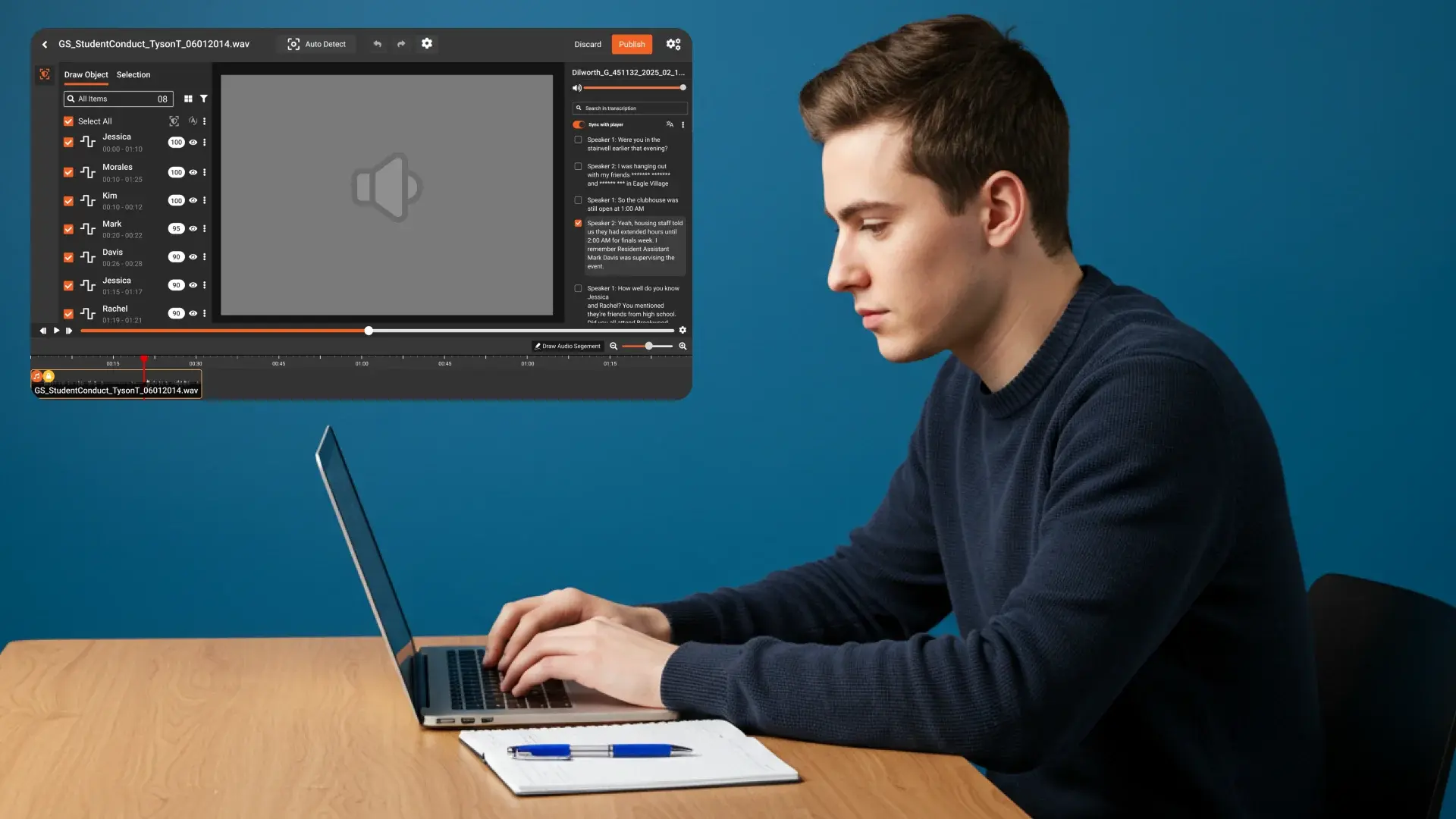
Top software for redacting visual and auditory PII addresses this by treating each asset as a single object, regardless of how many streams it carries. Video, audio, transcripts, and redaction masks live in one workspace. One timeline. One audit trail.
That single point of control matters when:
- You must prove a consistent standard across digital evidence and contact center recordings.
- You need to apply the same PII definitions to both faces and spoken identifiers.
- You want to reduce the cognitive load on reviewers who already work under strict time limits.
When buyers look for top software for redacting visual and auditory PII, they are really looking for confidence that nothing slips through. A single workflow is the only practical way to get there at scale.
Core capabilities to evaluate in top software for redacting visual and auditory PII
Not all video and audio redaction software is built for regulated, high volume use. If you are shortlisting vendors, focus on how well they unify visual PII redaction and auditory PII redaction into one defensible pipeline.
Unified detection across video, audio, and text
Look for AI redaction software that detects and links PII signals across multiple layers:
- Visual entities: Faces, license plates, screen contents, ID badges, documents.
- Auditory entities: Names, addresses, phone numbers, social security numbers, account numbers, and other spoken PII redaction targets.
- Text artifacts: Captions, transcripts, and on-screen text that may expose personal data.
The top software for redacting visual and auditory PII will surface all these detections on a single timeline. Reviewers should see where a person appears, speaks, and is referenced in text, without toggling between tools or exports.
Human in the loop review and control
Full automation sounds appealing. In practice, regulated teams need a human in the loop to validate high risk decisions. Evaluate whether the multimedia redaction platform supports:
- Review queues to route assets to specific reviewers or teams.
- Confidence scoring so reviewers prioritize lower confidence detections.
- One click overrides to remove or add redaction masks with clear logging.
- Role based access to segregate duties between operators, reviewers, and approvers.
Top software for redacting visual and auditory PII never forces you to trust the model blindly. It gives you enough context to validate and enough control to correct without reprocessing from scratch.
Auto tracking for faces and other visual entities
Manual frame by frame face masking is not sustainable. Enterprise teams rely on face redaction software that provides:
- Automatic person detection with persistent IDs across scenes.
- Object tracking so a blur or pixelation box follows a face or plate through the entire shot.
- Batch operations to apply or remove redaction for a person across the whole asset with a single click.
This level of visual PII redaction transforms a tedious chore into a quality control task. Reviewers focus on exceptions and edge cases, not repetitive box drawing.
Spoken PII detection with contextual understanding
For auditory PII redaction, speech to text alone is not enough. You need AI redaction software that understands patterns and context, not just keywords. Important capabilities include:
- Language models tuned for your domain, accents, and audio quality.
- Pattern recognition for number sequences that look like card numbers or IDs.
- Context aware detection that distinguishes between "May" as a month and "May" as a name.
- Custom PII definitions for organization specific terms, project codes, or case identifiers.
The top software for redacting visual and auditory PII will also allow you to apply different redaction styles to audio tracks, such as bleeping, muting, or replacement tone, while keeping lip sync misalignment to a minimum.
Audit ready logs and exportable evidence
Your redaction work does not end when you hit export. Legal, compliance, and external parties often need evidence that the process was controlled. Evaluate whether the multimedia redaction platform can produce:
- Event logs with timestamps for detections, human overrides, and approvals.
- Policy snapshots that show which PII rules were applied during processing.
- Side by side comparison of original and redacted versions for internal QA.
- Immutable outputs where redaction masks are baked into the final file.
Top software for redacting visual and auditory PII turns your workflow into a defendable story, not just a technical process. That story matters in hearings, audits, and data protection assessments.
How unified visual PII redaction actually works in practice
To understand why a unified workflow matters, follow a typical case from intake to delivery.
A public records request arrives for ten hours of body cam footage. The footage includes bystanders, minors, license plates, and incidental audio containing names and addresses. You must deliver within a statutory deadline and prove you protected all third party PII.
With top software for redacting visual and auditory PII, the workflow looks like this:
- Ingest: You upload the footage into a secure multimedia redaction platform. The system ingests video, audio, and metadata as one asset per file.
- Automated analysis: The AI engine scans for faces, plates, screens, and other visual PII. At the same time, it transcribes audio and flags spoken PII redaction candidates such as names and numbers.
- Unified timeline: All detections appear on one timeline, with markers representing visual and auditory events. Reviewers play through once, confirming or adjusting masks across both streams.
- Bulk actions: A reviewer decides that all bystanders should be redacted, but the primary subject should remain visible and audible. They tag the main subject and apply a rule to redact all other detected individuals in a single step.
- Quality check: A second reviewer spot checks scenes with high PII density and verifies alignment between what is seen and what is heard.
- Export: You generate a single redacted video with synchronized visual blurs and audio mutes, plus logs that describe what was done.
Contrast that with a split tool workflow, where one team runs face redaction software on the video file, a second team runs spoken PII redaction on separate audio or transcripts, and a third team attempts to reconcile the two outputs. Each handoff is a point of failure. Every re-export introduces risk.
Top software for redacting visual and auditory PII removes those seams. You trade three disconnected processes for one controlled, observable pipeline.
Designing a defensible spoken PII redaction workflow for audits and discovery
Courts and regulators are increasingly sophisticated about AI use. They know automated PII redaction exists. They want to see how you use it responsibly, especially for spoken PII redaction that is harder to inspect manually at scale.
When you design a workflow around top software for redacting visual and auditory PII, consider how each step will look under scrutiny:
- Policy alignment: Map your legal and regulatory requirements to concrete detection rules in the platform. For example, define which PII categories must always be redacted versus those that may remain in under certain legal bases.
- Model configuration: Document which AI models are used for speech recognition and entity detection, and how you tune confidence thresholds.
- Exception handling: Describe how reviewers handle false positives and false negatives, and how they escalate borderline cases.
- Approval workflow: Ensure every asset has a clear owner and approver, tracked in system logs.
Top software for redacting visual and auditory PII should make it easy to encode these choices into the platform. You do not want your defensible story sitting only in a policy binder. It should be visible in how the software behaves and in the metadata it produces.
Example of an enterprise multimedia redaction platform that handles both visual and auditory PII
Enterprise buyers often discover that basic plugins or desktop tools cannot keep up with their case volumes, geographic spread, and compliance obligations. At that point, they turn to a dedicated multimedia redaction platform built for complex environments.
An enterprise grade solution such as VIDIZMO REDACTOR illustrates what top software for redacting visual and auditory PII looks like in practice:
- End to end workflow from ingestion and automated analysis through human review, approval, and export, all within a single system.
- Visual and auditory AI models optimized for real world evidence footage, including low light video and noisy audio.
- Scalability to process large backlogs of video and audio in parallel, using cloud infrastructure and GPU acceleration.
- Security and access control aligned with enterprise identity providers and least privilege principles.
- Integration paths into case management, content management, and evidence management systems.
Platforms in this class are built for repeatable redaction at scale, not ad hoc one offs. They address the operational realities of agencies, enterprises, and service providers that handle mixed video and audio evidence every day.
For buyers evaluating top software for redacting visual and auditory PII, solutions like VIDIZMO REDACTOR provide a benchmark for what an integrated, audit friendly environment should feel like. They show how unified visual PII redaction and auditory PII redaction can coexist without overloading reviewers or weakening controls.
Operational outcomes from adopting top software for redacting visual and auditory PII
The value of investing in a unified video and audio redaction software platform shows up in concrete outcomes, not just cleaner user interfaces.
- Reduced review time: Automated detection and tracking cut the hours spent manually scanning for faces and PII phrases, while still keeping humans in control for final decisions.
- Fewer missed identifiers: Consistent AI models and policies across visual and auditory channels reduce the chance that a face is blurred but the name is still clearly heard.
- Lower rework rates: With one workflow and one final asset, you spend less time re exporting after discovering a missed identifier in a separate audio track or transcript.
- Stronger defensibility: Comprehensive logs, policy enforcement, and unified outputs make it easier to stand behind your redaction choices.
- Scalability for surges: When a major case or regulatory change triggers a spike in requests, you can ramp capacity without redesigning your process.
Ultimately, top software for redacting visual and auditory PII is not only about compliance. It is about giving your teams a realistic way to keep up with demand, maintain quality, and avoid burnout from repetitive, high stakes manual work.
If you regularly handle sensitive video and audio, it is worth stepping back from a tool by tool mindset. Instead, consider whether your organization is ready for a unified multimedia redaction platform that treats every asset as one object, every workflow as one story, and every redaction decision as part of a coherent record.

FAQ
Frequently Asked Questions
How is top software for redacting visual and auditory PII different from basic editing tools
Top software for redacting visual and auditory PII focuses on detection accuracy, workflow control, and auditability. Basic editing tools require manual box drawing and waveform editing, with no automated PII detection, no unified timeline across video and audio, and limited logging. Enterprise platforms use AI to flag likely PII, streamline reviewer decisions, and produce exportable logs that support legal and regulatory scrutiny.
Can video and audio redaction software handle poor quality recordings
Modern AI redaction software can work with low light video and noisy audio, but performance varies. Look for platforms that offer models trained on evidence grade footage and that expose confidence scores. In many cases, top software for redacting visual and auditory PII allows reviewers to adjust thresholds and add manual masks where automated detection struggles.
Do we still need human reviewers if detection is automated
Yes. Automation reduces manual effort but does not remove the need for judgment. Human in the loop review is essential for handling edge cases, interpreting context, and aligning redaction with legal strategy. The goal of top software for redacting visual and auditory PII is to shift reviewers from finding every instance to validating and refining AI suggestions.
How does unified visual PII redaction improve compliance
Unified visual PII redaction keeps video, audio, and transcripts in one workflow with shared policies and logs. This reduces inconsistencies between what is seen and heard, simplifies training, and makes it easier to demonstrate compliance. Instead of stitching together evidence from multiple tools, you can show a single pipeline governed by defined rules.
What output formats should enterprise buyers expect
Enterprise grade multimedia redaction platforms typically support standard video formats such as MP4 and MOV, along with audio formats such as WAV and MP3. They should also produce machine readable logs, transcripts, and redaction reports. Top software for redacting visual and auditory PII often supports export presets aligned with court systems, regulators, or internal archival requirements.
How does a multimedia redaction platform integrate with existing systems
Integration usually happens through APIs, SDKs, or connectors to evidence management, content management, or case management systems. You can route ingested media to the multimedia redaction platform, process it, and then return redacted outputs and metadata to the source system. When evaluating top software for redacting visual and auditory PII, confirm that it can fit into your current ecosystem without forcing a full rip and replace.
What should we look for in audit trails and logging
Audit trails should capture who uploaded each asset, which models and policies were used, when detections occurred, what overrides were made, and who approved final exports. Time stamped, immutable logs are important. Top software for redacting visual and auditory PII provides these logs in a format that legal, compliance, and external parties can understand without deep technical knowledge.
Is automated PII redaction suitable for cross border or multi region deployments
Yes, if the platform supports regional hosting, data residency controls, and configurable PII policies. Different jurisdictions emphasize different identifiers and exemptions. A flexible platform lets you tailor visual PII redaction and auditory PII redaction rules per region while maintaining a consistent core workflow. This is a key consideration when selecting top software for redacting visual and auditory PII for global operations.
How do we evaluate ROI for investing in top software for redacting visual and auditory PII
ROI comes from reduced manual review time, lower rework rates, fewer missed PII incidents, and faster response to legal or regulatory requests. You can model savings by comparing current hours spent per hour of media against projected hours after automation, then factor in reduced risk exposure. Pilot projects with a multimedia redaction platform can provide concrete baseline and post implementation metrics.
Can the same platform handle both day to day operations and high profile cases
A mature multimedia redaction platform is designed for both routine workloads and peak demand. It should scale horizontally, maintain consistent policies, and support granular access controls for sensitive matters. When you choose top software for redacting visual and auditory PII, confirm that it can flex from small internal reviews to large, multi party disclosures without changing tools or workflows.
TopicsRedaction
About the author
Hassaan Mazhar is a B2B SaaS content strategist at VIDIZMO specializing in AI redaction, compliance technology, and enterprise content marketing. He builds trust-driven narratives for legal, public sector, and enterprise audiences navigating data privacy and video intelligence challenges.
You may also like
Video Redaction Best Practices: Motion, Frame Rates, Tracking and Failing Safe
I led our video redaction project for a county public safety agency where two people handled every disclosure, and ...
Redacting Dash Cam, Body Cam and Drone Footage From a Moving Camera
A fleet claims manager preparing crash footage for an insurer and defense counsel is doing a different job from a ...

Why Frame-Rate Headers Lie: Redacting Variable Frame Rate Video
A video file keeps time frame by frame, and the frames-per-second figure a player displays is a summary of that timing, ...