FOI request volumes across Canadian public bodies have been climbing year over year. At the same time, public sector budgets and staffing are tightening. The arithmetic does not balance, and the work has to land somewhere. Increasingly it lands at consultancies. Municipalities, health authorities, ministries, and Indigenous governments are outsourcing FOI processing to firms that can absorb the volume without expanding their own headcount.
The consultancy inherits the volume problem. It also inherits something the public body did not have to deal with: every client carries its own legislation, its own exemption codes, its own file formats, and its own security posture. A consultancy serving five municipalities, one health authority, and a provincial ministry is operating across five different statutory frameworks, three different data residency expectations, and a mixed bag of Adobe, Word, body camera, and 911 audio inputs. Manual redaction does not scale across that surface area. This post covers how AI-powered redaction lets consultancies handle higher volume, more file types, and more clients without proportional headcount growth.
Why Redaction Is the Bottleneck for FOI Consultancies
In a typical FOI engagement, the consultancy handles intake from the public body, scoping with the requester, retrieval of responsive records, redaction, review, and release. Of those steps, redaction consumes the most time. It is the only step where every page, every minute of audio, and every frame of video has to be examined directly.
Manual redaction in Adobe or Word does not scale across mixed file types. The consultancy ends up with multiple tools strung together: Adobe for PDFs, a separate utility for video, a third tool for 911 audio, sometimes a manual transcription step before the audio can even be reviewed. Each tool has its own learning curve, its own audit log (or lack of one), and its own export format. Assembly of the final response is its own operational task on top of the redaction itself.
Each client adds another layer of decision logic. Ontario municipal records run under MFIPPA section 14 for law enforcement exemptions and section 38 for personal information. Provincial records run under FIPPA. Federal records run under the Access to Information Act and the Privacy Act. Health authority records carry PHIPA on top of FIPPA. BC public bodies run under FIPPA BC. Each statute has its own exemption framework, its own privacy balance test, and its own appeal process. A consultant moving between client engagements has to switch contexts on every file.
Five Operational Challenges FOI Consultancies Face Across Multi-Client Engagements
Multi-client data segregation
Each client's records must be isolated from every other client's records at the data, access, and audit levels. A redaction tool that uses a single shared workspace across all engagements creates a defensibility problem the moment one client questions the consultancy's handling of their records.
Mixed media types
FOI productions increasingly span beyond documents. Body camera footage in police complaint files. 911 audio in incident records. Surveillance video in transit authority responses. Scanned older paper records. Photographs of evidence. A document-only redaction tool covers a shrinking portion of the work.
Jurisdictional variation
Beyond MFIPPA, FIPPA, PHIPA, ATIP, and FOIPPA, individual public bodies have local interpretation conventions, exemption codes specific to their record types, and stylistic norms (some agencies use highlighting in addition to redaction marks, some attach exemption code legends to release packages). A redaction tool needs to support per-client configuration without forcing the consultancy to maintain entirely separate processes.
Audit trails and chain of custody
Each release has to be defensible at the level of the individual record. The consultancy needs to be able to show, per file, what was redacted, on what statutory basis, by which reviewer, and when. Across multiple engagements, this audit evidence has to stay client-segregated; one client's audit log does not belong in another client's release file.
Canadian data residency
Public sector clients increasingly require records to remain in Canadian jurisdiction during processing. Tools that route content through US-based cloud infrastructure may be acceptable for some commercial work but typically fail the requirements of provincial ministries, health authorities, and federal agencies. The consultancy needs to be able to offer Canadian-resident processing as a default.
How AI Redaction Changes the Unit Economics of FOI Consultancy Work
The unit economics shift when detection becomes automated and judgment stays human.
In a manual workflow, the consultant spends most of their time finding things. Reading every page of a 200-page response file looking for names, dates of birth, addresses, financial information. Scrubbing through hours of body camera footage looking for bystanders to obscure. Listening to 911 audio looking for spoken identifiers. The judgment work (what is exempt under section 14, what is exempt under section 38, what is releasable subject to redaction) takes a fraction of the total time.
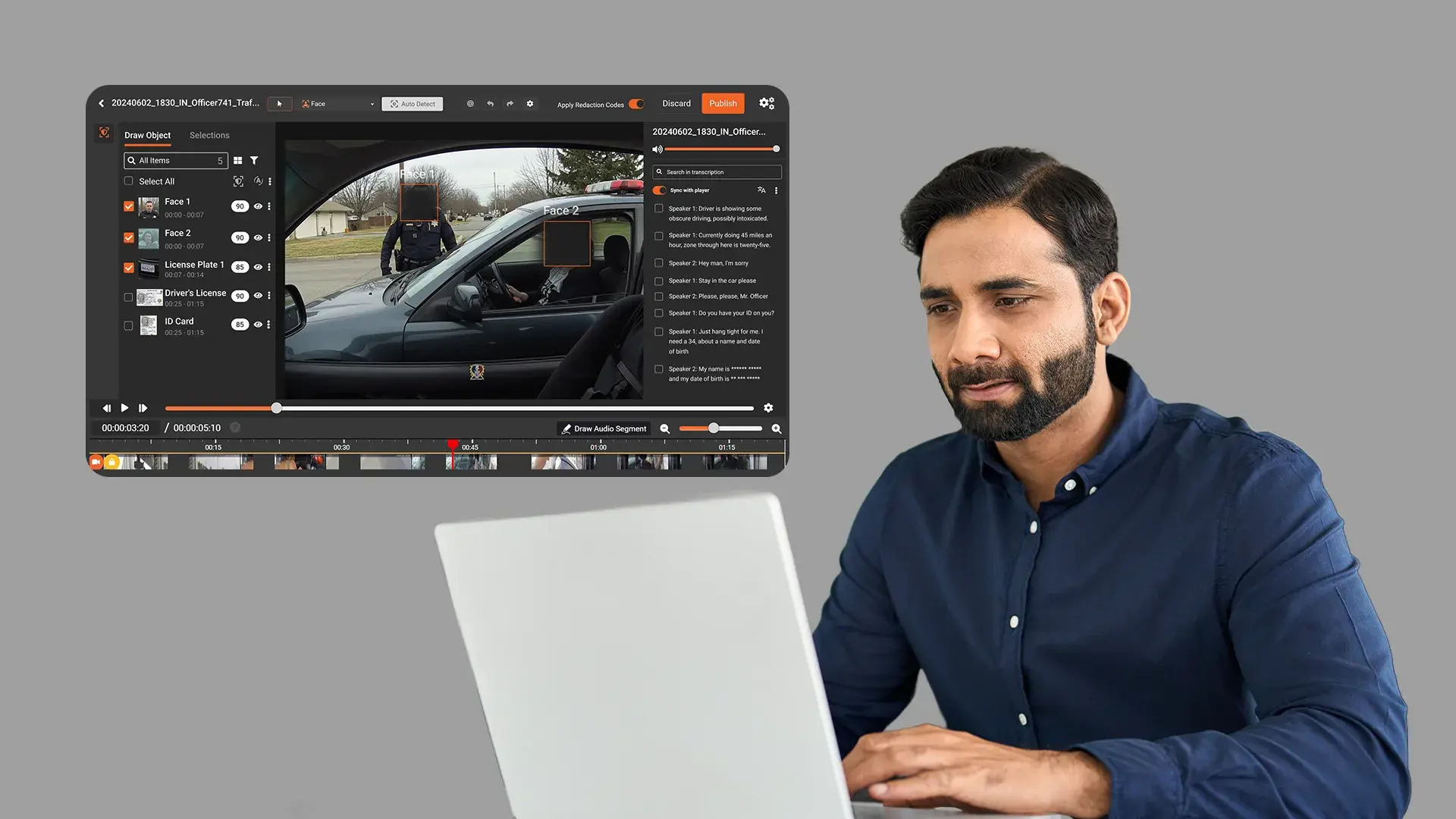
In an AI-assisted workflow, the platform handles the finding. PII detection runs across documents, audio, and video automatically. OCR handles scanned records. License plates and faces in video are detected with persistent tracking across frames. Spoken names in audio are detected through transcription and PII analysis. The consultant's role shifts to confirming detections, applying exemption codes, and approving the release.
The same consultant handles substantially more files in the same hours. The same file gets a more consistent redaction because detection completeness is set by the tool rather than by the reviewer's attention. The audit log records what the AI flagged, what the consultant confirmed, and what was applied as the final release. The defensibility evidence becomes a side effect of the workflow rather than a separate documentation step.
Across a portfolio of five or ten public sector clients, this is the difference between adding three consultants every quarter to keep up and adding one or none. Bulk processing across the portfolio handles surge events when multiple clients have busy weeks at once.
What to Look for in a Redaction Platform Built for FOI Consultancies
Multi-tenant or per-client workspace separation
The platform should support isolated workspaces per client engagement, with separate user provisioning, separate audit logs, and separate retention policies. Mixing client data across a single shared workspace is a defensibility problem.
Multi-format support
Documents (PDF, Word, Excel, PowerPoint, scanned PDFs through OCR), video (MP4, MOV, body camera and dashcam formats, H.264 streams), audio (WAV, MP3, common 911 and call recording formats), and image attachments. Single-format tools force the consultancy to maintain multiple parallel workflows.
Canadian data residency
Hosting in Azure Canada Central or another Canadian-resident region for SaaS deployments. On-premises deployment available for clients whose contracts require records to stay inside their own infrastructure. Confirm this in writing during procurement; some vendors with global footprint do not actually offer Canadian-resident processing as a default.
Integration with existing FOI case management tools
The consultancy probably already runs FOI case management software (AccessPro, Privasoft, or similar). The redaction tool should integrate with the case management workflow rather than force a wholesale replacement. API access and standard export formats matter here.
Granular audit logs per client
Per-record, per-action logs scoped to the client engagement. Operator, IP address, timestamp, action type, and the exemption code or statutory basis attached to each redaction. Stored in tamper-proof storage suitable as audit evidence.
Flexible deployment
SaaS for the typical engagement, dedicated SaaS for clients with elevated security requirements, private cloud for clients who want the consultancy to operate inside the client's own Azure or AWS environment, on-premises for clients with the strictest data residency posture. The consultancy should not be locked into one deployment model that fits some clients and excludes others.
VIDIZMO Redactor's document redaction, video redaction, and audio redaction capabilities cover the format range. Country-specific PII detection includes Canadian Social Insurance Numbers alongside US, UK, EU, and other patterns. Canadian data centers are available for dedicated SaaS deployments. The Portal architecture supports per-client workspace isolation with independent audit logs. For the broader public-sector context, see the government agencies and FOIA public records redaction software overviews.
Building a Redaction Operating Model That Scales With Your Consultancy
The economics of FOI consultancy work are shifting. Public sector outsourcing is rising. The volume per engagement is rising. The mix of media types is widening. The clients are not relaxing their statutory or data residency expectations. The consultancies that grow profitably in this market are the ones that handle larger portfolios with smaller proportional staffing, and the ones whose tooling absorbs the volume rather than passing it through to billable hours.
Redactor fits into existing consultancy workflows rather than replacing the FOI case management software the firm already runs. Book a demo to see multi-client deployment with per-engagement isolation and Canadian-resident processing.

FAQ
Frequently Asked Questions
Can FOI consultancies use one redaction platform across multiple public sector clients?
Yes, when the platform supports per-client workspace separation. The Portal architecture in VIDIZMO Redactor lets each client engagement run as an isolated workspace with its own users, content, audit logs, and retention policies. Cross-client data leakage is prevented at the application, database, and storage layers. The consultancy operates a single platform license while each client experiences their engagement as a private space. This is the operating model most consultancies move to once they have more than two or three concurrent engagements.
Does the platform support Canadian data residency for public sector clients?
Yes. VIDIZMO Redactor supports dedicated SaaS deployments in Canadian data centers (Azure Canada region) for clients that require records to remain in Canadian jurisdiction during processing. On-premises deployment is also available for clients whose contracts require records to stay inside their own infrastructure. Provincial ministries, health authorities, and federal agencies typically require one or the other; commercial and municipal clients sometimes accept dedicated SaaS in Canadian regions.
How does AI redaction handle exemption codes that vary by statute?
The platform detects PII categorically (names, addresses, dates of birth, Social Insurance Numbers, medical record numbers). The consultant applies the statutory framework that covers the specific record. For a MFIPPA municipal release, exemption codes from sections 14, 38, and others are attached to the relevant redactions. For an ATIP federal release, the corresponding sections of the Access to Information Act apply. The exemption code attachment is a workflow step, not a detection rule, which means the same platform supports MFIPPA, FIPPA, PHIPA, ATIP, and FOIPPA workflows without separate configurations per statute.
What happens to client audit logs after the engagement ends?
Audit logs are scoped to the client engagement and retained according to the consultancy's policy and the client's contractual requirements. At engagement close, the audit artifact for each release is exportable as a permanent record. Some clients require the consultancy to deliver audit logs as part of the engagement deliverables; others accept retention by the consultancy under defined terms. The platform supports per-engagement retention policies that match these arrangements.
Can the platform integrate with existing FOI case management software?
Yes, through REST API and webhook integration. Most consultancy workflows keep FOI case management as the system of record (intake, scoping, requester correspondence, release tracking) and use the redaction platform as the processing engine. Files flow from case management into the redaction platform, redacted output and audit logs flow back. Custom integration with specific case management vendors (AccessPro, Privasoft, others) is typically done through the API rather than through pre-built connectors.
Does the platform handle body camera and 911 audio alongside documents?
Yes. The same platform handles documents (PDF, Word, scanned with OCR), video (body camera, dashcam, surveillance, H.264 CCTV), audio (911 recordings, interview transcripts, dispatch audio), and image attachments. Single-platform multi-format coverage removes the assembly step of producing a release across mixed media types. Audit logs across the formats are unified per engagement.
TopicsRedactionCompliance

About the author
Ali Rind is a Product Marketing Executive at VIDIZMO, where he focuses on digital evidence management, AI redaction, and enterprise video technology. He closely follows how law enforcement agencies, public safety organizations, and government bodies manage and act on video evidence, translating those insights into clear, practical content. Ali writes across Digital Evidence Management System, Redactor, and Intelligence Hub products, covering everything from compliance challenges to real-world deployment across federal, state, and commercial markets.
You may also like

Video Redaction Best Practices: Motion, Frame Rates, Tracking and Failing Safe
I led our video redaction project for a county public safety agency where two people handled every disclosure, and ...

Redacting Dash Cam, Body Cam and Drone Footage From a Moving Camera
A fleet claims manager preparing crash footage for an insurer and defense counsel is doing a different job from a ...

Why Frame-Rate Headers Lie: Redacting Variable Frame Rate Video
A video file keeps time frame by frame, and the frames-per-second figure a player displays is a summary of that timing, ...