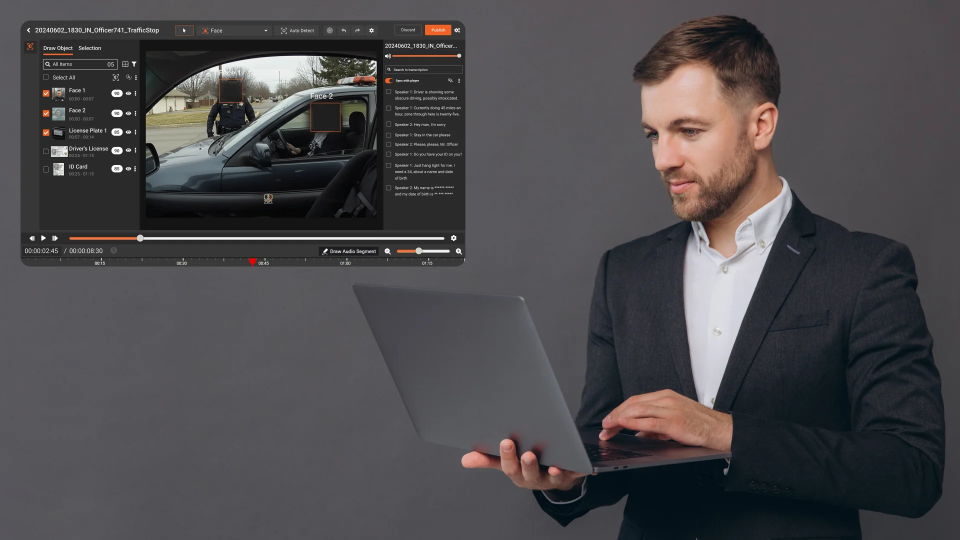
Your team is already behind on disclosure. Another batch of body cam footage lands on your desk. The clock is ticking, counsel is waiting, and someone has to manually scrub every frame for PII. Eyes blurred, five tools open, version chaos, and no clear audit trail. Everyone hopes nothing gets missed.
This is the daily risk when agencies rely on legacy tools instead of leading redaction software for video evidence containing PII. The problem is no longer about knowing that you need redaction. You already know. The pain is that your current stack cannot keep up with the volume, scrutiny, and compliance pressure you face in 2026.
Every gap in your video evidence redaction software carries a cost:
- Delayed case timelines and missed disclosure deadlines
- Inconsistent redaction quality across units and regions
- Exposure of PII that invites legal, regulatory, and media fallout
- Investigators and analysts stuck doing rote pixel work instead of investigative work
- IT and compliance teams unable to prove chain-of-custody and policy adherence
That is the pain. It is operational, reputational, and personal, because the accountability lands on you.
Why leading redaction software for video evidence containing PII is now a strategic decision
For many years, redaction software for law enforcement was treated as a niche utility. A point tool. A nice to have. That mindset no longer works. In 2026, leading redaction software for video evidence containing PII is a core part of your digital evidence ecosystem.
Agencies are dealing with a different reality:
- Massive growth in body worn camera, CCTV, in car, and interview room video
- More public records requests and disclosure obligations
- Higher expectations from courts, oversight bodies, and the public
- Stricter rules on PII redaction in video evidence under privacy and data protection standards
Procurement teams are no longer asking only about basic features. They are asking how evidence redaction software fits into broader initiatives: cloud migration, zero trust, case management modernization, and cross agency information sharing.
In that context, leading redaction software for video evidence containing PII must do more than blur faces. It must integrate, scale, and withstand audits. It must meet the expectations of three tough audiences at once:
- IT leaders who worry about security, architecture, and vendor lock in
- Compliance and legal teams who live in policies, statutes, and consent decrees
- Evidence managers and investigators who care about speed, accuracy, and usability
If any one of these groups lacks confidence in your chosen platform, adoption stalls and risk remains. This is why selecting leading redaction software for video evidence containing PII in 2026 is a strategic, cross functional decision, not a tactical software purchase.
Key evaluation criteria for leading redaction software for video evidence containing PII
Before you look at vendor demos, you need a clear, criteria driven lens. Here are the non negotiables agencies should prioritize when evaluating video evidence redaction software in 2026.
Operational accuracy instead of demo accuracy
Many tools look impressive in curated demos. Real life is different. Poor lighting, crowded scenes, occlusions, motion blur, and multiple camera angles are the norm in law enforcement and public sector video.
For leading redaction software for video evidence containing PII, focus on:
- Face, body, and object detection that works in low light and high motion environments
- Support for license plates, street signs, and other contextual PII indicators
- Configurable models and thresholds suited to your evidentiary standards
- Consistent accuracy across long duration footage, not only short clips
The real test is whether automated video evidence redaction reduces manual work without increasing your risk. You do not want your team spending as much time fixing false negatives and false positives as they used to spend redacting from scratch.
End to end video evidence workflows, not isolated editing
Redaction exists inside a wider evidence management process. Your redaction software for investigations must fit into that process or it becomes a bottleneck.
Look for:
- Intake workflows that can ingest from body worn camera systems, VMS, RMS, and case management tools
- Role based routing and approvals for redaction jobs
- Version control for original, working, and redacted copies
- Export profiles aligned with court, media, and public release requirements
Leading redaction software for video evidence containing PII should not live on an island. It should feel like a seamless part of your digital evidence lifecycle, from intake to production.
Scalability for multi agency and multi site environments
Most organizations underestimate scale. They focus on the number of users instead of the volume of evidence and concurrent processing loads. For secure video redaction for agencies, scalability is non negotiable.
Evaluate:
- Ability to process large backlogs and long form video without performance degradation
- Support for distributed processing nodes or cloud scaling
- Multi tenant or multi agency configurations if you operate shared services
- Performance metrics and SLAs for bulk redaction jobs
The right leading redaction software for video evidence containing PII should allow you to scale up for peak demand, not scramble to add ad hoc workstations and manual labor.
Operational requirements for automated video evidence redaction at scale
Automation matters, but only when it fits real world constraints. Automated video evidence redaction must be accurate enough to trust, transparent enough to audit, and flexible enough to adapt to different evidentiary standards.
Configurable policies for PII redaction in video evidence
Not all PII is equal, and not all cases have the same redaction requirements. Your evidence redaction software should let you translate policy into practice.
Critical capabilities include:
- Policy based templates for different case types, jurisdictions, or requesters
- Controls for what gets auto redacted versus flagged for review
- Support for complex combinations such as minors, victims, undercover officers, and bystanders
- Text, audio, and image PII redaction within the same workflow where possible
This is where leading redaction software for video evidence containing PII separates itself from simple editing tools. You need a system that encodes your obligations into repeatable, enforceable workflows.
Human in the loop review that does not slow everything down
No agency leader wants a black box. Automated video evidence redaction must support human in the loop validation without forcing reviewers to watch every second in real time.
Look for:
- Smart timelines and heatmaps that show where detections occurred
- Batch operations for confirming or rejecting multiple detections
- Frame accurate controls for sensitive segments
- Tiered review workflows for high profile or high risk footage
The goal is not to remove humans from the process. The goal is to use human attention where it adds the most value. Leading redaction software for video evidence containing PII should make that possible.
Support for diverse formats and long term accessibility
Evidence does not arrive in a neat, uniform format. Your redaction software for law enforcement must handle the messy reality of device types, codecs, and legacy archives.
Verify that your platform can:
- Ingest and process common and niche video formats used in your environment
- Convert outputs into court friendly, standards based formats
- Maintain compatibility for long term storage, retrieval, and playback
- Integrate with your Digital Evidence Management or records systems of record
If your leading redaction software for video evidence containing PII cannot handle your historical and edge case formats, you risk fragmenting your process between old and new tools.
Security, compliance, and auditability expectations for 2026
In 2026, secure video redaction for agencies is not just a technical preference. It is a legal and political requirement. Breaches, leaks, or mishandled PII can destroy trust that took years to build.
End to end security controls aligned with public sector standards
Your IT and security teams will scrutinize any redaction software for investigations. Leading platforms must meet modern expectations across infrastructure, data protection, and operational security.
Expect at minimum:
- Encryption in transit and at rest for all video assets and metadata
- Granular role based access control with least privilege defaults
- Support for single sign on and multi factor authentication
- Hardened deployment models for on premises, private cloud, or compliant public cloud
Evidence handling cannot be a security exception. Leading redaction software for video evidence containing PII must sit comfortably within your agency security architecture.
Chain of custody and audit ready video redaction
Every action on an evidentiary file needs to be traceable. Courts, auditors, and oversight bodies expect a clear chain of custody. Audit ready video redaction is not optional for agencies anymore.
Look for capabilities such as:
- Immutable audit logs of access, edits, redactions, and exports
- Time stamped records of who did what, when, and under which authority
- Integrity checksums and hashing to demonstrate files were not tampered with
- Exportable audit reports that align with your internal and external audit processes
Leading redaction software for video evidence containing PII should make it simple to show that you followed procedure. When an incident occurs, you do not want to reconstruct your steps from email threads and manual logs.
Compliance alignment across jurisdictions
Different jurisdictions have different rules governing PII redaction in video evidence. Public records statutes, privacy laws, consent decrees, and prosecutorial guidelines all shape how your agency operates.
While no platform can replace legal advice, your video evidence redaction software should support:
- Configurable retention and data residency policies
- Segmentation of data by jurisdiction or business unit
- Template driven workflows for specific regulatory regimes
- Documentation that supports your own compliance assessments and approvals
Agencies that deploy leading redaction software for video evidence containing PII with clear compliance alignment reduce the risk of policy drift, inconsistent practices, and unpleasant surprises during reviews or investigations.
How modern enterprise redaction platforms meet agency workflows
When agencies evaluate evidence redaction software today, they look for signs that the platform was built for their reality, not lightly adapted from a consumer or media editing tool.
Modern, enterprise grade solutions bring together several elements into a cohesive platform:
- Automated detection and redaction for faces, objects, and contextual PII
- Integrated video, audio, and sometimes document redaction in one evidence workflow
- Tight integration with Digital Evidence Management, case systems, and authentication providers
- Deployment models that support both on premises and cloud first strategies
An example is a platform like VIDIZMO REDACTOR, which illustrates how leading redaction software for video evidence containing PII can align with large agency needs without forcing one size fits all workflows.
Capabilities you would expect from a modern platform in this category include:
- AI assisted automated video evidence redaction with human in the loop oversight
- Centralized management for multi agency, multi tenant deployments
- Comprehensive audit logging that supports audit ready video redaction
- Support for CJIS aligned and similar high security environments when required
These are not nice to have features. They are the baseline for any agency making a long-term term investment in leading redaction software for video evidence containing PII in 2026.
Positioning an enterprise solution like VIDIZMO REDACTOR in your 2026 stack
Once you narrow your options to a shortlist of leading vendors, the decision becomes less about one feature and more about how each platform fits into your broader digital strategy.
Here is a practical lens for final stage evaluation.
- Architecture fit: Does the platform align with your cloud posture, security stack, and identity providers
- Operational fit: Can it support your current workload and projected growth without constant customization
- Governance fit: Does it give compliance and legal teams the control and visibility they need
- User fit: Can investigators, analysts, and records staff use it with minimal friction and training
Enterprise ready tools, including solutions like VIDIZMO REDACTOR, are built with these dimensions in mind. They are designed to sit at the intersection of IT governance, compliance accountability, and frontline usability.
For your agency, the question is not only whether a platform is technically capable. It is whether you will be comfortable standing behind it when a judge, auditor, or journalist asks how you protect PII in your video evidence.
Leading redaction software for video evidence containing PII should enable a simple, confident answer. You can describe your process, show your audit logs, and demonstrate that your system does what you say it does, at scale.

FAQ
Frequently Asked Questions
How should agencies compare different video evidence redaction software options in 2026?
Agencies should move beyond feature checklists and focus on four dimensions: evidentiary accuracy, workflow integration, security posture, and auditability. Run real world pilots with your own footage, including difficult cases. Assess how each platform handles chain of custody, access control, bulk processing, and audit ready video redaction. Involve IT, legal, and frontline users in structured evaluations.
What role should automation play in leading redaction software for video evidence containing PII?
Automation should handle repetitive detection and masking tasks at scale, while humans validate high risk segments and edge cases. Automated video evidence redaction must be configurable to your policies and transparent in how it makes detection decisions. The right balance reduces manual workload and turnaround times without introducing blind trust in a black box system.
How does redaction software for law enforcement support chain of custody requirements?
Modern redaction platforms maintain immutable logs of every action on an evidentiary file, including access, redaction, export, and deletion events. They support hashing and integrity checks, maintain clear separation of original and redacted versions, and provide timestamped records of who performed which actions. This documentation supports chain of custody in court and during internal or external audits.
What security controls are essential for secure video redaction for agencies?
Essential controls include encryption in transit and at rest, granular role based access control, integration with agency identity and access management, and hardened infrastructure deployments. Agencies should also expect robust logging, incident response processes, and alignment with relevant frameworks such as CJIS where applicable. Leading redaction software for video evidence containing PII should not require exceptions to existing security policies.
How can agencies ensure consistency in PII redaction in video evidence across units?
Agencies should define standard operating procedures for PII redaction and implement them as configurable rules and templates within their evidence redaction software. Centralized policy management, shared workflow templates, and common review practices reduce variation across units, precincts, or regions. Training is still important, but the software should encode as much of the policy as possible.
What deployment models should agencies expect from leading redaction software for video evidence containing PII?
Agencies should expect flexible deployment options, including on premises, private cloud, and compliant public cloud environments. The chosen model should align with your data residency, connectivity, and security requirements. Enterprise solutions like VIDIZMO REDACTOR illustrate how vendors can offer multiple deployment patterns while maintaining feature parity and security controls.
How does evidence redaction software integrate with existing digital evidence systems?
Integration typically occurs through APIs, connectors, and event-basedsed workflows. Redaction software for investigations should connect with body worn camera systems, video management systems, records management, and case management platforms. The goal is to avoid manual file transfers and duplicate storage, and instead treat redaction as a defined step in the digital evidence lifecycle.
What should agencies look for in audit ready video redaction capabilities?
Audit ready capabilities include comprehensive activity logging, easy export of audit reports, clear linkage between original and redacted versions, and consistent enforcement of retention and access policies. Agencies should confirm that the platform can support internal audits, external oversight, and court inquiries without special development or manual reconstruction of events.
When is the right time to upgrade to leading redaction software for video evidence containing PII?
Agencies should consider upgrading when manual processes or legacy tools begin to impact disclosure timelines, staff workloads, or risk exposure. Indicators include growing backlogs, difficulty handling multi hour footage, inconsistent PII redaction outcomes, or gaps in chain of custody documentation. Introducing a modern, enterprise grade solution before these issues escalate reduces long term operational and reputational risk.
TopicsRedaction
About the author
Hassaan Mazhar is a B2B SaaS content strategist at VIDIZMO specializing in AI redaction, compliance technology, and enterprise content marketing. He builds trust-driven narratives for legal, public sector, and enterprise audiences navigating data privacy and video intelligence challenges.
You may also like
Video Redaction Best Practices: Motion, Frame Rates, Tracking and Failing Safe
I led our video redaction project for a county public safety agency where two people handled every disclosure, and ...
Redacting Dash Cam, Body Cam and Drone Footage From a Moving Camera
A fleet claims manager preparing crash footage for an insurer and defense counsel is doing a different job from a ...

Why Frame-Rate Headers Lie: Redacting Variable Frame Rate Video
A video file keeps time frame by frame, and the frames-per-second figure a player displays is a summary of that timing, ...