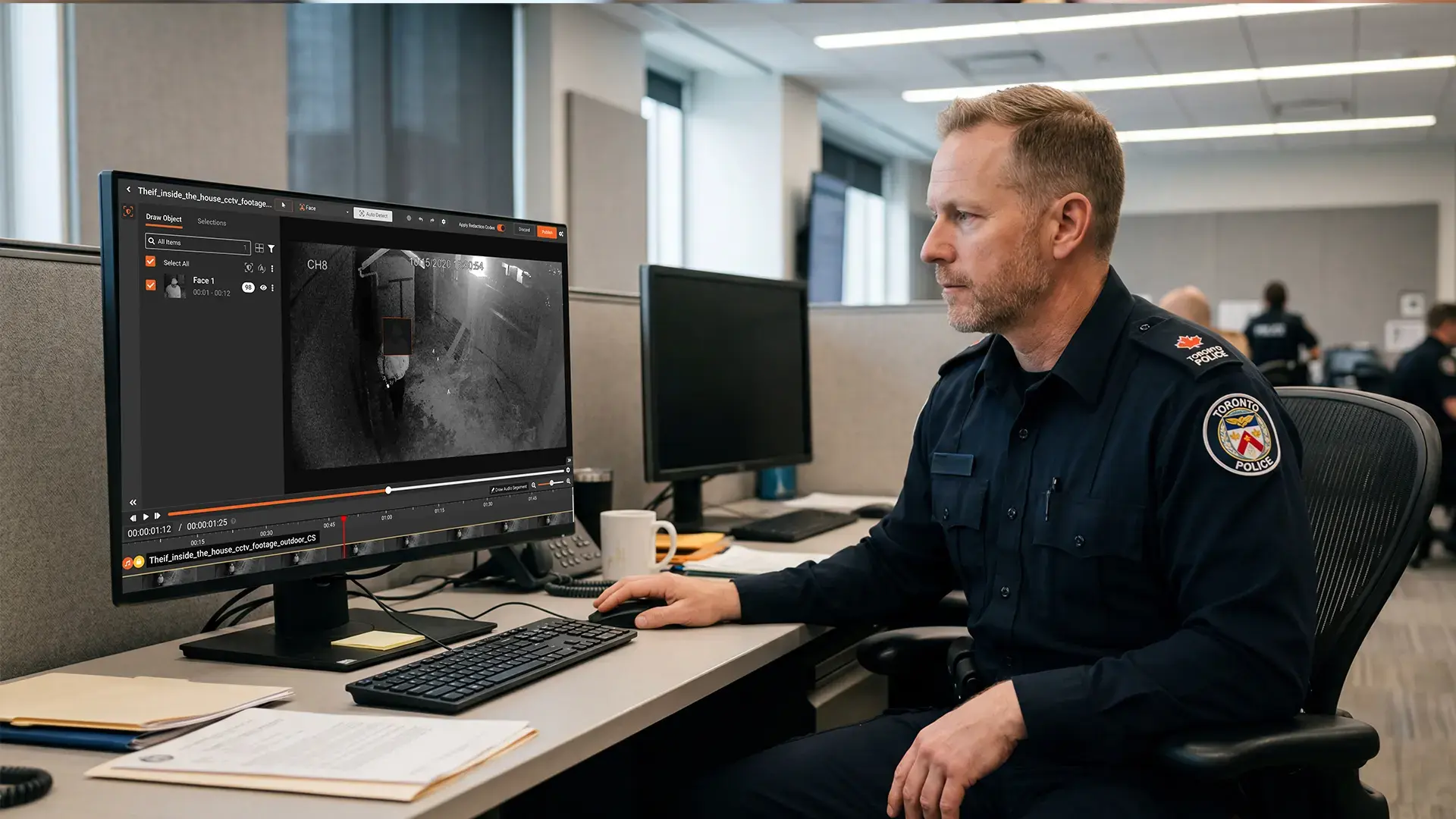
Crown disclosure in Canada is not a request-driven process. It is a constitutional obligation that begins the moment an investigation produces evidence relevant to a charge. The Supreme Court settled this in 1991 with R v Stinchcombe, and every police agency in the country has operated under that ruling since.
The problem in 2026 is volume. Body-worn cameras, in-car video, CCTV, mobile phone captures, and interview recordings now dominate what police hand to the Crown. A single investigation can produce hundreds of hours of footage that needs reviewing, redacting, and packaging before it reaches defence counsel. The math on manual redaction stopped working years ago.
This guide covers what Canadian police agencies must redact for Crown disclosure, why video has changed the workload, and what to look for in software built to handle the task.
The Stinchcombe Foundation
The Supreme Court ruled in R v Stinchcombe that the Crown has a constitutional duty to disclose all relevant non-privileged information in its possession to the defence, regardless of whether the Crown intends to use that material at trial. The duty flows from Section 7 of the Charter and the accused's right to make full answer and defence.
Stinchcombe was the starting point. R v O'Connor extended the framework to third-party records. R v McNeil addressed police disciplinary information. R v Quesnelle clarified what counts as a record held by another agency. Each case adjusted the perimeter, but the core principle held: if the Crown has it and it is relevant, disclosure is the default.
The cost of getting it wrong is significant. Incomplete disclosure can lead to stays of proceedings, mistrials, or successful appeals years after conviction. The Crown carries the obligation, but the practical work of identifying, organizing, and redacting often falls to the investigating police service. The Public Prosecution Service of Canada Deskbook sets out how federal prosecutors expect this work to be handled.
What's in a Modern Disclosure Package
A Crown brief in 2026 looks nothing like one from a decade ago. Officer notes, witness statements, and forensic reports are still present, but the bulk is now digital: body-worn camera footage from every officer on scene, dashcam from responding vehicles, CCTV from nearby businesses, 911 audio, custodial interview recordings, surveillance video, social media captures, and content extracted from suspect mobile devices.
Investigators routinely deal with iPhone MOV files, body-worn camera proprietary formats, and CCTV exports that arrive in containers built before modern codecs existed. Each format has to be ingested, reviewed, and packaged. Format support is not a convenience for police IT. It determines whether a case file can be turned over on time.
What Must Be Redacted Before Disclosure
Even when disclosure is mandatory, redaction protects information that the Crown has either no obligation or no right to share. The categories police agencies most commonly redact include third-party personal information for bystanders and uninvolved members of the public, identifying information for confidential informants protected under informer privilege from R v Leipert, undercover officer identities and tactical methods, and content from ongoing investigations.
Sealed warrant material and information subject to public interest privilege under sections 37 and 38 of the Canada Evidence Act also fall under mandatory redaction. Statutory bans add another layer. Section 110 of the Youth Criminal Justice Act prohibits identifying young persons charged with offences. Section 486.4 of the Criminal Code creates publication bans for complainants in sexual offence cases. Provincial mental health, child welfare, and health information statutes restrict what can be released, particularly Ontario's PHIPA and equivalents in other provinces.
The work of identifying which category applies to which frame of video, which spoken phrase in a 911 call, or which paragraph of a notebook entry is the bottleneck. Software does not replace legal judgment, but it removes the manual scrubbing.
Why Video Changed the Equation
A one-hour body-worn camera recording typically takes four to eight analyst hours to redact frame by frame using manual tools. A single shift produces several hours of footage per officer. A serious investigation can generate hundreds of hours from a single scene.
Disclosure deadlines do not stretch to accommodate this. Crown election decisions, preliminary inquiry dates, and trial scheduling move on court calendars, not on the agency's redaction backlog. When disclosure falls behind, the consequences land on the Crown first and the agency reputationally afterwards.
This is the operational reason automated redaction has moved from optional to essential. The distinction between redaction and masking matters here. Permanent removal is what defence counsel and the court expect, and visual masking that can be peeled off in another application is not defensible.
Privacy Law Sits on Top of Disclosure
Canadian privacy law applies in parallel to disclosure obligations. The federal Privacy Act governs how federal institutions, including the RCMP at the federal level, handle personal information. PIPEDA covers federally regulated private sector organizations. Provincial public sector acts including Ontario's FIPPA, British Columbia's FIPPA, Manitoba's FIPPA, and Newfoundland's ATIPPA govern police records held by provincial and municipal agencies.
Sectoral statutes add specific obligations. Ontario's PHIPA covers personal health information that may appear in evidence. Quebec's Law 25 imposes consent and breach notification rules. Each provincial police framework, such as Ontario's Community Safety and Policing Act, layers on its own requirements.
The point for IT and disclosure teams is straightforward. Disclosure does not override privacy. Both obligations apply at once. Redaction is what makes the two compatible. Guidance from the Office of the Privacy Commissioner of Canada covers the federal side in detail.
The Police-to-Crown-to-Defence Workflow
The handoff chain is where chain of custody matters most. An investigator captures evidence in the field. The disclosure coordinator or records officer organizes and redacts it. The Crown receives the brief, reviews for sufficiency, and supplements where needed. Defence counsel receives the final package.
At each step, the original evidence must remain intact, the redacted copy must be permanent, and the audit trail must show who did what and when. If a redaction is later challenged, the agency needs to demonstrate the legal basis, the operator, and the time it was applied.
What Disclosure-Grade Redaction Software Needs to Do
Software built for this work has to meet a specific bar. Permanent redaction must survive export, copy, and re-encoding. Multi-modal coverage across video, audio, documents, and images should sit in one workflow rather than separate tools per format. Chain of custody and audit logs need to be tied to every redaction action, with operator, IP, timestamp, and reason captured.
Compliance template support that maps redactions to statutory authorities matters when a Charter challenge to a redaction needs a documented response. On-premises and air-gapped deployment is necessary for agencies that cannot place evidentiary content in shared cloud environments. Format coverage that includes proprietary body-worn camera containers, iPhone MOV, and dashcam exports is a practical requirement, not a marketing claim. Bulk processing, configurable confidence thresholds, and human review tooling round out what an agency should expect.
Where VIDIZMO Redactor Fits
VIDIZMO Redactor is built for the workflow above. It supports more than 255 file formats including iPhone MOV, body-worn camera proprietary containers, and standard CCTV exports. Three redaction modes are available: fully automated for policy-driven processing, semi-automated for case-by-case review, and a studio mode for manual frame-level work. This lets agencies match the tool to investigator skill levels.
The platform deploys on-premises and operates fully air-gapped with no loss of AI capability. Model updates are delivered through scheduled deployment cycles rather than over-the-wire calls. Chain of custody, audit logging, and configurable compliance templates support the documentation requirements that disclosure work demands. Portal-per-division architecture allows divisional agencies, including those structured along RCMP divisional lines or provincial and municipal force boundaries, to keep unit data fully isolated.
For procurement, see the contracting vehicles available for federal, provincial, and municipal acquisition.

FAQ
Frequently Asked Questions
What is Stinchcombe disclosure?
Stinchcombe disclosure refers to the Crown's constitutional duty in Canada to disclose all relevant non-privileged information to the defence in a criminal case. The duty was established by the Supreme Court of Canada in R v Stinchcombe (1991) and flows from Section 7 of the Charter. It applies whether or not the Crown intends to rely on the material at trial.
What information must be redacted before Crown disclosure?
Police agencies must redact third-party personal information, confidential informant identifiers, undercover officer details, sealed warrant content, information subject to Canada Evidence Act privilege, young person identifiers under YCJA section 110, and complainant information covered by publication bans. Provincial privacy and health legislation may add further redaction requirements depending on the agency's jurisdiction.
How does Crown disclosure differ from FOIA?
Crown disclosure is a constitutional obligation that operates automatically when a charge is laid, while FOIA in the United States is a request-driven public records process. Canadian disclosure has no statutory response window comparable to FOIA's 10 to 30 day clock. Timing instead follows court schedules, Crown election decisions, and trial dates.
Can Canadian police agencies use cloud redaction software for disclosure work?
Some Canadian agencies use cloud-based redaction software, but federal and many provincial agencies require on-premises or air-gapped deployment for evidentiary content. The choice depends on data residency requirements, the sensitivity of the case material, and the agency's information security policy. On-premises deployment offers the strongest control over sovereign data.
What happens when Crown disclosure is incomplete?
Incomplete or late Crown disclosure can result in stays of proceedings, adjournments, mistrials, or successful appeals. The Supreme Court has been consistent that disclosure failures affecting the accused's ability to make full answer and defence are serious Charter breaches. Agencies that systematically struggle with disclosure also face reputational consequences with prosecution services.
Is automated redaction defensible in Canadian courts?
Yes, when the process is documented and human reviewed. Canadian courts focus on whether the redaction was applied for a recognized legal basis, whether the original evidence remains intact, and whether the chain of custody is preserved. Automated redaction supported by audit logs and a human review step meets these requirements when properly configured.
TopicsRedactionCompliance

About the author
Ali Rind is a Product Marketing Executive at VIDIZMO, where he focuses on digital evidence management, AI redaction, and enterprise video technology. He closely follows how law enforcement agencies, public safety organizations, and government bodies manage and act on video evidence, translating those insights into clear, practical content. Ali writes across Digital Evidence Management System, Redactor, and Intelligence Hub products, covering everything from compliance challenges to real-world deployment across federal, state, and commercial markets.
You may also like
Video Redaction Best Practices: Motion, Frame Rates, Tracking and Failing Safe
I led our video redaction project for a county public safety agency where two people handled every disclosure, and ...
Redacting Dash Cam, Body Cam and Drone Footage From a Moving Camera
A fleet claims manager preparing crash footage for an insurer and defense counsel is doing a different job from a ...
Why Frame-Rate Headers Lie: Redacting Variable Frame Rate Video
A video file keeps time frame by frame, and the frames-per-second figure a player displays is a summary of that timing, ...