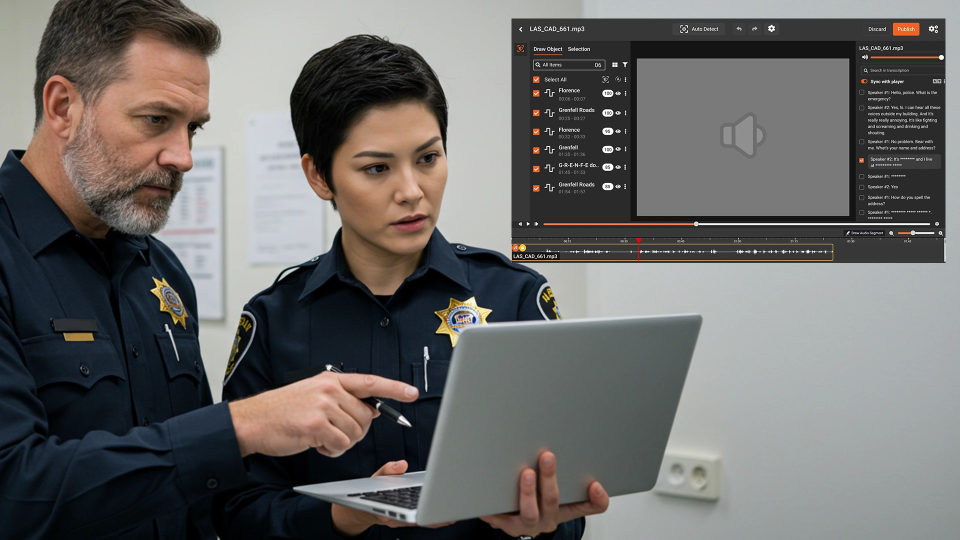
911 and EMS audio redaction is the process of removing personally identifiable information (PII) and protected health information (PHI) from emergency call recordings, dispatcher conversations, and EMS field audio before those files reach the public, defense counsel, news media, or insurance carriers. By hand, a trained analyst needs four to eight hours to process a single hour of multi-channel dispatch audio. With AI, that same hour drops to minutes, and every bleep carries a reviewable audit trail.
The gap matters because the volume keeps climbing. The National Emergency Number Association estimates U.S. Public Safety Answering Points (PSAPs) field roughly 240 million 911 calls a year, and a growing share involve medical complaints routed to EMS. Every one of those calls is a potential public records request, a potential discovery item, and a potential HIPAA exposure if it leaves the building unredacted.
This guide walks through why audio redaction has shifted from a back-office task to a mission-critical function for PSAPs and EMS agencies, what AI redaction actually does (and doesn't do), and what to look for when moving off legacy recorder workflows.
Key Takeaways
- 911 and EMS audio routinely contains PHI, caller addresses, SSNs, and minor identifiers that fall under HIPAA, CJIS, and state public records law at the same time.
- Manual redaction averages 4 to 8 analyst hours per hour of multi-channel dispatch audio. AI redaction with human review cuts that to minutes.
- Legacy recorders like NICE Inform store audio reliably but weren't built for spoken-PII detection, bulk export, or cloud-based review workflows.
- The right AI tool combines speaker diarization, 33+ spoken PII categories, configurable confidence thresholds, and exemption code logging.
- For agencies under 500 sworn or under 200 EMS field staff, cloud-hosted redaction is almost always the right call, with on-premises reserved for CJIS-restricted environments.
Why Redaction Has Become a Mission-Critical Function
Ten years ago, redaction was a once-a-month task handled by a single records clerk with audio-editing software. Today it's a daily compliance workload that touches three different bodies of law on the same recording.
A typical 911 call about a cardiac arrest contains the caller's name and home address (PII), the patient's symptoms and prior conditions (PHI), the responding officer's badge number and tactical channel chatter (CJIS), and frequently a minor's voice in the background. Releasing that file without redaction can violate the HIPAA Privacy Rule at 45 CFR 164.502, the FBI CJIS Security Policy, and most state open records statutes at the same time.
Three pressures have compounded since 2024. State legislatures have tightened public records timelines, with several now requiring 911 audio release within tighter statutory windows. Higher penalties for privacy violations mean regulators expect strong governance for any 911 or medical audio. And the migration from legacy analog recorder systems to modern cloud telephony has produced more audio per shift, in more formats, with more downstream consumers asking for copies.
In our deployments, we have watched mid-sized PSAPs go from processing 40 records requests a month in 2022 to well over 150 a month by late 2025, with no corresponding increase in records staff. Something has to give, and in practice it's usually accuracy.
What's Actually on the Recording
A common mistake is treating 911 audio as a single channel of caller speech. In reality, a fully reconstructed incident pulls from several streams that all need separate review:
- Caller channel: Names, addresses, phone numbers, dates of birth, medical history, sometimes credit card numbers when the caller is reporting fraud in progress.
- Dispatcher channel: Officer and medic call signs, tactical frequencies, BOLO details, NCIC returns read aloud.
- Field radio traffic: Patient status, scene descriptions, hospital destinations, sometimes minor witnesses.
- EMS patch line: Direct PHI exchange between medics and emergency department physicians, fully covered by HIPAA.
- ALI/ANI metadata: Caller phone number and address pulled from the Automatic Location Identification database, often spoken back by the dispatcher for confirmation.
Any single release can mix all five streams. That's why redaction has become a workflow problem, not just an editing problem.
How AI-Powered Audio Redaction Works
AI audio redaction is the automated detection and muting (or bleeping) of spoken sensitive information inside audio recordings, using speech-to-text transformer models and named-entity recognition tuned for PII and PHI categories. The output is a redacted copy of the original audio, paired with a timestamped log of every redacted span and the category that triggered it.
In practice, the workflow has three stages. First, the system transcribes the audio with speaker diarization so each channel or speaker is labeled. Second, an NLP model scans the transcript for sensitive categories, names, addresses, phone numbers, SSNs, medical conditions, dates of birth, and applies a confidence score to each detection. Third, a human reviewer accepts, rejects, or adjusts the proposed redactions before export. You can see how spoken PII redaction works in call recordings in more detail.
The middle stage is where the real time savings come from. Industry benchmarks consistently show that manual audio review runs at roughly 4 to 8 hours per hour of recording for trained staff. With AI pre-tagging, reviewers spend their time validating decisions rather than scrubbing waveforms, and total turnaround drops to roughly 10 to 20 minutes per hour of audio.
What Good AI Redaction Actually Catches
Not all AI redaction tools detect the same things. When evaluating options, the useful question is which spoken categories the system handles natively versus which require custom pattern training.
.png?width=1083&height=420&name=image%20(24).png)
The part most teams overlook is custom patterns. Every agency has internal terminology, officer badge formats, hospital code names, that off-the-shelf models won't catch. A redaction system that lets you add regex plus context-word rules is the difference between 85% recall and 99% recall on your specific audio.
Why Confidence Thresholds Matter More Than Raw Accuracy
Vendors love quoting headline accuracy numbers. From what we have seen, those numbers are almost useless without context. What matters operationally is whether the system lets you tune the confidence threshold for each category.
A FOIA officer releasing audio to a journalist might run at a 60% confidence threshold (catch everything possibly sensitive, accept more false positives, review carefully). A defense attorney getting discovery might run the same audio at 85% (catch the obvious stuff, let the reviewer add anything else). The same source file, two different release contexts, two different threshold settings. A tool that hardcodes one threshold forces you to either over-redact or under-redact.
How VIDIZMO Redactor Helps 911 & EMS Agencies Modernize Safely
VIDIZMO Redactor handles 911 and EMS audio as part of a broader media redaction platform, which matters because PSAPs rarely deal with audio in isolation. A single incident packet often pulls together the 911 call, body-worn camera footage, MDT screenshots, and EMS run sheets, and handling them in one system with one audit trail beats stitching together separate tools. It's the same multi-format approach behind redaction software built for law enforcement, which already covers masking 911 calls alongside bodycam and case documents.
On the audio side, Redactor uses speaker diarization and spoken PII detection to label dispatchers and callers separately, then flags sensitive spoken content for a reviewer to confirm. The practical win for agencies coming off NICE Inform, Eventide, or similar legacy recorders is the overnight workflow: a watch folder pulls from the recorder's export directory, auto-redaction policies pre-tag everything, and records staff arrive to a review queue instead of a raw archive.
Deployment matches the agency's compliance posture, with CJIS-aligned Azure Government and HIPAA workflows for cloud, and on-premises or air-gapped options for stricter data sovereignty. For most PSAPs under 500 sworn, the cloud option is the right call. Every redaction is logged by timestamp, category, confidence score, reviewer, and exemption code, which is what makes an export defensible if it's challenged later.

Redaction Is No Longer Optional
The combination of higher request volumes, tighter statutory timelines, and stiffer privacy penalties has made audio redaction a baseline operational requirement for any agency that handles 911 calls or EMS field audio. Treating it as an occasional task handled by a single clerk with editing software is a posture that doesn't survive a serious records request, let alone a litigation hold.
The good news is that the technology has caught up. AI-driven detection with human-in-the-loop review is no longer experimental, and the legal community has broadly accepted machine-assisted redaction when paired with audit trails that document who reviewed what and when. Modern speech-to-text and named-entity models perform reliably on clear, broadcast-quality audio, with accuracy dropping on the noisiest field recordings. That degradation on poor audio is exactly why human review of flagged segments stays in the workflow rather than being designed out of it.
For agency leaders weighing the move, the practical decision points are usually four: deployment model (cloud vs on-prem vs hybrid), category coverage (do the spoken PII types match your actual records requests), workflow integration (does it pull from your recorder and push to your records system), and audit logging (will the export hold up if a defense attorney challenges what was removed). Get those four right and the rest is implementation detail.
FAQ
Frequently Asked Questions
What is 911 and EMS audio redaction?
911 and EMS audio redaction is the process of identifying and muting or bleeping sensitive information in emergency call recordings before release. This includes PII like names and addresses, PHI like medical conditions, and tactical information like officer call signs. Modern redaction tools use AI to detect these spoken elements automatically, then route the results to a human reviewer who validates each decision before the file is exported.
Who has access to 911 recordings?
Access depends on jurisdiction and recording type, but typically includes the originating PSAP, law enforcement agencies investigating the underlying incident, prosecutors and defense counsel during discovery, and the public through state open records requests. EMS portions covered by HIPAA have narrower access rules and usually require redaction of PHI before release to anyone outside the treatment chain or a court order. Most states allow journalists and family members to request recordings, with statutory timelines that vary widely by state.
How do agencies redact audio in Axon or other body camera platforms?
Most body camera platforms include basic redaction tools focused on video, with audio handled as a separate manual step inside the same interface. Axon, for example, offers audio redaction through its Evidence.com tools, but the workflow is per-file and operator-driven. For high-volume audio redaction across 911 calls plus body camera audio plus EMS recordings, agencies typically pair their body camera platform with a dedicated multi-format redaction system that can pull audio from multiple sources and apply consistent rules across all of them. Our guide on body-worn camera redaction covers how the audio and video layers fit into one reviewable workflow.
Can I request a recording of a 911 call?
Yes, by submitting a written public records request to the PSAP or its parent agency, citing the date, approximate time, and location of the call if known. The agency will determine whether the recording is releasable, apply required redactions, and provide it within the statutory timeline set by your state. Some calls are exempt from disclosure, including those tied to ongoing investigations, those involving minors as victims, and those where release would compromise public safety.
How does AI audio redaction compare to manual redaction for accuracy?
In our experience with PSAP and EMS deployments, AI redaction paired with human review typically matches or exceeds pure manual accuracy because tired reviewers miss things that fresh transformer models don't. The right benchmark isn't AI alone vs human alone, it's AI plus human vs human alone. The combined workflow catches more sensitive content while cutting total review time by 70 to 90 percent depending on audio quality.
TopicsRedaction

About the author
Ali Rind is a Product Marketing Executive at VIDIZMO, where he focuses on digital evidence management, AI redaction, and enterprise video technology. He closely follows how law enforcement agencies, public safety organizations, and government bodies manage and act on video evidence, translating those insights into clear, practical content. Ali writes across Digital Evidence Management System, Redactor, and Intelligence Hub products, covering everything from compliance challenges to real-world deployment across federal, state, and commercial markets.
You may also like
Video Redaction Best Practices: Motion, Frame Rates, Tracking and Failing Safe
I led our video redaction project for a county public safety agency where two people handled every disclosure, and ...
Redacting Dash Cam, Body Cam and Drone Footage From a Moving Camera
A fleet claims manager preparing crash footage for an insurer and defense counsel is doing a different job from a ...
Why Frame-Rate Headers Lie: Redacting Variable Frame Rate Video
A video file keeps time frame by frame, and the frames-per-second figure a player displays is a summary of that timing, ...