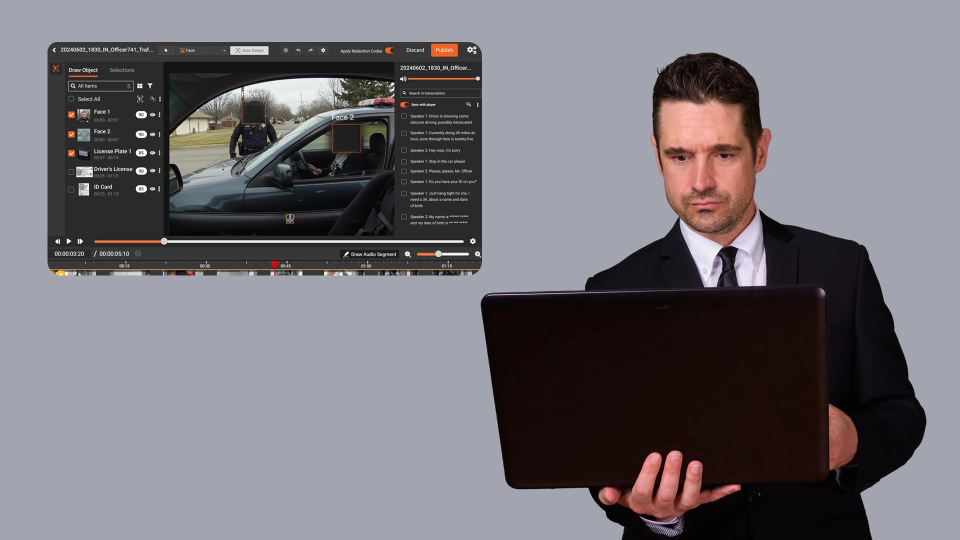
Government agencies, law enforcement departments, and regulated enterprises generate more redactable content today than at any point in history. Body camera footage, surveillance recordings, call center audio, medical records, and public records requests all demand accurate, timely redaction of sensitive information, and the volume keeps growing.
For many organizations, the question is no longer whether to redact, but how. Redaction services span a wide spectrum: from self-service software tools that staff operate in-house, to fully managed "white glove" services where a vendor handles the entire redaction workflow. Which model fits your organization? That depends on volume, sensitivity, staffing, and deadlines. This guide helps you decide.
This guide covers the full landscape of redaction services, including what they involve, which industries rely on them, how to evaluate providers, and when each delivery model makes sense.
What Are Redaction Services?
Redaction services cover the professional removal, obscuring, or masking of sensitive information from video, audio, documents, images, and PDFs before files are shared, published, or archived. What gets removed? Personally identifiable information (PII), protected health information (PHI), financial data, and other content protected by law or policy.
Redaction services fall into three broad categories:
- Software-only (self-service): The organization licenses a redaction platform and operates it internally. Staff upload files, configure detection rules, review AI-generated redactions, and export final outputs.
- Managed redaction (white glove): A vendor takes custody of the files, or operates within the organization's own infrastructure, and handles the redaction process end-to-end, including quality assurance, exemption code application, and delivery of final redacted files with chain of custody documentation.
- Hybrid: The organization handles routine, day-to-day redaction with software, while routing complex, sensitive, or surge-volume requests to a managed service provider.
Modern redaction services go far beyond blacking out text in a PDF. A full-coverage provider handles video redaction (faces, license plates, vehicles, persons), audio redaction (spoken names, Social Security numbers, credit card numbers), document redaction (text and embedded images in PDFs and Office files), and image redaction.
Why Organizations Need Redaction Services
Demand for professional redaction services is growing across government and commercial sectors, driven by five forces.
Growing public records request volumes. Freedom of Information Act (FOIA) requests at the federal level and state open records laws (CPRA, GIPA, and others) generate a steady stream of disclosure obligations. Investigative journalism, civic transparency movements, and litigation-driven discovery amplify request volumes year over year. Agencies that once handled dozens of requests monthly now face hundreds.
Compliance mandates across regulated industries. Healthcare organizations must protect PHI under HIPAA. Financial institutions handle PCI-DSS and GLBA requirements. Law enforcement agencies operate under CJIS security policies. Each regulation carries penalties for non-compliance, and redaction is a core mechanism for meeting these obligations.
Body camera and surveillance footage volumes. Law enforcement body-worn camera (BWC) mandates have created an enormous redaction workload. A single officer wearing a body camera during an eight-hour shift generates hours of footage containing faces of bystanders, juveniles, informants, and license plates. All of it requires redaction before public release. Multiply that across a department of hundreds of officers, and manual redaction becomes impossible.
Staffing shortages. Many agencies, particularly smaller law enforcement departments and civilian government offices, lack the staff, expertise, or infrastructure to handle large-scale redaction in-house. Public records request backlogs grow as disclosure deadlines pass, exposing agencies to legal action.
Cost of errors. Incomplete or inaccurate redaction exposes organizations to lawsuits, regulatory fines, and reputational damage. Public cases illustrate the risk: a widely reported redaction failure in Citi Group's bankruptcy filings exposed data on approximately 150,000 individuals, and Morgan Stanley paid a reported $6.5 million fine over data protection failures. The stakes are high enough to justify professional-grade redaction services.
Types of Redaction Services
Software-Only (Self-Service)
In the self-service model, an organization licenses redaction software and operates it with internal staff. Modern platforms use AI to detect faces, license plates, spoken PII, and text-based PII across video, audio, and documents. The result: what once took an analyst eight hours per hour of footage now takes minutes.
Best for:
- Organizations with trained redaction analysts on staff
- Moderate, predictable redaction volumes
- Agencies that need immediate turnaround with no vendor handoff delay
- Organizations handling highly sensitive content that cannot leave their infrastructure
Considerations:
- Requires staff training and ongoing skill maintenance
- Internal capacity limits throughput during surge periods
- Software licensing is a fixed cost regardless of volume fluctuations
- Quality depends on the skill and consistency of internal operators
Managed Redaction Services (White Glove)
In the managed service model, a vendor handles the redaction process on behalf of the organization. VIDIZMO's white glove managed redaction service combines fully automated bulk processing for standardized requests with human oversight for complex or sensitive content. Custom redaction rules and exemption codes are configured per engagement to match each agency's specific compliance requirements.
Key characteristics of a well-structured managed service include:
- Dual quality assurance (QA) review: Automated AI redaction followed by human verification before delivery
- Custom exemption code configuration: Rules tailored to each agency's compliance framework (FOIA Exemptions 1-9, state-specific codes)
- Complete chain of custody: Immutable audit trail documenting every action taken on every file throughout the engagement
- Scale capacity: Ability to handle backlogs of hundreds of thousands of files (tested at 2M recordings)
- Tiered pricing: Per-page or per-file pricing models that scale with volume
Best for:
- Agencies with no dedicated redaction staff
- Backlog clearance projects, including legacy files, mass FOIA requests, or digitization efforts
- Surge demand from high-profile cases or investigations
- Smaller departments that lack budget for full-time redaction analysts
Hybrid Model
The hybrid approach combines self-service software with managed services. The organization handles routine, day-to-day redaction internally using the same platform the managed service runs on, while routing overflow, backlogs, and complex requests to the vendor.
Why does this work? The same redaction platform powers both modes. Staff trained on the software produce outputs consistent with the managed service, so when volume spikes or complex cases arise, the vendor absorbs the overflow without a separate tool, separate training, or separate quality standards.
Best for:
- Organizations with variable demand (seasonal FOIA spikes, case-driven surges)
- Agencies building internal capacity while clearing existing backlogs
- Departments that want a safety net for high-volume periods without maintaining peak-capacity staffing year-round
What Industries Use Redaction Services?
Any industry that generates records containing sensitive information and faces disclosure, sharing, or regulatory review obligations is a candidate for redaction services.
Law enforcement. Body camera footage, dashcam recordings, surveillance video, interview recordings, and 911 calls all require redaction before public release. FOIA and state open records laws mandate timely disclosure, and CJIS security policies govern how criminal justice information is handled. Video redaction services are increasingly essential for departments of all sizes.
Government agencies. Civilian agencies at federal, state, and local levels handle public records requests across all media types, including documents, emails, video recordings, and audio files. Defense contractors face NIST SP 800-171 and DFARS requirements for sensitive data handling. Learn more about how AI supports these workflows in our document redaction guide for government.
Healthcare. Medical records, prescription data, telehealth recordings, and clinical trial documentation contain PHI protected under HIPAA. Healthcare organizations use redaction services to share records with insurers, researchers, and legal teams without exposing patient information.
Legal. eDiscovery productions, depositions, court filings, and case evidence require redaction of privileged information, PII, and content subject to protective orders. Volume and deadlines in litigation make manual redaction impractical. See how redaction software supports legal and compliance workflows.
Financial services. Call recordings with credit card numbers, bank account details, and Social Security numbers fall under PCI-DSS and GLBA requirements. Audio redaction services process thousands of call recordings per day.
Education. Student records, campus security footage, and classroom recordings are protected under FERPA. Data breaches in higher education carry significant financial and reputational consequences. Our guide on education redaction software for FERPA compliance covers this in detail.
Retail and transportation. CCTV surveillance footage from stores, transit stations, and fleet vehicles requires anonymization of bystander faces and license plates for GDPR, CCPA, and other privacy regulations.
How to Evaluate a Redaction Service Provider
Selecting the right redaction company requires evaluating capabilities across several dimensions. Not all providers offer the same depth of coverage, and the wrong choice can mean re-implementation or compliance gaps.
Media Format Coverage
Format breadth is the first differentiator to evaluate. Some vendors handle only video; others handle only documents. A provider worth evaluating covers video, audio, documents (PDF, DOCX, XLSX, PPTX), and images in a single platform. Look specifically for:
- Proprietary CCTV format support (many body cameras and surveillance systems produce non-standard H.264 files that require conversion)
- Objects inside PDFs, since text-only document redaction tools miss faces, license plates, and other visual PII embedded as images within PDF files
- Scanned document support via OCR, including handwritten text recognition (ICR)
- Support for 255+ file formats without requiring manual conversion
AI Detection Capabilities
Evaluate the breadth and accuracy of AI-powered PII detection:
- Visual PII: Faces, persons, license plates, vehicles, weapons, screens
- Spoken PII: Names, addresses, Social Security numbers, credit card numbers, dates of birth, medical information, and 33+ spoken PII categories in total
- Text PII: 40+ PII types across documents and embedded text
- Accuracy controls: Configurable confidence thresholds (e.g., 25%-90%), model size selection, and frame-by-frame tracking parameters
- Language support: Transcription and spoken PII detection across 82 languages for audio redaction
For a deeper look at how AI handles PII across media types, see our guide to PII redaction software for audio, video, and documents.
Compliance Certifications
Ask for documentation, not just claims, of compliance certifications:
- CJIS: For law enforcement and criminal justice agencies. Look for providers that support CJIS-compliant deployments on government cloud infrastructure.
- FedRAMP: For federal agency deployments. Ask whether the vendor supports FedRAMP High deployments via authorized hosting environments.
- HIPAA: For healthcare data. Look for providers that support HIPAA-compliant deployments.
- ISO 27001: The vendor's own information security management certification.
- SOC 2 Type II: Infrastructure-level security certification.
Deployment Flexibility
Data sovereignty is a critical concern, especially for law enforcement and government agencies:
- SaaS (shared or dedicated): Fastest to deploy, lowest infrastructure overhead
- Government cloud: FedRAMP-authorized environments for federal agencies
- On-premises: Data never leaves the agency's network, essential for CJIS-sensitive environments
- Hybrid: Mixed deployment for different data sensitivity levels
Vendors that are cloud-only cannot serve agencies with on-premises requirements.
Staffing Model and Security
For managed services specifically, understand how the vendor staffs the engagement:
- Are staff background-checked? At what clearance level?
- Is the default staffing model onshore or offshore?
- For CJIS-sensitive agencies: are onshore resources with appropriate background checks available? Note that this is not always a standard offering and may require advance planning.
- What is the lead time for standing up dedicated staffing for large projects?
Chain of Custody and Audit Trail
For any content that may be used in legal proceedings or regulatory compliance, the provider must maintain:
- Immutable audit logs documenting every action taken on every file
- Chain of custody documentation from intake to delivery
- Exemption code tracking, including which exemption was applied to each redacted element and by whom
- Version control preserving original files alongside redacted copies
Key Questions to Ask Before Outsourcing Redaction
Before signing with a managed redaction service provider, get clear answers to these questions:
- What is the chain of custody process? How is each file tracked from intake through processing, QA review, and delivery?
- Where does the data reside during processing? Can processing happen on your own infrastructure (on-premises)?
- Are staff background-checked? At what level, and is this the default or an add-on?
- What redaction accuracy rate is guaranteed? What is the QA process: single review or dual QA?
- Can custom exemption codes be configured? Can you specify state-specific FOIA exemption codes or agency-specific rules?
- What is the turnaround time for bulk requests? Are SLAs documented?
- What audit documentation is provided? Will you receive an immutable audit log with every delivery?
- What file formats are supported natively? Do proprietary body camera or CCTV formats require manual conversion?
How VIDIZMO Redactor Powers Managed Redaction Services
VIDIZMO Redactor is the AI-powered platform behind both self-service and managed redaction workflows. Agencies operating in-house and VIDIZMO's white glove managed service run the same software, with the same detection models, same audit trail, and same format coverage.
Multi-format AI redaction. VIDIZMO Redactor processes video, audio, documents, images, and PDFs across 255+ file formats. In video: faces, persons, license plates, vehicles, weapons, and screens. In audio: 33+ categories of spoken PII across 82 languages. In documents: 40+ PII types, including text in scanned documents (OCR), handwritten text (ICR), and objects embedded as images inside PDFs, a capability most text-only redaction tools miss entirely.
Managed white glove service. VIDIZMO operates a managed redaction service built on the Redactor platform. Standardized requests go through fully automated bulk processing. Complex or sensitive content gets semi-automated workflows with human oversight. Every engagement includes custom redaction rules, exemption code configuration, and dual QA review before delivery.
Scale. Bulk processing has been tested at 2M recordings. Queue-based automation runs overnight and off-hours. One deployment supports 5,000 users processing four million pages per year.
Deployment flexibility. SaaS (shared or dedicated), government cloud, on-premises, or hybrid. On-premises deployment means data never leaves the agency's network, a hard requirement for many CJIS-sensitive law enforcement agencies.
Chain of custody. Immutable audit trails document every redaction action, exemption code application, and QA decision. Multi-layer architecture allows exemption basis to be recorded on each redacted element without exposing the underlying content.
FOIA exemption codes. Federal FOIA Exemptions 1 through 9 and state-specific exemption codes can be mapped to individual redaction decisions, providing the legal defensibility that general-purpose outsourcing cannot guarantee.
Ready to clear your backlog? Request a redaction assessment for your organization.
Choosing the Right Model for Your Organization
The right redaction model depends on your current situation:
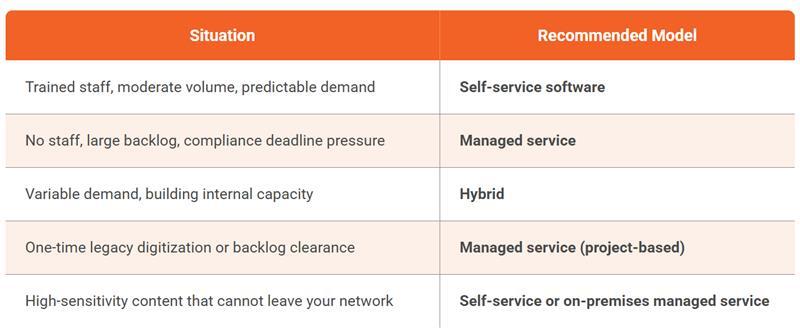
Many organizations start with a managed service to clear backlogs and build institutional knowledge, then transition to a hybrid model where internal staff handle routine work and the managed service absorbs overflow.
FAQ
Frequently Asked Questions
What types of files can redaction services handle?
A full-service provider handles video (body cameras, surveillance, dashcam), audio (call recordings, 911 calls, interviews), documents (PDFs, Word, Excel, PowerPoint), and images. The broadest platforms support 255+ file formats, including proprietary CCTV formats.
How do managed redaction services maintain chain of custody?
Through immutable audit logs that document every action taken on every file, from intake through AI processing, human review, exemption code application, and final delivery. On-premises deployment options allow processing without files ever leaving the agency's network.
How much do redaction services cost?
Pricing varies by model: per-user annual licensing (for software), per-hour processing fees (for managed services), or per-page/per-file pricing (for bulk managed processing). Request a total cost of ownership estimate that includes all components.
Can redaction services handle CJIS requirements?
Yes, when deployed on infrastructure that supports CJIS-compliant configurations such as government cloud or on-premises environments. Ask providers specifically about their CJIS compliance posture and whether staff are background-checked.
What is the difference between redaction software and redaction services?
Redaction software is a tool you operate yourself. Redaction services include a vendor operating the tool on your behalf, with quality assurance, chain of custody documentation, and scale capacity included. Many providers offer both.
TopicsRedaction

About the author
Ali Rind is a Product Marketing Executive at VIDIZMO, where he focuses on digital evidence management, AI redaction, and enterprise video technology. He closely follows how law enforcement agencies, public safety organizations, and government bodies manage and act on video evidence, translating those insights into clear, practical content. Ali writes across Digital Evidence Management System, Redactor, and Intelligence Hub products, covering everything from compliance challenges to real-world deployment across federal, state, and commercial markets.
You may also like
Video Redaction Best Practices: Motion, Frame Rates, Tracking and Failing Safe
I led our video redaction project for a county public safety agency where two people handled every disclosure, and ...
Redacting Dash Cam, Body Cam and Drone Footage From a Moving Camera
A fleet claims manager preparing crash footage for an insurer and defense counsel is doing a different job from a ...

Why Frame-Rate Headers Lie: Redacting Variable Frame Rate Video
A video file keeps time frame by frame, and the frames-per-second figure a player displays is a summary of that timing, ...