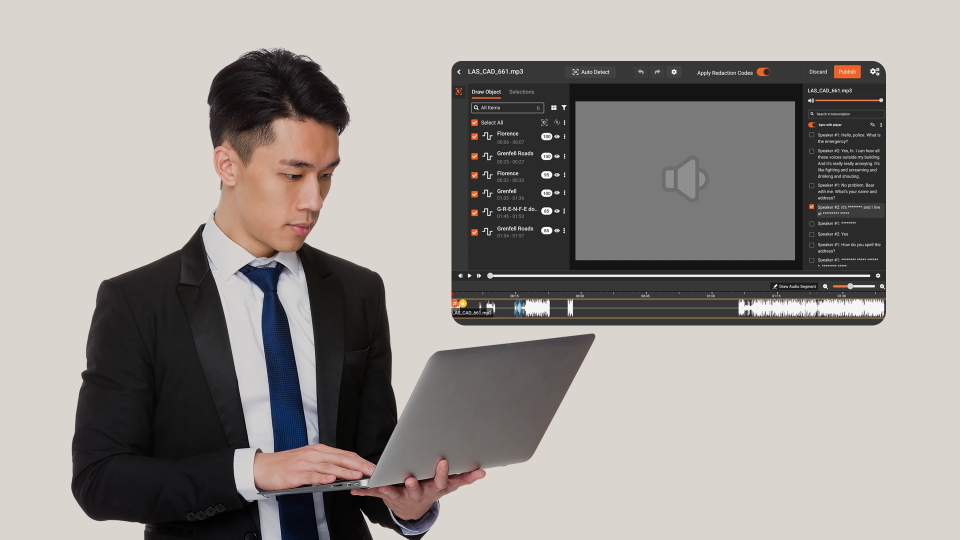
A customer reads their credit card number over the phone. An employee confirms a Social Security number during a verification call. A patient shares a diagnosis on a recorded telehealth session.
Every one of those recordings now contains spoken PII that must be redacted before the file can be stored long-term, shared with a third party, or produced in response to a legal request. And unlike a name on a PDF, spoken PII cannot be found with a text search. It has to be heard or transcribed first, then detected.
That gap between what is recorded and what can be safely shared is where audio redaction services come in. For a broader view of how audio and video redaction works across multiple formats, see our complete guide to redaction services.
Why Audio Redaction Is Different
Audio redaction is fundamentally different from redacting a document or a video frame. The PII is invisible, embedded in speech, not displayed as text or shown on screen.
Transcription comes first. Before any PII can be detected, the recording must be transcribed into text. The accuracy of that transcription directly determines whether PII gets caught or missed. A call recorded in Spanish, Mandarin, or Arabic needs language-specific transcription models, and not all providers support more than a handful of languages.
Spoken PII covers a wide range. Credit card numbers, Social Security numbers, dates of birth, addresses, patient names, account numbers, passwords, and even vehicle identification numbers (VINs) all show up in recorded conversations. A compliance team reviewing call center recordings might encounter a dozen PII types in a single shift.
Speaker diarization matters. In a two-party call, you may need to redact what the customer said while preserving the agent's responses. Without speaker diarization, the ability to identify and separate individual speakers, the entire recording gets treated as one undifferentiated stream, and targeted redaction becomes impossible.
Recording integrity cannot break. Unlike a document where you delete text, audio redaction must preserve the recording's original duration and sync. A muted or bleeped segment replaces the spoken PII without cutting or compressing the file. Courts, regulators, and auditors expect the recording to play back at its original length.
Who Needs Audio Redaction Services
Audio redaction is not a niche problem. It spans every industry that records phone calls, interviews, or conversations.
Call centers generate the largest volume. A mid-sized contact center recording every customer interaction can produce thousands of audio files per day. PCI-DSS requires that credit card numbers spoken during calls are not stored in recordings. HIPAA applies the same standard to health information shared over the phone. The Telephone Consumer Protection Act (TCPA) and Fair Debt Collection Practices Act (FDCPA) add further obligations. For a deeper look at how call centers manage this, see our guide on audio redaction software for call recordings.
Legal teams handle depositions, witness interviews, court proceedings, and eDiscovery audio. Privileged content, minor identities, and confidential informant details all require redaction before production. Learn how AI is reshaping this process in our post on medical record redaction for mass tort law firms.
Law enforcement processes 911 call recordings, suspect interviews, and body camera audio tracks. FOIA requests increasingly target audio evidence, and state open records laws impose tight response windows. Our post on CCTV redaction for law enforcement covers how agencies handle this at scale.
Healthcare organizations record telehealth sessions, patient intake calls, and clinical consultations. PHI spoken during these interactions falls under HIPAA.
Financial institutions and insurers record customer service calls where account numbers, policy details, and claim information are discussed openly.
The Problem with Doing It In-House
Manual audio review is among the most time-consuming redaction tasks. An analyst must listen to the entire recording, identify each instance of spoken PII, mark the timestamps, and apply mute or bleep, one segment at a time.
A single 30-minute call can take 60 to 90 minutes to review and redact manually. Now multiply that across hundreds or thousands of daily recordings.
Even with AI-powered software, in-house audio redaction still requires staff to configure detection rules, set confidence thresholds, review flagged segments, and approve final outputs. If the compliance team is already short-staffed, and in most call centers and legal departments it is, the tool sits underused while the backlog grows.
Multi-language recordings compound the problem. A global call center with customers speaking English, Spanish, French, Arabic, and Mandarin needs transcription models for each language. Many redaction tools support only English or a narrow set of European languages. Our overview of AI automation for faster and accurate redaction explains how AI addresses these challenges at scale.
What Audio Redaction Services Include
A managed audio redaction service handles the entire workflow:
- Ingestion: Recordings are uploaded or transferred through a secure channel with chain of custody documentation
- Transcription: AI transcription converts speech to text across all required languages
- PII detection: Automated detection flags spoken PII across configured categories (names, SSNs, credit cards, health information, and more)
- Redaction application: Flagged segments are muted or bleeped while preserving recording duration
- Quality assurance: Human reviewers verify that all PII was caught and no content was incorrectly redacted
- Delivery: Redacted recordings are returned with an audit trail documenting every redaction decision
The key difference from software-only tools: managed services provide the staff, not just the technology. Organizations that lack internal capacity for audio review get compliant recordings back without hiring or training anyone.
How VIDIZMO Redactor Handles Audio Redaction at Scale
VIDIZMO Redactor processes audio redaction with AI-powered transcription and detection, backed by a managed service option for organizations that need it:
- 82-language transcription supports global call center operations from English and Spanish to Arabic, Mandarin, Hindi, and 77 more
- 33+ spoken PII categories detected automatically, including names, addresses, phone numbers, SSNs, credit cards, passport numbers, dates of birth, ages, VINs, usernames, passwords, IP addresses, MAC addresses, URLs, and country-specific identifiers. See how spoken PII redaction works in practice
- Speaker diarization isolates individual speakers so you can redact one party's statements without affecting the other
- Mute and bleep options preserve recording duration and integrity, with no cuts or compression
- Bulk processing queues handle thousands of recordings through overnight or off-hours automation. Learn more about bulk redaction capabilities
- Managed service with dual QA review for call centers and legal teams that need end-to-end processing without adding headcount
The platform supports CJIS-compliant deployments on Azure Government and HIPAA-compliant workflows, with a complete audit trail for every redaction decision. For a full comparison of leading tools, see our best AI redaction software guide.

Key Takeaways
- Audio redaction requires transcription before PII detection. It is fundamentally different from document or video redaction.
- Call centers, legal teams, law enforcement, healthcare, and financial institutions all generate recordings with spoken PII that must be removed.
- Multi-language support is critical for global operations. Verify language coverage before choosing a provider.
- Managed audio redaction services solve the staffing gap that software alone cannot fill.
- Look for speaker diarization, bulk processing, and dual QA review when evaluating providers.
Finding the Right Audio Redaction Partner
If your organization records calls, interviews, or conversations that contain sensitive information, the redaction obligation already exists. The question is whether your current approach, whether manual review, understaffed compliance teams, or no process at all, can keep up with the volume.
For call centers processing thousands of recordings daily and legal teams facing discovery deadlines, managed audio redaction services remove the bottleneck without adding headcount.
FAQ
Frequently Asked Questions
What types of spoken PII can audio redaction services remove?
Names, Social Security numbers, credit card numbers, dates of birth, addresses, phone numbers, passport numbers, medical information, account numbers, VINs, usernames, passwords, and country-specific identifiers. VIDIZMO Redactor detects 33+ spoken PII categories automatically.
How do audio redaction services handle multi-language recordings?
Through language-specific AI transcription models. VIDIZMO supports 82 languages with validated word error rates. Each recording is transcribed in its detected language before PII detection runs against the transcript.
What is the difference between muting and bleeping in audio redaction?
Muting replaces the spoken PII with silence. Bleeping replaces it with a tone. Both preserve the original recording duration. The choice depends on organizational preference and regulatory requirements. Some agencies prefer silence; others prefer an audible indicator that redaction occurred.
How do call centers comply with PCI-DSS using audio redaction?
PCI-DSS prohibits storing spoken credit card numbers, CVVs, and authentication data in call recordings. Audio redaction services detect and remove these elements from recordings before long-term storage. Compliance requires that the redaction is documented with an audit trail.
Can audio redaction services handle thousands of recordings per day?
Yes, with bulk processing capabilities. VIDIZMO Redactor supports queue-based automation that processes recordings overnight or during off-hours, and the managed service scales to handle surge volumes without internal staffing constraints.
Is audio redaction required for HIPAA compliance?
If a recording contains PHI, including patient names, diagnoses, treatment details, or health plan numbers, it must be redacted before any non-authorized disclosure. This applies to telehealth recordings, patient intake calls, clinical consultations, and any recorded conversation where health information is discussed.
TopicsRedactionAudio Redaction

About the author
Ali Rind is a Product Marketing Executive at VIDIZMO, where he focuses on digital evidence management, AI redaction, and enterprise video technology. He closely follows how law enforcement agencies, public safety organizations, and government bodies manage and act on video evidence, translating those insights into clear, practical content. Ali writes across Digital Evidence Management System, Redactor, and Intelligence Hub products, covering everything from compliance challenges to real-world deployment across federal, state, and commercial markets.
You may also like
Video Redaction Best Practices: Motion, Frame Rates, Tracking and Failing Safe
I led our video redaction project for a county public safety agency where two people handled every disclosure, and ...
Redacting Dash Cam, Body Cam and Drone Footage From a Moving Camera
A fleet claims manager preparing crash footage for an insurer and defense counsel is doing a different job from a ...
Why Frame-Rate Headers Lie: Redacting Variable Frame Rate Video
A video file keeps time frame by frame, and the frames-per-second figure a player displays is a summary of that timing, ...