
Define Redacted: What It Means, Why It Matters, and How to Do It Right
by Hassaan Mazhar, Last updated: April 1, 2026, ref:

Redacted means that specific information has been permanently removed or obscured from a document, video, audio recording, or image before it's shared, published, or released. The removed content typically includes personally identifiable information (PII), classified details, privileged communications, or any data that could cause harm if disclosed.
You've probably seen it: black bars across a PDF, blurred faces in a news broadcast, or a court filing with entire paragraphs blanked out. Each of those is an example of redaction. The word itself comes from the Latin redigere, meaning "to drive back" or "to reduce." When something is redacted, it's been reduced to only the information safe for the intended audience.
Redaction is not the same as deletion. Deletion removes a file entirely. Redaction preserves the document while selectively hiding sensitive portions. This distinction matters for compliance, legal defensibility, and public transparency. Government agencies responding to Freedom of Information Act (FOIA) requests rely on redaction. So do law firms preparing evidence for discovery and hospitals protecting patient health records. All of them need to share what they must while shielding what they can't.
Key Takeaways
- Redacted means sensitive information has been permanently removed or obscured from a record before release, preserving the rest of the document intact.
- Proper redaction requires irreversible removal of data, not just visual concealment. Highlight-and-black-box methods in standard PDF editors often leave underlying text extractable.
- Organizations in government, healthcare, legal, finance, and education face specific regulatory mandates (FOIA, HIPAA, GDPR, FERPA, PCI-DSS) requiring defensible redaction workflows.
- Modern redaction spans five media types: documents, PDFs, images, video, and audio. Text-only tools leave visual and spoken PII exposed.
- Audit trails documenting who redacted what, when, and under which exemption code are essential for legal defensibility.
What Does "Redacted" Actually Mean in Practice?
Redacted means that a specific piece of information within a record has been identified as sensitive, then permanently and irreversibly obscured so it can't be recovered from the released version. The original, unredacted record is preserved separately under access controls.
In practice, redaction looks different depending on the media type:
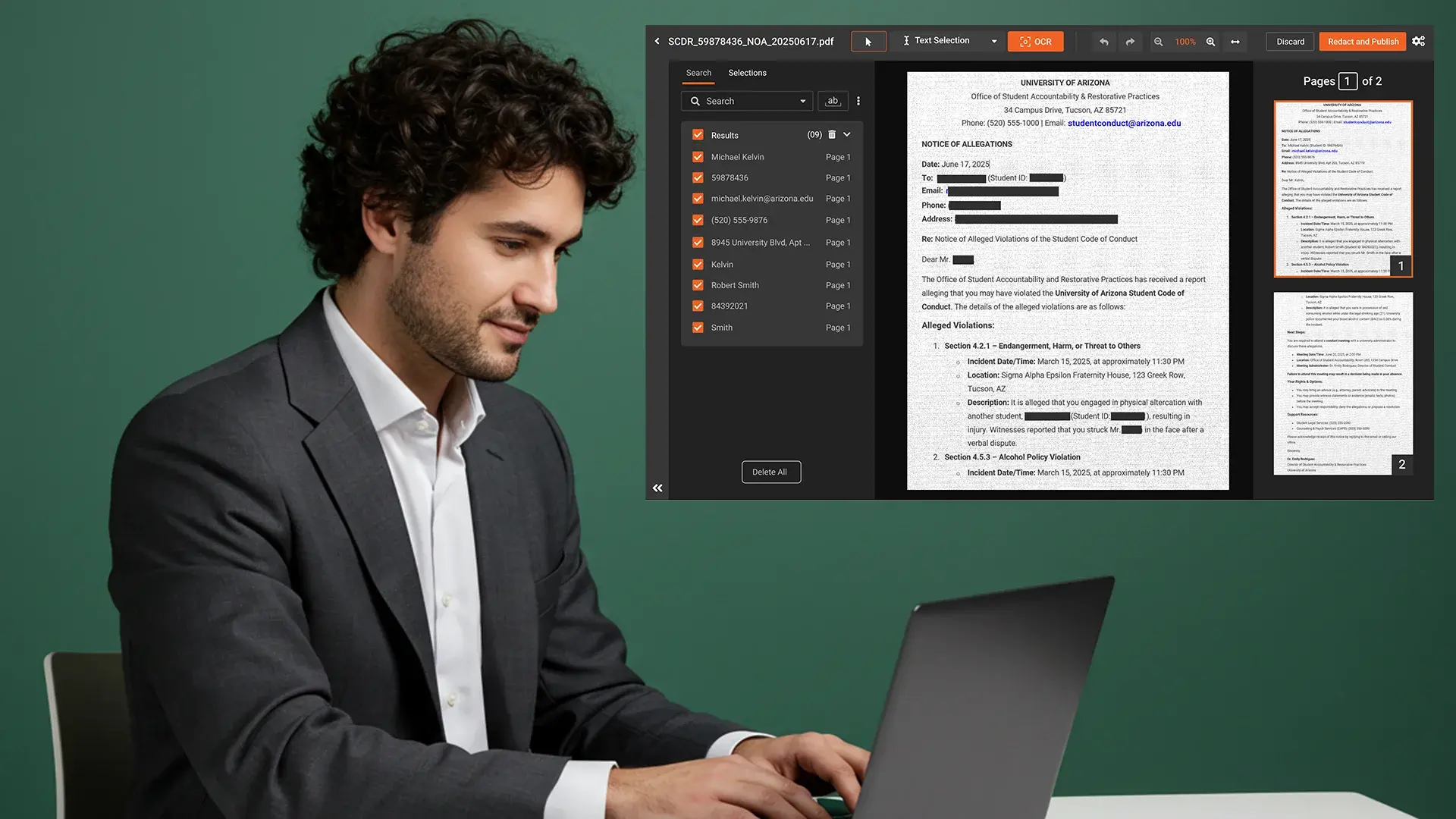
- Documents and PDFs: Black boxes, white boxes, or colored overlays replace sensitive text. The underlying characters are removed from the file's data layer, not just visually covered.
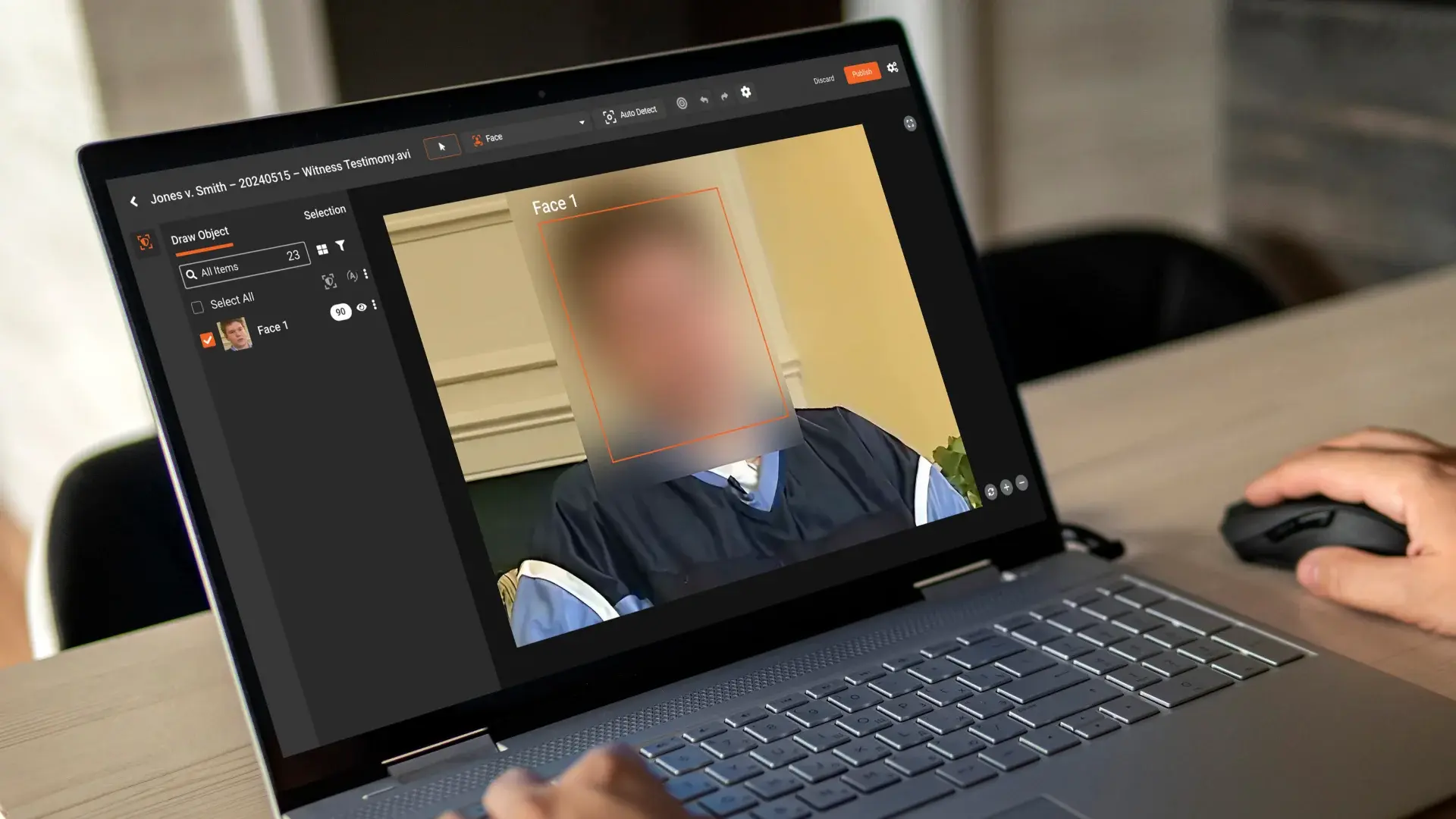
- Video: Faces, license plates, screens, or other identifying objects are blurred, pixelated, or covered with a solid overlay that tracks the object frame by frame.
- Audio: Spoken names, Social Security numbers, addresses, and other PII are muted or replaced with a bleep tone.
- Images: Faces, text, and identifiers are obscured with blur or solid fill.
The critical requirement across all formats: the redaction must be irreversible in the output file. A common and dangerous mistake is using a standard PDF editor to draw a black rectangle over text. That rectangle often leaves the original text embedded in the file's metadata or data layer. Anyone with a free PDF reader can copy and paste the "hidden" text. Proper redaction tools strip the underlying data entirely.
Why Do Organizations Redact Information?
Organizations redact records because laws require it, because litigation demands it, or because releasing unprotected PII creates unacceptable risk. Often, all three apply at once.
Legal and regulatory mandates
Federal agencies in the United States must respond to FOIA requests within 20 business days. State-level equivalents like California's California Public Records Act (CPRA) have their own deadlines, sometimes as short as 10 days. Both require agencies to release records while redacting information covered by statutory exemptions: personal privacy, law enforcement investigations, trade secrets, and more.
Healthcare providers must redact protected health information (PHI) before sharing records outside covered entities, per HIPAA's Privacy Rule. Financial institutions redact account numbers, SSNs, and credit card data under PCI-DSS and GLBA. Schools protect student records under FERPA. The European Union's GDPR gives individuals the right to have personal data obscured or removed from shared datasets.
Litigation and eDiscovery
During legal proceedings, parties exchange large volumes of evidence. Privileged communications, attorney work product, and irrelevant PII must be redacted before production. The consequences of getting this wrong go beyond embarrassment. In the Paul Manafort federal case, improper PDF redaction in court filings revealed information the defense intended to conceal. The redaction tool used didn't strip the underlying text layer, leaving the "hidden" text fully extractable.
Operational risk reduction
Even outside formal legal requirements, organizations redact to limit exposure. A company sharing internal investigation files with an external auditor will redact employee PII not relevant to the audit. An insurance company sending claims data to a third-party vendor will strip policyholder SSNs. The principle is data minimization: share only what's needed, protect everything else.
What Types of Information Get Redacted?
The types of information that get redacted fall into well-defined categories, though the specific items vary by regulation and context.
Personally identifiable information (PII)
PII covers any data that can identify a specific individual: Social Security numbers, driver's license numbers, dates of birth, home addresses, phone numbers, email addresses, passport numbers, and biometric identifiers. Under NIST SP 800-122, PII also includes information that can be linked with other data to identify someone, such as ZIP code combined with gender and birth date.
Protected health information (PHI)
PHI includes medical record numbers, patient names, treatment plans, diagnosis codes, prescription records, insurance claim details, and lab results. HIPAA's Safe Harbor de-identification method identifies 18 specific data elements that must be removed for a record to be considered de-identified.
Financial data
Credit card numbers, bank account numbers, routing numbers, SWIFT/IBAN codes, CVV codes, and tax identification numbers all require redaction. PCI-DSS requires masking of primary account numbers (PAN), displaying at most the first six and last four digits.
Law enforcement and government data
Witness identities, confidential informant information, ongoing investigation details, classified intelligence, juvenile records, and victim information. FOIA exemptions 6 and 7(C) specifically protect personal privacy in law enforcement records.
Business confidential information
Trade secrets, proprietary formulas, internal financial projections, merger and acquisition details, employee disciplinary records, and attorney-client privileged communications.
How Is Redaction Different from Anonymization, Masking, and Encryption?
Redaction is often confused with related data protection techniques. They serve different purposes and aren't interchangeable.
| Technique | What It Does | Reversible? | Best For |
|---|---|---|---|
| Redaction | Permanently removes or obscures specific content from a record | No (in the output file) | Public records release, legal discovery, compliance disclosure |
| Anonymization | Removes all identifiers so data can't be linked to an individual | No | Research datasets, aggregate analytics |
| Data masking | Replaces sensitive values with realistic but fake data | Sometimes (depends on method) | Test environments, training databases |
| Encryption | Scrambles data so it's unreadable without a decryption key | Yes | Data at rest, data in transit |
| Tokenization | Replaces sensitive data with a non-sensitive placeholder (token) | Yes (via token vault) | Payment processing, cloud data storage |
The key distinction: redaction is designed for records that will be shared or published. It produces a version safe for the intended audience. Encryption and tokenization protect data during storage or transit, but the recipient eventually sees the original data. Anonymization and masking are typically applied to structured datasets, not individual documents or media files.
What Are the Common Methods for Redacting Documents and Media?
Redaction methods range from manual approaches still used in small-volume settings to AI-powered automation built for high-volume processing. The right method depends on file volume, media types, accuracy requirements, and regulatory context.
Manual redaction
An operator reviews each page or each minute of footage, identifies sensitive content, and applies redaction marks by hand. In documents, this means selecting text regions and applying black-box overlays. In video, it means drawing redaction boxes around faces or objects frame by frame.
Manual redaction is accurate when performed by a trained analyst, but it's painfully slow. A single hour of body camera footage can take 4 to 8 analyst hours to redact manually. For agencies processing thousands of FOIA requests per year, those hours pile up into backlogs that push organizations past statutory deadlines.
Semi-automated redaction
AI models detect potential PII, faces, license plates, or spoken identifiers and flag them for human review. The analyst confirms, rejects, or adjusts each detection before the redaction is finalized. This approach balances speed with accuracy, and it's the most common workflow in environments where errors carry legal consequences (court evidence, healthcare records, regulatory filings).
Fully automated redaction
Organizations processing tens of thousands of files use fully automated workflows. An administrator configures detection rules: which PII types to find, what confidence threshold to apply, which media types to process. Files go into a queue and process without manual intervention, often running overnight. This model is essential for agencies managing disclosure backlogs, call centers recording thousands of calls daily, or FOIA offices with recurring bulk release obligations.
Pattern-based vs. AI-based detection
Pattern-based detection uses regular expressions and keyword lists to find structured data like SSNs (###-##-####), credit card numbers, or phone numbers. It works well for text documents with predictable formats. AI-based detection uses machine learning models to identify unstructured sensitive content: faces in video, spoken names in audio, handwritten notes in scanned documents. Most modern redaction platforms combine both approaches.
What Are the Biggest Risks of Improper Redaction?
Improper redaction isn't a theoretical risk. It results in data breaches, legal penalties, and operational disruption.
Recoverable redactions
The single most common redaction failure: using a tool that visually covers text without removing the underlying data. Adobe Acrobat's drawing tools, for example, can place a black rectangle over text, but the text remains selectable and extractable.
This isn't hypothetical. The TSA inadvertently published its airport screening procedures in 2009 with "redacted" sections that were trivially unmasked. Citigroup's bankruptcy filing exposed names and details of approximately 150,000 customers through improperly redacted court documents. Both failures happened because the redaction tool didn't strip the text layer.
Incomplete redaction
An analyst redacts a name on page 3 but misses the same name in a footer on page 47, or in a cross-reference table on page 12. Large documents with repeated PII across headers, footers, tables of contents, and appendices are especially vulnerable. Without search-and-redact functionality that finds every instance of a term across an entire document, incomplete redaction is nearly guaranteed in high-page-count files.
Metadata exposure
A document's metadata can contain author names, tracked changes, comments, revision history, GPS coordinates (in images), and other sensitive details. Redacting the visible content while leaving metadata intact defeats the purpose. Proper redaction workflows include metadata stripping as a standard step.
Format-specific gaps
An organization might redact text in PDFs but overlook faces visible in images embedded within those PDFs. Or it might redact video footage but skip the audio track, where a witness's name is spoken aloud. Multi-format content (documents containing images, videos with audio, PDFs with embedded objects) requires redaction across every layer, not just the most obvious one.
What Should a Redaction Workflow Look Like?
A defensible redaction workflow has distinct stages, each with clear responsibilities and quality checks. Whether your organization processes 50 records a month or 50,000, the stages are the same. Scale changes the tooling, not the process.
- Intake and classification: Identify which records require redaction, under which regulatory authority (FOIA exemption, HIPAA Safe Harbor, court order, internal policy), and by what deadline.
- PII identification: Scan for sensitive content across all media types in the record. For text, this means pattern matching and keyword search. For video and images, this means object detection (faces, plates, screens). For audio, this means spoken PII detection via transcription analysis.
- Redaction application: Apply redaction marks with appropriate exemption codes. Each redaction should reference the legal basis for removal (e.g., FOIA Exemption 6: Personal Privacy).
- Quality review: A second analyst reviews the redacted output to verify completeness and accuracy. In high-stakes environments, dual review (the "four-eyes" approach) is standard.
- Output generation: Produce the redacted copy as a separate file. The original, unredacted record must be preserved under access controls for audit or legal challenge.
- Audit trail documentation: Log every action: who submitted the file, who applied each redaction, which exemption code was used, who approved the output, and when the redacted version was released.
Organizations that skip steps 4 and 6 expose themselves to legal challenges. If a FOIA requester or opposing counsel disputes a redaction, the agency must show that each redaction was applied deliberately under a specific legal authority. Without an audit trail, that defense falls apart.
How Does AI Change the Redaction Process?
AI doesn't replace the redaction workflow. It accelerates steps 2 and 3 (identification and application) from hours to minutes while maintaining or improving accuracy.
Computer vision models detect and track faces, license plates, vehicle types, screens, weapons, and custom objects across video frames. Natural language processing (NLP) identifies spoken PII in audio recordings: names, addresses, SSNs, credit card numbers, and dozens of other categories. Optical character recognition (OCR) combined with PII pattern matching finds sensitive text in scanned documents and images, including handwritten notes.
The most significant impact is on volume-constrained organizations. A county clerk's office processing 2,000 FOIA requests per year can't assign analysts to manually review every page and every video frame. AI pre-processing identifies and flags the majority of sensitive content, leaving human reviewers to verify edge cases and ambiguous detections.
Accuracy controls matter
AI detection isn't perfect. A false negative (missed PII) has very different consequences than a false positive (over-redaction). Effective AI redaction tools offer configurable confidence thresholds. Setting the threshold higher reduces false positives but may miss some detections. Lowering it catches more potential PII but requires more human review. The right threshold depends on the use case: FOIA releases prioritize catching every possible PII instance, while internal reviews may tolerate more false positives to speed processing.
How VIDIZMO Redactor Handles Multi-Format Redaction
VIDIZMO Redactor is an AI-powered redaction platform that processes video, audio, images, documents, and PDFs within a single application. It supports 255+ file formats, including proprietary CCTV recordings that are automatically rewrapped into standard MP4 for processing.
For video, the platform uses AI to detect and track faces, license plates, persons, vehicles, screens, weapons, and custom-trained objects across frames. Redaction styles include blur, pixelate, and solid overlay. A multi-layer redaction architecture allows different exemption codes to be applied to different redacted elements within the same video, with independent layer visibility and permissions.
For audio, the system identifies 33+ categories of spoken PII (names, SSNs, addresses, phone numbers, credit card numbers, passport numbers, and more) across 82 languages and applies mute or bleep redaction. Speaker diarization separates individual voices for targeted processing.
For documents and PDFs, the platform combines OCR (including Perso-Arabic script support for Arabic, Urdu, Sindhi, Dari, and Pashto), handwritten text recognition (ICR), and layout detection to find PII in headers, footers, tables, columns, and embedded images. It can detect and redact objects (faces, plates) inside PDF image layers, a capability that text-only redaction tools miss entirely.
Bulk processing has been tested with over 1.1 million recordings. Queue-based automation runs overnight or during off-hours for high-volume organizations. The UK's Department for Work and Pensions (DWP) runs 5,000 users processing 4 million pages per year on a single Redactor deployment.
Redaction Across Industries: Who Needs It and Why
Redaction requirements vary by industry, but the underlying need is the same: share records safely while complying with applicable law.
Government and law enforcement
Every government agency at federal, state, and local levels handles public records requests. Law enforcement agencies face additional requirements around body-worn camera footage, surveillance recordings, 911 calls, and witness interview tapes. CJIS (Criminal Justice Information Services) policy governs how criminal justice information is handled. FOIA exemptions 1 through 9 define what can be withheld and require agencies to document the basis for each redaction.
Healthcare
Hospitals, clinics, insurers, and pharmaceutical companies handle PHI across medical records, prescriptions, diagnostic images, telehealth recordings, and insurance claims. According to the HIPAA Journal, over 382 million healthcare records were exposed between 2009 and 2022, with more than 540 healthcare organizations breached in 2023 alone. Redaction is a front-line defense when sharing records with external parties, researchers, or in response to subpoenas.
Legal
Law firms and corporate legal departments redact privileged communications, PII, and irrelevant content before producing documents in discovery. Federal rules of Civil Procedure require reasonable efforts to protect privileged material. Failure to properly redact can waive privilege claims entirely.
Finance and insurance
Banks, credit unions, and insurance companies redact account numbers, SSNs, and transaction details when sharing records with regulators, auditors, or during M&A due diligence. The Morgan Stanley data breach resulted in a $6.5 million fine, partly due to inadequate data protection controls during asset disposition. That's the kind of penalty that makes a CFO pay attention.
Education
Schools and universities redact student records under FERPA before responding to records requests. Campus surveillance footage requires redaction of bystander faces. The MOVEit breach in 2023 affected over 900 colleges, exposing data on more than 50,000 individuals.
Best Practices for Getting Redaction Right
These practices consistently separate organizations that handle redaction well from those that face incidents.
- Use a dedicated redaction tool, not a PDF editor. Standard document editors (Adobe Acrobat drawing tools, Word track changes, or image editing software) don't perform true redaction. They overlay content visually without removing the underlying data. Only tools specifically built for redaction guarantee irreversible removal.
- Redact across all media layers. A single record may contain text, images, embedded objects, audio, and metadata. Redacting one layer while ignoring others creates gaps. Your workflow should cover every layer present in the file.
- Standardize exemption codes. Every redaction should reference a specific legal authority. FOIA exemptions 1 through 9, HIPAA Safe Harbor elements, CPRA exemptions: standardizing codes ensures consistency across analysts and supports legal defensibility.
- Implement dual review for high-risk records. For records going to the public, opposing counsel, or regulators, a second reviewer should verify that all PII has been caught and that all redactions have valid exemption codes. This "four-eyes" approach is standard in federal FOIA offices and law firms.
- Strip metadata before release. Author names, revision history, GPS coordinates, tracked changes, and document properties can all contain sensitive information. Metadata removal should be an automatic step in your output process.
- Preserve the original under access controls. The unredacted original must be retained in case of legal challenge, audit, or future re-release with different exemptions. Role-based access controls should restrict who can view originals.
- Maintain a complete audit trail. Log every step: file intake, analyst assignment, redaction actions, review approvals, and output generation. If a redaction is challenged, the audit trail is your evidence that proper procedures were followed.
How to Evaluate Redaction Software
Not all redaction tools handle the same media types, offer the same accuracy controls, or meet the same compliance requirements. Here's a framework for evaluating your options.
| Criterion | What to Look For | Why It Matters |
|---|---|---|
| Format coverage | Video, audio, images, documents, PDFs in one platform | Multi-format records are common; separate tools create workflow gaps |
| AI detection breadth | Visual PII (faces, plates), spoken PII, text PII, OCR for scanned docs | Each media type has different PII exposure vectors |
| Accuracy controls | Configurable confidence thresholds, model size options, human review step | Balances false positives vs. false negatives for your risk profile |
| Audit trail | Immutable logs of every action, exemption code documentation | Legal defensibility when redactions are challenged |
| Deployment options | Cloud, on-premises, government cloud, hybrid | Data sovereignty and air-gapped network requirements |
| Batch processing | Queue-based bulk processing, unattended automation | Volume-constrained organizations can't process files one at a time |
| Compliance features | FOIA exemption codes, HIPAA Safe Harbor support, chain of custody | Regulatory requirements dictate workflow capabilities |
Request a hands-on evaluation with your own files. Vendor demos using curated sample data won't reveal how a tool handles your specific formats, volumes, and edge cases.
Frequently Asked Questions
What does "redacted" mean in a legal document?
In a legal document, redacted means that specific text, images, or data have been permanently removed or obscured before the document is shared with parties outside the privilege or confidentiality boundary. Legal redaction typically references a specific exemption code (such as FOIA Exemption 6 for personal privacy or attorney-client privilege) as the basis for each removal. The original, unredacted version is preserved under access controls.
Is redacted the same as censored?
No. Censorship removes content based on social, political, or moral objections. Redaction removes content to protect privacy, comply with law, or prevent harm from disclosure of sensitive data. Redaction preserves the document and provides a legal basis for each removal. Censorship suppresses the document or its ideas entirely.
Can redacted text be recovered or unredacted?
If redaction is performed correctly with a dedicated redaction tool, the underlying text is stripped from the file and cannot be recovered from the released version. The original unredacted file is preserved separately. However, improper redaction using standard PDF editors or drawing tools often leaves text extractable beneath the visual overlay. That's why using purpose-built redaction software matters.
What file types can be redacted?
Redaction applies to any file type containing sensitive information: PDFs, Word documents, Excel spreadsheets, PowerPoint presentations, images (JPG, PNG, TIFF), video files (MP4, AVI, proprietary CCTV formats), and audio recordings (WAV, MP3). VIDIZMO Redactor, for example, supports 255+ formats across all media types in a single workflow.
How long does redaction take?
Processing time depends on volume, media type, and method. Manual redaction of one hour of video can take 4 to 8 analyst hours. AI-powered semi-automated redaction reduces this to minutes of review time per file. Fully automated batch processing can handle thousands of files overnight without human intervention, making it practical for organizations with high-volume disclosure obligations.
What regulations require redaction?
Multiple regulations require or imply redaction before records can be shared. FOIA requires federal agencies to redact exempt information before releasing public records. HIPAA requires removal of 18 PHI identifiers for de-identification. GDPR mandates data minimization when processing personal data. FERPA protects student education records. PCI-DSS requires masking of payment card numbers. CCPA and CPRA give California consumers rights over their personal information in disclosed records.
What is the difference between redaction and data masking?
Redaction permanently removes sensitive content from a document or media file, producing an output where the original data cannot be retrieved. Data masking replaces sensitive values with realistic but fictional substitutes (e.g., replacing a real SSN with a fake one) and is primarily used in non-production databases and test environments. Redaction is the standard for external disclosure; masking is the standard for internal data environments.
See how AI-powered redaction works across documents, video, and audio. Explore how Redactor handles multi-format redaction or start a free trial to test it with your own files.
Jump to
You May Also Like
These Related Stories
.jpg)
How to Redact Documents for Court Filings: A Step-by-Step Guide
Redacted Text Explained: How It Works and How to Do It Right

No Comments Yet
Let us know what you think