
by Zain Noor, Last updated: March 18, 2026

Financial documents are among the most sensitive assets an organization handles. Bank statements, loan files, KYC documents, invoices, and tax records often contain nonpublic personal information (NPI), financial identifiers, and confidential business data.
Whether these documents are shared with auditors, vendors, regulators, internal teams, or customers, improper redaction can lead to data breaches, regulatory penalties, fraud, and loss of trust.
This guide explains why financial document redaction matters, what exactly needs to be redacted, common challenges financial teams face, and how organizations can implement redaction at scale using modern, AI-powered tools like VIDIZMO Redactor.
Why Redacting Financial Documents Is Critical
1. Regulatory and compliance obligations
Financial organizations are legally required to protect customer information. Regulations and standards such as:
- Gramm–Leach–Bliley Act (GLBA) – mandates safeguards for customers’ sensitive financial data
- FTC Safeguards Rule – requires “reasonable” administrative, technical, and physical protections
- PCI DSS – governs handling and protection of payment card data
These frameworks don’t prohibit sharing documents, but they require limiting the exposure of sensitive data to only what is necessary.
Redaction is often the safest and most defensible way to meet these obligations.
2. High frequency of document sharing
Financial documents are routinely shared for:
- Loan underwriting and servicing
- KYC/AML verification
- Audits and regulatory reviews
- Dispute resolution and investigations
- Outsourced processing and BPO workflows
Without proper redaction, each share increases breach risk.
3. Manual redaction no longer scales
Traditional redaction methods manual black boxes, editing PDFs, or copy-paste removal, are:
- Slow and labor-intensive
- Highly error-prone
- Difficult to audit
- Ineffective for scanned documents
As document volumes grow, manual redaction becomes a liability rather than a safeguard.
What Are Financial Documents and What Should Be Redacted?
Different financial documents contain different categories of sensitive data. A one-size-fits-all approach does not work.
Common financial document types
- Bank statements
- Loan and mortgage documents
- Credit reports
- KYC / AML forms
- Invoices and vendor payment records
- Tax documents
- Checks and payment confirmations
Sensitive information that typically requires redaction
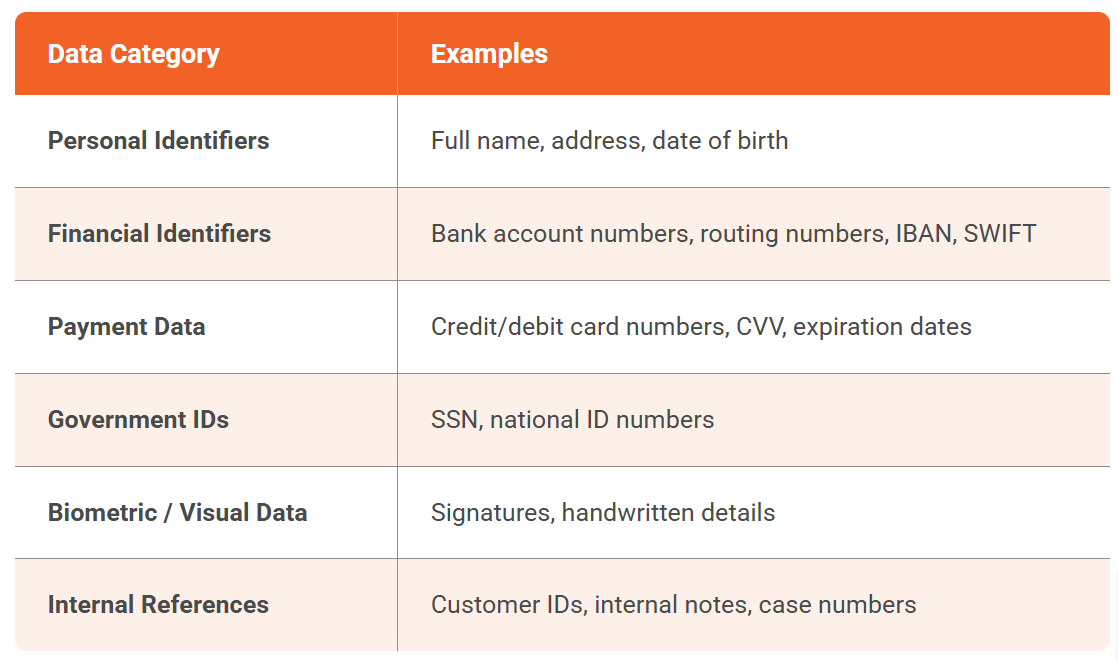
Important: Over-redaction can be just as damaging as under-redaction. The goal is to remove risk while preserving document usability.
Redaction Challenges Unique to Financial Organizations
1. Scanned and image-based documents
Many financial documents are scanned PDFs or images, meaning:
- Sensitive data is embedded in images, not text
- Standard “text-only” redaction tools fail
- OCR accuracy becomes critical
2. Volume and turnaround pressure
Financial teams often face:
- Thousands of documents per day
- Tight regulatory or customer deadlines
- Limited staff for quality checks
Redaction must be fast, consistent, and repeatable
3. Inconsistent redaction policies
Different teams may redact different fields in the same document type, leading to:
- Compliance gaps
- Rework
- Audit challenges
4. Lack of auditability
Many tools cannot clearly answer:
- Who redacted what?
- When was it redacted?
- Was the redaction permanent and irreversible?
For regulated industries, this visibility is non-negotiable.
Best Practices for Redacting Financial Documents
1. Define document-specific redaction policies
Create standardized rules for each document type:
- What must always be redacted
- What can remain visible
- What requires conditional redaction
2. Use automated detection, not just manual masking
Effective financial redaction should support:
- OCR for scanned documents
- Pattern-based detection (account numbers, IDs)
- AI-based PII recognition
Automation significantly reduces human error.
3. Ensure redaction is permanent
True redaction:
- Removes underlying data
- Cannot be reversed or copied
- Is not just a visual overlay
4. Implement review and audit workflows
Redaction processes should include:
- Reviewer approval (where required)
- Audit logs
- Consistent enforcement across teams
How VIDIZMO Redactor Solves Financial Redaction Challenges
VIDIZMO Redactor is designed for enterprise-scale, compliance-driven environments, making it well-suited for financial organizations.
Key capabilities for financial document redaction
AI-powered detection
- Automatically identifies PII and sensitive financial data
- Supports OCR-based redaction for scanned documents
- Detects custom patterns such as account numbers or routing formats
Multi-format support
Unlike PDF-only tools, VIDIZMO supports:
- Videos
- Documents (PDFs, scanned files)
- Images (checks, forms, IDs)
- Audio and video (customer calls, recorded interviews)
This ensures consistent privacy protection across all content types.
Bulk and scalable workflows
- Redact thousands of documents in a batch
- Apply consistent policies across datasets
- Reduce turnaround time from days to minutes
Governance and audit readiness
- Centralized redaction management
- Traceable actions for compliance and audits
- Reduced reliance on ad-hoc tools and manual processes
Who Should Use Financial Document Redaction Software?
VIDIZMO Redactor is especially valuable for:
- Banks and credit unions
- Fintech companies
- Mortgage lenders
- Insurance and financial services providers
- BPOs handling financial data
- Compliance, risk, and privacy teams
- Audit, legal, and investigations teams
Redaction vs. Editing: Why It Matters in Finance
A common mistake is editing or covering text instead of truly redacting it.
In financial contexts, this can expose hidden data through:
- Copy-paste
- File metadata
- Layer removal
True redaction permanently removes the data, a critical distinction for compliance and security.
Financial Redaction Is a Risk-Control Strategy
Redacting financial documents is no longer a back-office task; it is a core function of privacy, security, and compliance.
Organizations that rely on manual or consumer-grade tools face:
- Higher breach risk
- Slower operations
- Regulatory exposure
By adopting AI-powered, scalable redaction solutions like VIDIZMO Redactor, financial organizations can:
- Protect sensitive data
- Maintain document usability
- Meet regulatory expectations
- Scale securely as document volumes grow
Start Your Free Trial Today - No Credit Card Needed

About the Author
Jump to

Redact Bank Statements Securely in 2026 | Best Practices & Tools

PDF File Redaction Tool for Secure & Compliant Document Sharing
.webp)

No Comments Yet
Let us know what you think