
by Ali Rind, Last updated: March 13, 2026
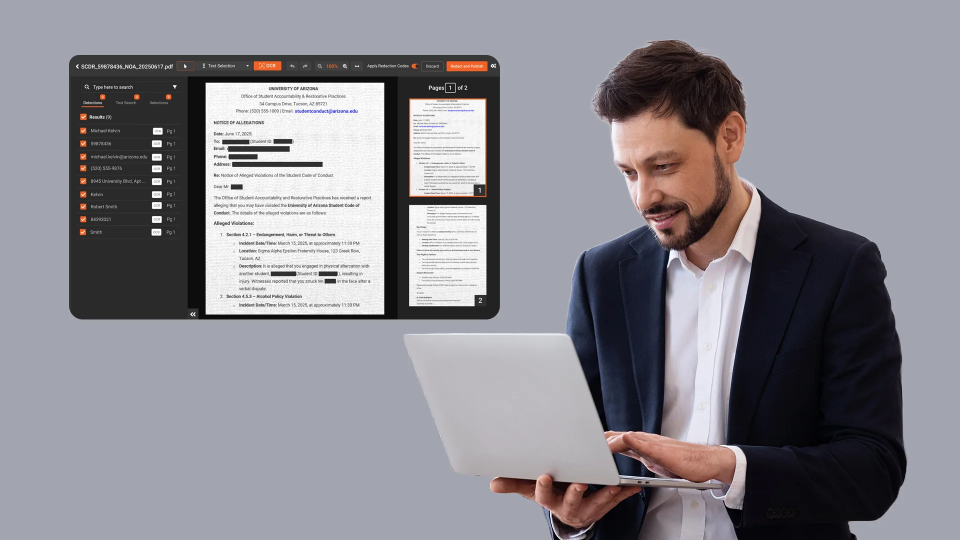
Every organization that handles sensitive documents faces the same question eventually: who is going to redact all of this?
Whether it is FOIA responses, patient records, litigation discovery files, or insurance claims, the volume of documents requiring redaction grows faster than internal teams can keep up. And the stakes are high. A single missed Social Security number or an un-redacted patient name can trigger regulatory penalties, legal exposure, and public trust damage.
For Records Managers, Compliance Officers, and Legal Counsel weighing their options, this article breaks down the three approaches to document redaction services and when each one makes sense. For a broader view of all redaction services across media types, visit the VIDIZMO Redaction Services page.
What Document Redaction Services Actually Cover
Document redaction services go well beyond blacking out lines of text in a PDF. A full-scope service handles:
- Multiple file formats including PDFs, Word documents, Excel spreadsheets, PowerPoint presentations, scanned images, and email attachments
- Multiple PII types such as names, Social Security numbers, dates of birth, financial account numbers, health information, legal case identifiers, and more
- Scanned and legacy documents that exist only as scanned images and require optical character recognition (OCR) before any text-based redaction can happen
- Embedded visual content including photos, signatures, faces, and license plates embedded inside PDFs and Office documents that are invisible to text-only redaction tools
The compliance dimension varies by industry. Government agencies align redaction with FOIA exemption codes. Healthcare organizations must protect protected health information (PHI) under HIPAA. Legal teams redact privileged content during eDiscovery productions. Financial institutions handle PCI-DSS and GLBA requirements. Each context demands different rules, and the right service provider adapts to those rules, not the other way around.
Three Approaches: Manual, Automated, and Managed
Organizations typically land on one of three models. The right choice depends on volume, sensitivity, and staff availability.
Manual In-House Redaction
Staff open documents, manually identify sensitive content, and apply redactions using tools like Adobe Acrobat. This works at low volumes, around a few documents per week, but does not scale. Manual redaction is slow, error-prone, and expensive per page. It is also the default method at most organizations simply because nothing else has been set up.
Automated Software
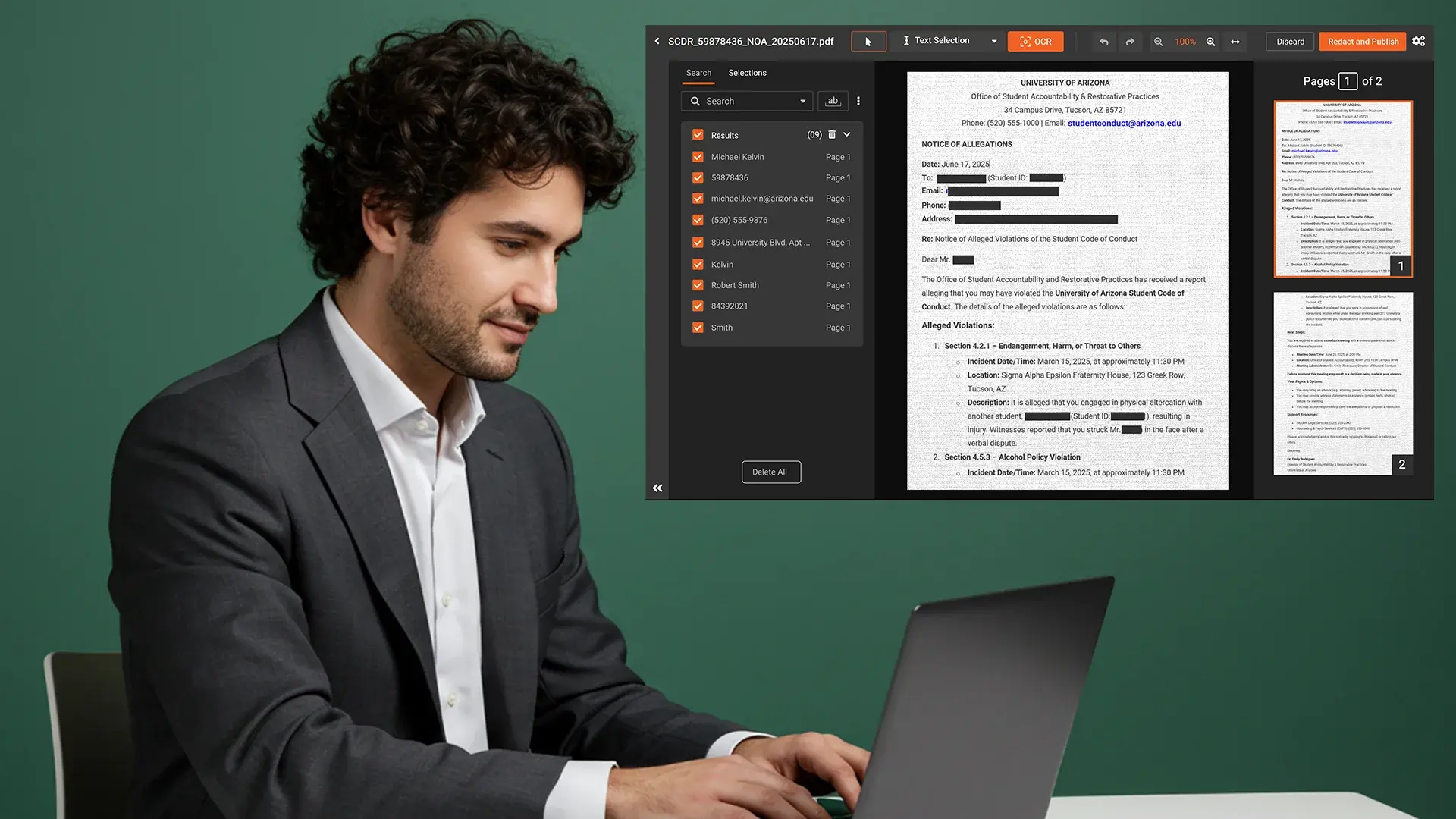
AI-powered redaction platforms detect PII across documents, apply redactions automatically, and let staff review before finalizing. The speed difference is dramatic. A batch of 50 PDFs that would take a staff member days to process manually can run through AI detection in under an hour. However, software requires trained operators to configure detection rules, review AI output, and handle edge cases. If the team is already stretched thin, adding a tool does not add the people to run it.
VIDIZMO Redactor's AI-powered document redaction software is purpose-built for exactly this scenario, reducing compliance workloads while keeping human review in the loop.
Managed Document Redaction Services
A provider takes on the redaction workload, either by accessing documents within the organization's own environment or through a secure transfer arrangement with chain of custody protections. The provider handles detection, redaction, quality assurance, and delivery of redacted files. Organizations that face backlog clearance, surge capacity demands, or simply lack the internal staff for redaction find this model most practical.
The hybrid approach combines automation and managed services: routine, high-volume document redaction runs through automated software in-house, while complex or overflow requests route to a managed service provider.
Five Questions to Ask Any Document Redaction Provider
Before selecting a document redaction service, evaluate providers against these criteria:
1. Does it handle more than basic PDFs? Many redaction tools only process text-layer PDFs. If your documents include scanned images, handwritten notes, or embedded photos, you need a provider with OCR, handwritten text recognition (ICR), and visual PII detection, not just text search-and-replace.
2. Can it detect PII in embedded images? A face embedded in a PDF, a license plate photo in an insurance claim, or a signature on a scanned form are all invisible to text-only tools. Look for providers that detect objects inside documents, not just text strings.
3. How is quality assured? A single missed redaction can undo the entire effort. Ask whether the service includes human review, dual QA layers, or confidence scoring on automated detections. Fully automated outputs shipped without human review carry real risk, especially for litigation-bound or FOIA-responsive documents.
4. What audit trail is provided? Regulated industries need to prove what was redacted, when, by whom, and under which authority. Look for chain of custody documentation, exemption code tagging, and activity logging.
5. Does it support your compliance framework? FOIA exemption codes, HIPAA safe harbor rules, and PCI-DSS requirements all impose different redaction standards. A generic service that treats all redaction the same way may not meet your specific regulatory obligations.
How VIDIZMO Redactor Handles Document Redaction at Scale
VIDIZMO Redactor addresses document redaction across the full spectrum, from self-service automation to managed "white glove" redaction services:
- 255+ supported formats covering PDFs, Office documents, images, scanned files, and more, all within a single platform
- OCR for scanned documents and handwritten text recognition (ICR), including Perso-Arabic script support for Arabic, Farsi, and Urdu
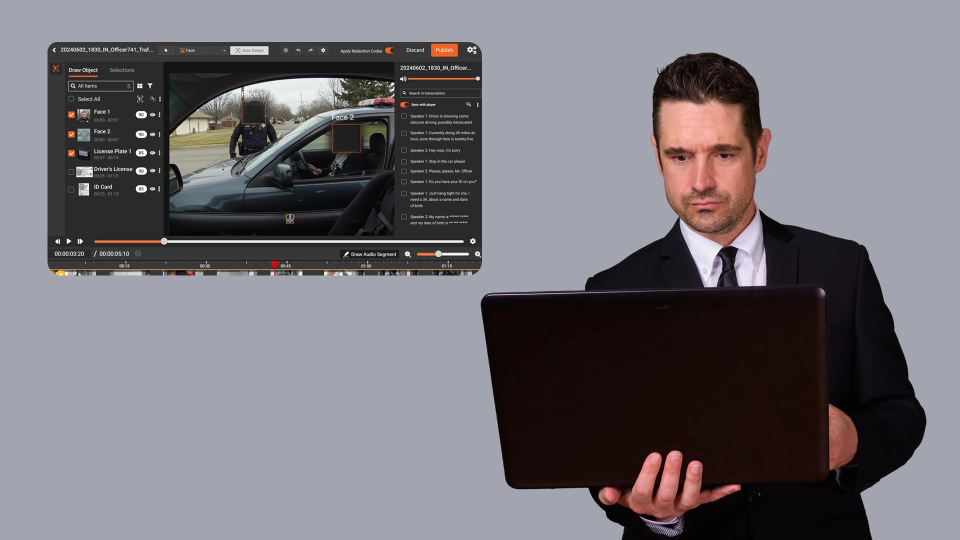
- Objects inside PDFs detected and redacted: faces, license plates, and other visual PII embedded as images within PDFs that most document redaction tools miss entirely
- 40+ PII types detected including country-specific identifiers such as US SSN, UK National Insurance, Indian Aadhaar, and Canadian SIN
- Bates stamping for legal workflows that require sequential page identification
- Managed redaction service with dual QA review for organizations that need overflow or full-service capacity, having processed 1.1M+ recordings across all media types
The platform supports CJIS-compliant deployments on Azure Government, HIPAA-compliant workflows, and FOIA exemption code tagging across all document types. Government agencies can learn more about VIDIZMO's tailored capabilities on the FOIA redaction software page, while healthcare and legal teams can explore dedicated use case pages for healthcare and legal redaction.
Key Takeaways
- Document redaction services cover PDFs, Office files, scanned images, and embedded visual content, not just plain text
- Three models exist: manual in-house, automated software, and managed services. Most organizations benefit from a hybrid approach
- Text-only tools miss visual PII embedded in documents such as faces, license plates, and signatures in scanned PDFs, which require object detection
- Evaluate providers on format coverage, OCR capability, QA process, audit trails, and compliance framework support
- Managed services solve the staffing problem that software alone cannot. Adding a tool does not add the people to run it
Choosing the Right Document Redaction Path
The right approach depends on where your organization stands today. If you have trained staff and manageable volumes, automated software delivers speed and consistency. If you are facing a backlog, a compliance deadline, or simply do not have the headcount, managed document redaction services close the gap without the overhead of hiring and training.
Most organizations land somewhere in between, and the hybrid model exists for exactly that reason.
Request a redaction assessment for your organization, see how VIDIZMO Redactor can help you in it or book a meeting.

About the Author

Jump to
Bulk Document Redaction for Law Firms: Redact Thousands of Documents
Redaction Services: The Complete Guide to Managed Redaction

No Comments Yet
Let us know what you think