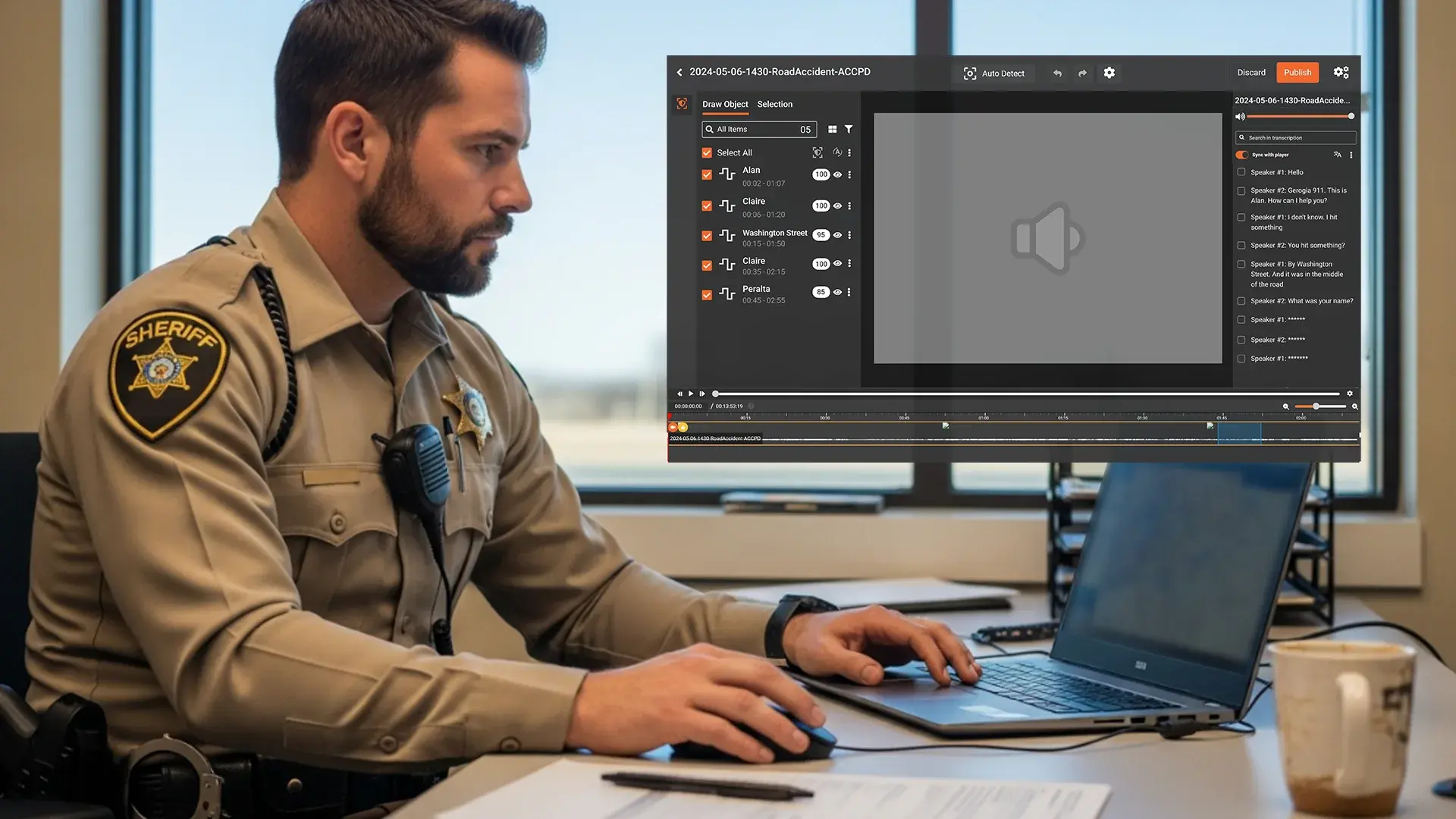
TL;DR:
To redact government documents at scale, agencies must move beyond manual workflows to AI-powered automation solutions like VIDIZMO Redactor, an all-in-one, AI redaction solution. Key steps include automated PII/PHI discovery, secure batch processing, and maintaining FOIA/CJIS compliance security requirements. Modern AI-driven redaction workflows can reduce manual effort by up to 90% while preserving strict data residency, privacy, and security controls.
Government agencies are required to be transparent, but they are also legally obligated to protect sensitive information. Every year, agencies process thousands of FOIA and public-records requests involving police reports, emails, contracts, investigations, and citizen data.
The challenge is not whether to redact but how to redact sensitive documents accurately, consistently, and at scale without exposing protected information or creating compliance risk.
This 2026 guide explains government document redaction from a legal, operational, and practical perspective. You’ll learn what must be redacted, why redaction is required under FOIA, how to prevent common redaction failures, and how agencies can build a compliant, scalable redaction workflow.
What Is Government Document Redaction?
Government document redaction is the process of permanently removing or obscuring sensitive or legally protected information from records before they are released to the public. Agencies redact documents to comply with FOIA exemptions, protect privacy, safeguard investigations, and prevent security risks while still disclosing non-exempt information.
Government document redaction applies across every level of government, federal, state, and local, and spans both traditional records (paper scans, PDFs) and modern formats (emails, spreadsheets, multimedia exhibits). What counts as "sensitive" varies by record type: a FOIA release, a litigation production, and a public court filing are each governed by different rules for what must be withheld and how the redaction must be documented.
What Does “Redacted” Mean in a Government and Legal Context?
In government and legal environments, redacted does not mean “hidden” or “summarized.” It means:
- Sensitive content is removed or irreversibly obscured
- The information cannot be recovered from the released file
- The redaction is legally justified and defensible
This distinction matters because improper redaction, such as covering text with black boxes or highlights, can leave underlying content extractable, especially in PDFs.
Why Government Agencies Redact Sensitive Documents
Government agencies redact documents to strike a balance between public transparency and legal, privacy, and security obligations.
1. To Protect Personal Privacy (PII & PHI)
Government records often contain personally identifiable information (PII), including:
- Social Security numbers
- Home addresses
- Dates of birth
- Financial identifiers
- Medical information
FOIA permits agencies to withhold certain information, and agencies often must redact sensitive personal data to protect privacy.
2. To Safeguard Law Enforcement Investigations
Redaction protects:
- Confidential informants
- Witness identities
- Investigative methods
- Evidence details that could compromise cases
Releasing this information prematurely can endanger lives or interfere with ongoing proceedings.
3. To Protect National Security and Public Safety
Certain records contain sensitive information related to:
- National defense
- Foreign policy
- Critical infrastructure
- Internal security procedures
FOIA permits withholding or redaction of properly classified or security-sensitive information.
4. To Comply with FOIA Exemptions
FOIA contains nine exemptions that justify withholding or redacting information, including:
- Personal privacy
- Law enforcement records
- Confidential commercial information
- Internal deliberations
These obligations apply broadly across federal, state, and local government, but federal agencies face additional, agency-specific requirements layered on top of FOIA. For a deeper look at those requirements, see our guide to redaction best practices for federal agencies.
What Information Should Be Redacted in Government Documents?
Below is a practical checklist for sensitive documents redaction across government agencies.
Personally Identifiable Information (PII)
- Social Security or national ID numbers
- Driver’s license or passport numbers
- Personal phone numbers and email addresses
- Home addresses and dates of birth
Sensitive Law Enforcement Information
- Witness and informant identities
- Surveillance or investigative techniques
- Case routing notes and internal assessments
Protected or Vulnerable Individuals
- Information about minors
- Victim identities in sensitive cases
- Protected persons or witnesses
Financial and Commercial Data
- Bank account numbers
- Taxpayer identifiers
- Confidential business or procurement data
Security and Operations Data
- System credentials
- Building layouts or access procedures
- Internal security documentation
Where Redaction Becomes Difficult: Doing It at Scale
Most agencies know what to redact. The real challenge is doing it accurately and repeatedly across hundreds or thousands of documents, often under strict deadlines.
Manual processes, inconsistent tools, and visual “black box” redaction increase the risk of:
- missed sensitive fields
- hidden text or metadata leaks
- inconsistent decisions across departments
- FOIA appeals and reputational damage
These risks grow when agencies handle mixed content such as PDFs, scans, images, videos, audio, and emails, each with its own redaction challenges. Without standardized, auditable workflows, it is hard to prove that redaction is complete, consistent with FOIA exemptions, and compliant with CJIS, HIPAA, and other regulations.
This is where structured workflows and purpose-built tools, such as VIDIZMO Redactor, matter.
How VIDIZMO Redactor Helps Agencies Redact Safely and at Scale
VIDIZMO Redactor is designed as the only enterprise-grade AI redaction platform that handles video, audio, images, and documents in one place, with compliance-ready workflows, flexible deployment, and scalable bulk processing specifically for government agencies and regulated environments that handle FOIA requests, public records, investigations, and compliance disclosures.
In practice, agencies use VIDIZMO Redactor to:
- Apply true permanent redactions (not visual masking)
- Detect sensitive text using OCR for scanned documents
- Standardize redaction rules across departments
- Helps sanitize hidden layers and metadata (depending on file type and structure)
- Enforce review workflows and audit trails
- Process large volumes of documents without sacrificing accuracy
It fits naturally into FOIA and records-management workflows where accuracy, defensibility, and scale matter.
The 7-Step Compliant Document Redaction Workflow (2026)
Agencies that redact safely at scale follow a repeatable process.
Step 1: Intake and Triage
- Identify request type (FOIA, litigation, public records)
- Track deadlines and priorities
- Normalize incoming file formats
Step 2: Classify Documents and Apply Policy Rules
- Map document types to redaction policies
- Identify applicable FOIA exemptions
- Document the basis for withholding
Step 3: Detect Sensitive Information
- Use OCR for scanned files
- Detect patterns (IDs, dates, addresses)
- Flag high-risk documents for deeper review
Step 4: Apply Permanent Redactions
- Remove sensitive content completely
- Avoid overlays, highlights, or annotations
- Ensure redactions cannot be reversed
Step 5: Sanitize Metadata and Hidden Layers
- Remove comments, OCR layers, embedded objects
- Clean document metadata before release
Step 6: Quality Assurance and Verification
- Perform second-person reviews for high-risk records
- Test for recoverability (copy/paste, search, export checks)
- Validate final release files
Step 7: Release and Audit Logging
- Publish release-ready versions
- Retain originals securely
- Maintain logs showing who redacted what, when, and why
Common Redaction Mistakes Agencies Should Avoid
❌ Using Visual Masking Instead of True Redaction
Text covered with black boxes can sometimes be copied or extracted.
❌ Ignoring Hidden PDF Layers and Metadata
Sensitive information may remain in OCR layers, comments, or metadata.
❌ Inconsistent Redaction Decisions
Different reviewers may redact the same fields differently without standardized rules.
❌ No Audit Trail
Without documentation, redaction decisions are difficult to defend during appeals or audits.
Tooling Checklist for Government Document Redaction Software
When evaluating redaction solutions, agencies should require:
- Permanent, irreversible redaction
- OCR for scanned documents
- Metadata and hidden-layer sanitization
- Batch and queue processing
- Review workflows and role-based access
- Audit trails and version history
- Secure, release-ready exports
Final Takeaway: Redaction Must Be Defensible, Not Just Fast
In 2026, compliant document redaction is about more than meeting deadlines. Agencies must ensure that every released record is:
- legally justified
- technically secure
- operationally repeatable
- defensible under appeal or audit
With the right workflow and the right tools, government agencies can meet transparency obligations without risking privacy, safety, or trust.
If your agency is looking to modernize FOIA or public-records redaction, VIDIZMO Redactor provides a practical path to redacting sensitive documents safely and at scale.

FAQ
Frequently Asked Questions
1. What is FOIA document redaction?
FOIA document redaction removes exempt or sensitive information from responsive records before release so agencies can disclose non-exempt content lawfully.
2. What can be redacted under FOIA?
Information related to privacy, law enforcement, national security, confidential business data, and other protected categories may be redacted under FOIA exemptions.
3. Can redacted text be recovered?
Yes—if redaction is done incorrectly. Proper redaction permanently removes content and sanitizes hidden layers and metadata.
4. Is redaction the same as censorship?
No. Redaction is a legally defined process tied to disclosure laws, while censorship refers to suppressing speech or ideas.
5. How do agencies redact documents at scale?
By combining standardized policies, automation (OCR and detection), human review, permanent redaction, and audit-ready workflows.
TopicsRedactionGovernment
About the author
Rida Shakil is a Content Specialist at VIDIZMO focused on AI-powered redaction, data privacy, and secure digital transformation. Her work helps compliance teams, legal professionals, and government organizations navigate the complexities of protecting sensitive information across media and documents.
You may also like

Video Redaction Best Practices: Motion, Frame Rates, Tracking and Failing Safe
I led our video redaction project for a county public safety agency where two people handled every disclosure, and ...
Redacting Dash Cam, Body Cam and Drone Footage From a Moving Camera
A fleet claims manager preparing crash footage for an insurer and defense counsel is doing a different job from a ...

Why Frame-Rate Headers Lie: Redacting Variable Frame Rate Video
A video file keeps time frame by frame, and the frames-per-second figure a player displays is a summary of that timing, ...