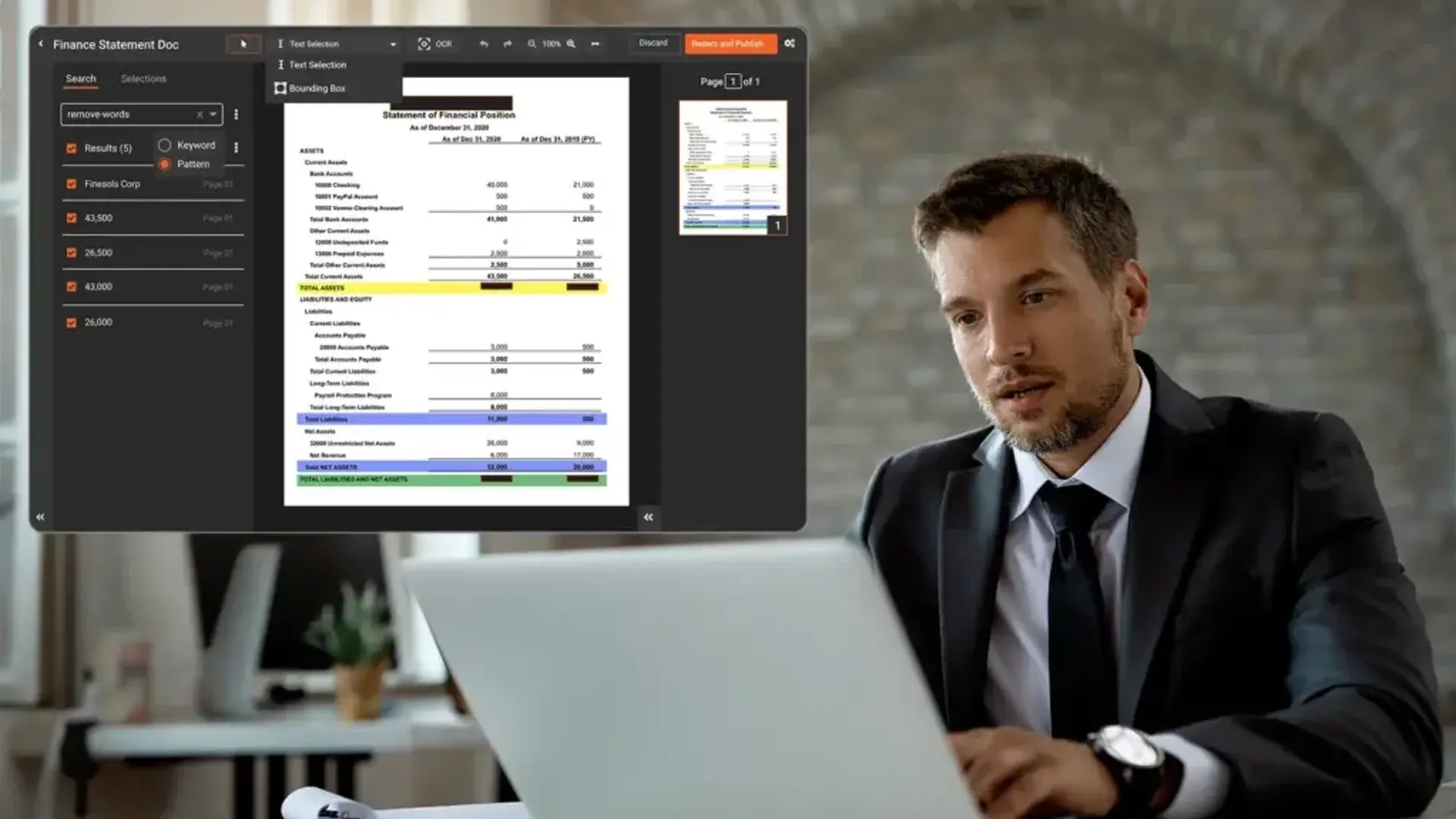
A document redaction tool is software that permanently removes or obscures sensitive information from files before they are shared, published, or released to the public. Government agencies, law firms, healthcare systems, and financial institutions use these tools daily to strip personally identifiable information (PII) from PDFs, Word documents, spreadsheets, scanned records, and images. One overlooked Social Security number or medical record number in a released file can trigger regulatory penalties, litigation, and reputational harm.
The need for automated document redaction has grown sharply. The Verizon 2023 Data Breach Investigations Report found that 74% of all data breaches included the human element, including errors in handling sensitive documents. Meanwhile, public records request volumes continue climbing. The National Freedom of Information Coalition has documented year-over-year increases in FOIA filings across state and federal agencies. Records teams face enormous pressure to redact and release documents faster without sacrificing accuracy.
This guide covers what a document redaction tool does, how to evaluate one, which compliance frameworks demand redaction, and the technical capabilities that separate basic tools from enterprise-grade platforms. Whether you are a FOIA officer clearing a backlog of 500 pending requests or a compliance lead preparing medical records for an audit, the goal is the same: remove protected data permanently, prove you did it correctly, and do it fast enough to meet your deadlines.
Key Takeaways
- A document redaction tool permanently removes PII from PDFs, Word files, spreadsheets, and scanned documents using pattern matching, OCR, and AI detection.
- Manual redaction of a 100-page document can take 2 to 4 hours. Automated tools reduce that to minutes while improving consistency.
- Effective tools must support OCR for scanned files, custom PII patterns, audit trails, and batch processing to handle real-world volumes.
- Compliance frameworks including FOIA, HIPAA, GDPR, and PCI-DSS all require documented, defensible redaction of protected information.
- Evaluation criteria should include format coverage, AI accuracy controls, deployment flexibility, and integration with existing records management systems.
What Does a Document Redaction Tool Actually Do?
A document redaction tool scans files for sensitive data patterns and either removes or permanently obscures the matching content. The redacted information cannot be recovered, copied, or extracted from the output file. This is fundamentally different from placing a black box over text in a PDF viewer, which often leaves the underlying data intact and searchable.
The core functions of any capable tool fall into four categories.
Pattern-Based Detection
The tool identifies known data formats such as Social Security numbers (XXX-XX-XXXX), credit card numbers, email addresses, phone numbers, and dates of birth. Most tools use regular expressions or built-in PII pattern libraries. More advanced tools let you define custom patterns specific to your organization, such as internal case numbers or employee IDs.
Optical Character Recognition (OCR)
Scanned documents, faxes, and photographed records do not contain searchable text. A document redaction tool with OCR capability converts these images to machine-readable text first, then applies the same detection and redaction logic. Without OCR, scanned records become a blind spot where any PII visible to a human reader passes through unredacted.
Permanent Removal
True redaction strips the underlying data from the file. The output document contains black bars, white space, or replacement characters where the sensitive information existed. The original text is removed from the file’s data layer, metadata, and any embedded objects. Tools that merely draw overlays without removing the data underneath are not performing real redaction.
Audit Trail Generation
For compliance purposes, the tool must log what was redacted, who authorized it, when it happened, and which redaction rules were applied. This audit trail makes a redaction defensible if challenged in court or during a regulatory review.
Why Do Organizations Need Automated Document Redaction?
Manual redaction does not scale. A trained analyst reviewing a 100-page PDF line by line, searching for 10 to 15 categories of PII, can spend 2 to 4 hours on a single document. Multiply that by the volume most organizations face, and the math breaks down fast.
A mid-sized city records office might receive 200 to 400 public records requests per month, each involving dozens or hundreds of pages. A healthcare organization preparing for a HIPAA audit might need to redact thousands of patient records. A law firm processing discovery materials could face tens of thousands of pages with sensitive client data scattered throughout.
Manual approaches create three specific risks:
- Inconsistency. Different analysts apply different standards. One person catches a date of birth; another misses it. Inconsistent redaction across a document set undermines the defensibility of the entire release.
- Deadline failure. FOIA mandates a response within 20 business days at the federal level. Many state open records laws require responses within 5 to 10 business days. When redaction is the bottleneck, agencies miss deadlines and face legal exposure.
- Human error. Fatigue and repetition lead to oversights. The HHS breach portal shows hundreds of annual incidents where protected health information was improperly disclosed through inadequate redaction.
Automated tools address all three problems. They apply the same rules to every page, process files in minutes instead of hours, and catch patterns that tired eyes miss. For a deeper look at how automated redaction software accelerates data protection, see our dedicated guide.
How to Redact Documents Step by Step
Follow these steps to redact documents effectively using any capable redaction tool.

1. Import your documents. Upload PDFs, Word files, Excel sheets, scanned images, or any other file format containing sensitive data.
2. Choose the redaction mode. Select manual redaction for full human control, semi-automated for AI-flagged suggestions with human review, or fully automated for high-volume batch processing.
3. Define what to redact. Specify which PII categories to target: names, SSNs, financial data, PHI, or custom patterns. Many tools offer predefined compliance templates for HIPAA, GDPR, and FOIA.
4. Run the redaction. The tool scans every page, applies detection rules, and removes or obscures matching content. Advanced tools also scrub metadata, hidden text, and revision history to eliminate residual traces.
5. Review and verify. Preview the redacted output to confirm all sensitive information is concealed. Use built-in comparison features to double-check changes against the original.
6. Save and export. Save the redacted version as a new file while keeping the original intact. Export in PDF, Word, or Excel formats with optional encryption, password protection, or audit trail attachments.
What Types of Documents Require Redaction?
Redaction isn't limited to one file format. Any document that contains PII and needs to be shared, released, or archived may require redaction. The most common types include:
.webp?width=1938&height=704&name=Guide%20to%20Document%20Redaction%20Software%20for%20Automated%20Document%20Redaction%20(1).webp)
The challenge grows when organizations store records in mixed formats. A single public records request might return PDFs, scanned images, Word files, and spreadsheet exports. A tool that handles only one format forces analysts to switch between applications, slowing the process and creating gaps where PII slips through.
Which Compliance Frameworks Require Document Redaction?
Multiple compliance frameworks either mandate redaction directly or require data minimization practices that make redaction necessary.
FOIA (Freedom of Information Act). Federal agencies must release records upon request but are required to redact information falling under nine specific exemptions, including national security data, personal privacy information, and law enforcement records. State equivalents impose similar requirements with varying deadlines. For a complete overview, see our guide to FOIA redaction software for government agencies.
HIPAA (Health Insurance Portability and Accountability Act). Healthcare organizations must remove 18 categories of protected health information (PHI) before sharing records for research, audits, or legal proceedings. The Safe Harbor method requires removing names, geographic data, dates, phone numbers, SSNs, medical record numbers, and more. The HIPAA Journal reports that over 385 million healthcare records were exposed between 2009 and 2023. Learn how healthcare redaction software addresses these requirements.
GDPR (General Data Protection Regulation). European data protection law requires data minimization. When sharing documents containing personal data, organizations must redact information not necessary for the stated purpose. Data subject access requests (DSARs) often require redaction of third-party data before releasing records to the requesting individual.
PCI-DSS (Payment Card Industry Data Security Standard). Organizations handling credit card data must mask or redact card numbers in stored documents, call recordings, and transaction records. Only the last four digits may be displayed.
FERPA (Family Educational Rights and Privacy Act). Educational institutions must redact student records before releasing information to unauthorized parties. Learn more in our guide on education redaction software for FERPA compliance.
How Should You Evaluate a Document Redaction Tool?
Not all redaction tools are equal. Here is a framework for evaluating your options based on what matters in production.
Format Coverage
Can the tool redact PDFs, Word documents, spreadsheets, images, and scanned files? If your organization handles mixed-format record sets, you need a single tool that covers them all.
OCR Quality
Test the tool’s OCR against your actual documents. Clean typed PDFs are easy. Scanned forms with handwritten notes, faded ink, or skewed pages are where OCR quality separates adequate tools from strong ones.
PII Detection Breadth
Basic tools recognize 5 to 10 patterns (SSN, phone, email). Enterprise tools detect 30 to 40+ categories, including national IDs for multiple countries, medical record numbers, financial identifiers like IBAN and SWIFT codes, and contextual PII such as a person’s name appearing in a paragraph.
Custom Pattern Support
Every organization has unique identifiers: case numbers, badge numbers, internal codes. The tool should let you define custom detection patterns using regular expressions and context words.
AI and Contextual Detection
Pattern matching catches structured data. But what about a person’s name in prose or a medical condition in a narrative paragraph? Advanced tools use natural language processing (NLP) to understand context, identifying PII that does not follow a rigid format.
Batch Processing
Can the tool process hundreds or thousands of files in a single operation? Look for queue-based processing that can run overnight without operator supervision.
Audit Trail and Reporting
The tool must generate a complete record of every redaction: the original content, the rule that triggered it, the user who approved it, and the timestamp. This is a legal necessity for defensible redaction under FOIA, HIPAA, and litigation discovery rules.
Deployment Options
Some organizations can use cloud-hosted tools. Others, particularly government agencies handling CJIS-regulated data, require on-premises or air-gapped deployments. Confirm the tool supports your security requirements before evaluating features.
What's the Difference Between Manual, Semi-Automated, and Fully Automated Redaction?
Manual redaction means an analyst reads every page, identifies sensitive data visually, and applies redaction marks by hand. This gives complete human control but is the slowest method. It is appropriate for small, high-stakes documents where every word matters, such as a classified briefing or a contested legal filing.
Semi-automated redaction lets the tool scan and flag potential PII, then presents the results to a human reviewer who accepts, rejects, or modifies each suggestion. This balances speed with oversight and is the preferred mode for most compliance-focused organizations because it pairs efficiency with a documented human review step.
Fully automated redaction processes files end to end without human intervention. An administrator configures detection rules, confidence thresholds, and output settings. The tool ingests files, applies redactions, generates audit logs, and exports clean copies. This mode handles the highest volumes and is best suited for recurring, standardized workloads like monthly call recording archives or batch public records processing.
Many organizations use all three modes: manual for sensitive one-offs, semi-automated for standard workflows, and fully automated for bulk recurring tasks.
How Does OCR Enable Redaction of Scanned and Legacy Documents?
OCR is the critical bridge between scanned paper records and automated redaction. Without it, a scanned PDF is just an image file. The redaction tool cannot search for SSNs or names because there is no text layer to search.
Quality OCR engines convert the image to machine-readable text with high accuracy, typically 95% or better on clean documents. The redaction tool then applies the same pattern matching and contextual detection it uses on native digital files.
Three OCR-related capabilities separate basic tools from enterprise-grade platforms:
- Handwritten text recognition (ICR). Many government and medical records contain handwritten notes, signatures, and annotations. Standard OCR misses these entirely. ICR models trained on handwriting styles can detect and flag this content for redaction.
- Layout detection. Complex documents have headers, footers, tables, multi-column layouts, and embedded images. The tool needs to understand document structure to apply redaction rules correctly.
- Multi-script support. Organizations serving diverse populations may encounter documents in Arabic, Urdu, Chinese, or other non-Latin scripts. OCR engines with multi-script support process these files rather than leaving them as unredacted blind spots.
How VIDIZMO Redactor Handles Document Redaction at Scale
VIDIZMO Redactor brings these capabilities together in a single platform covering documents, images, video, and audio. It provides AI-powered PII detection across PDFs, DOCX, XLSX, PPTX, and image files with OCR for scanned content, detecting 40+ PII types including SSNs, credit card numbers, medical record numbers, and country-specific identifiers such as UK National Insurance numbers and Indian Aadhaar numbers.
Three capabilities stand out at scale:
Objects inside PDFs. Many PDFs contain embedded images with faces, license plates, or handwritten notes. Redactor applies visual AI detection to these embedded objects, not just the text layer.
Batch processing validated at volume. The platform has been tested with two million recordings and documents. A major California county uses Redactor to bulk-redact two million call recordings containing CCPA/CPRA-sensitive data, and the Georgia Attorney General's Office runs it across 29 law enforcement agencies for open records and litigation productions.
Multi-layer redaction with exemption codes. Analysts can assign FOIA exemption codes (Exemptions 1 through 9) to different redaction layers, export specific layer combinations per request type, and log every decision for legal defensibility.
Ready to see how automated document redaction can reduce your backlog and strengthen compliance? Start a free Redactor trial and test it against your own documents.

Common Mistakes That Undermine Document Redaction
Even with the right tool, several common errors can compromise your redaction process.
Overlay-only redaction. Drawing black boxes over text in a PDF editor does not remove the underlying data. The text remains searchable and extractable. The Manafort case in 2019 demonstrated this when lawyers filed court documents with “redacted” text that could be read by copying and pasting. Always verify that your tool performs true data removal, not visual masking.
Ignoring metadata. Documents contain metadata including author names, tracked changes, comments, and revision history. A properly redacted document body can still leak sensitive information through unstripped metadata fields.
Skipping scanned pages. A mixed PDF might have 50 pages of digital text and 10 scanned inserts. If the tool does not apply OCR to the scanned pages, those pages pass through with all PII intact.
No quality assurance step. Fully automated redaction should not run without periodic quality checks. Set up a sampling process where a reviewer checks a percentage of automated output. Even a 5% spot-check rate catches pattern misconfiguration before it affects thousands of pages.
Inconsistent rules across departments. When different teams apply different redaction rules for the same data types, the organization cannot defend its practices as consistent and systematic. Centralize your redaction templates so every department works from the same standards. Our guide on redaction best practices for federal agencies covers this in detail.
Document Redaction for Specific Industries
Government and Public Records
Government agencies face statutory deadlines for FOIA and state open records responses. They need tools that process high volumes, apply exemption codes, and generate audit trails that withstand legal challenge. Learn how agencies are safely redacting sensitive documents at scale in 2026.
Healthcare
HIPAA’s 18 PHI categories require broad detection capabilities. Healthcare organizations redact medical records, insurance claims, lab results, and clinical trial data. For a detailed walkthrough, see our guide on PHI redaction in healthcare documents.
Legal
Law firms and corporate legal teams redact discovery materials, court filings, contracts, and investigation documents. They need precise control: partial redaction, Bates stamping, and exemption codes mapped to specific legal privileges. Our guide on redaction software for legal and compliance workflows covers the key requirements.
Financial Services
Banks, insurers, and financial advisors must protect credit card numbers, account details, SSNs, and transaction data under PCI-DSS, GLBA, and SOX requirements. Call recordings and scanned application forms are common document types requiring redaction before archiving or sharing with regulators.
Education
Educational institutions must comply with FERPA when sharing student records. Our guide on education redaction software for FERPA compliance explains how automated tools help schools and universities meet these requirements at scale.
FAQ
Frequently Asked Questions
What is a document redaction tool?
A document redaction tool is software that permanently removes or obscures sensitive information, including Social Security numbers, names, addresses, and financial data, from documents before they are shared or released. Unlike covering text with a black box, true redaction removes the underlying data from the file so it cannot be recovered through copying, searching, or extraction.
How does automated document redaction work?
Automated tools scan files using pattern matching, regular expressions, and AI-powered natural language processing to identify PII. The tool flags matches, applies redaction through permanent removal or replacement with black bars, and generates an audit trail documenting every change. OCR is applied to scanned documents so they receive the same detection treatment as digital-native files.
Is document redaction required for FOIA compliance?
Yes. The Freedom of Information Act requires federal agencies to release requested records but mandates redaction of information protected under nine specific exemptions, including national security data, personal privacy information, and law enforcement investigative records. State open records laws impose similar requirements with response deadlines often ranging from 5 to 20 business days.
How does a dedicated document redaction tool compare to Adobe Acrobat?
Adobe Acrobat offers basic redaction for individual PDFs but lacks batch processing, automated PII detection across multiple file types, audit trail generation, and OCR for scanned documents. A dedicated tool processes hundreds of files simultaneously, detects 30 to 40+ PII categories automatically, and creates defensible audit logs. For organizations processing more than a handful of documents per week, a dedicated tool is significantly faster and more consistent.
Can document redaction tools handle handwritten text?
Tools with intelligent character recognition (ICR) can detect and redact handwritten text in scanned documents. This matters most for government agencies and healthcare organizations where forms, notes, and annotations are often handwritten. Standard OCR handles typed text only. VIDIZMO Redactor includes ICR along with Perso-Arabic script OCR for Arabic, Urdu, and related languages.
How do I redact a PDF document?
Upload the PDF into your redaction tool, choose manual or automated mode, define which PII categories to target, run the redaction, review the output, and export the redacted version as a new file. Tools with AI detection and OCR ensure both native text and scanned content are covered. Always verify the tool performs true data removal rather than visual-only masking.
TopicsRedaction
About the author
Bassam Mazhar is a Product Marketing Executive at VIDIZMO covering video management, digital evidence, and data privacy. He focuses on delivering practical, AI-driven insights that help government agencies and enterprise organizations modernize how they store, manage, and act on video evidence.
You may also like

Video Redaction Best Practices: Motion, Frame Rates, Tracking and Failing Safe
I led our video redaction project for a county public safety agency where two people handled every disclosure, and ...
Redacting Dash Cam, Body Cam and Drone Footage From a Moving Camera
A fleet claims manager preparing crash footage for an insurer and defense counsel is doing a different job from a ...

Why Frame-Rate Headers Lie: Redacting Variable Frame Rate Video
A video file keeps time frame by frame, and the frames-per-second figure a player displays is a summary of that timing, ...