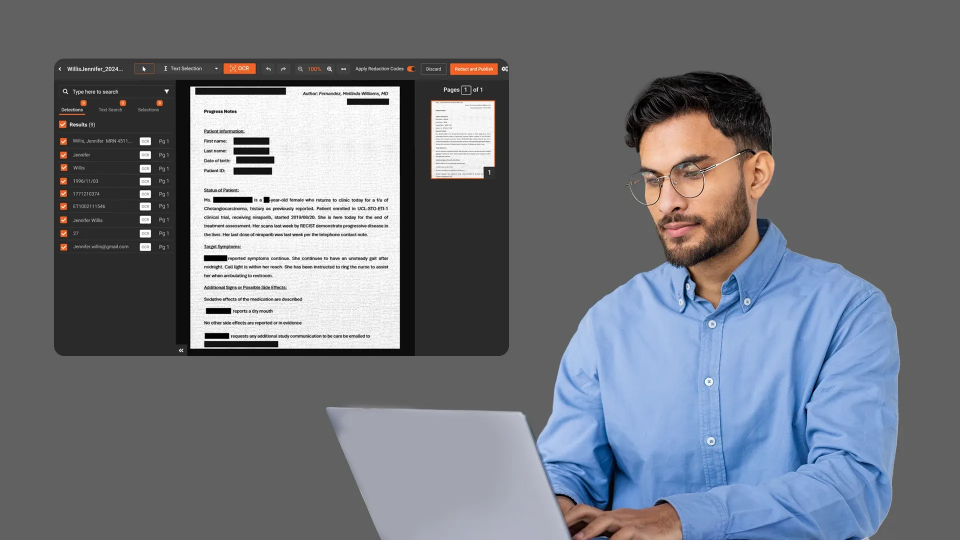
Applied Behavior Analysis (ABA) therapy generates some of the most PHI-dense documentation in behavioral health. Every session note includes client names, dates of birth, diagnoses, behavior descriptions, caregiver details, and insurance identifiers. When these records need to be shared for audits, insurance reviews, supervision, or legal requests, organizations must redact PHI from session notes before any disclosure.
For ABA clinic operators and compliance leads, the challenge is not just knowing what to redact. It is doing so consistently across thousands of session records without slowing down clinical operations or introducing human error.
What PHI Lives Inside ABA Session Notes
ABA therapy session notes are structured clinical documents that capture granular detail about each client interaction. Under HIPAA, any individually identifiable health information qualifies as protected health information (PHI). In a typical ABA session note, this includes:
- Client identifiers: Full name, date of birth, address, phone number, email, insurance member ID
- Clinical data: Diagnosis codes (ICD-10), treatment goals, behavior reduction targets, skill acquisition programs
- Session details: Date and time of service, location, duration, supervising BCBA name and credentials
- Caregiver information: Parent or guardian names, contact details, relationship to client
- Behavioral observations: Descriptions of specific behaviors, antecedents, consequences, and progress notes that may reference third parties (siblings, teachers, peers)
- Insurance and billing data: Payer name, policy number, authorization numbers, CPT codes
A single session note can contain 10 or more distinct PHI elements. Multiply that across a mid-sized ABA practice generating 200 to 500 session notes per week, and the volume of sensitive data requiring protection becomes substantial.
Why Manual Redaction Fails at Scale
Many ABA clinics still rely on manual redaction processes. Staff members open each document, visually scan for PHI, and apply black boxes or white-out over sensitive fields. This approach breaks down for several reasons.
Speed limitations. Manually reviewing and redacting a single session note can take 5 to 15 minutes depending on document length and PHI density. At 300 notes per week, that is 25 to 75 hours of redaction labor, often performed by administrative staff already stretched thin.
Inconsistency. Different team members redact different fields. One staff member may catch the client name and DOB but miss the caregiver phone number embedded in the narrative section. Another may overlook a referring physician name mentioned in a progress note. Without standardized rules, gaps are inevitable.
Narrative PHI is easy to miss. ABA session notes include free-text narrative sections where therapists describe behavioral incidents, conversations with caregivers, and contextual details. PHI embedded in running text (rather than labeled fields) is especially easy to overlook during manual review.
No audit trail. Manual redaction with PDF annotation tools or physical methods typically produces no record of what was redacted, by whom, or when. If a HIPAA audit or legal inquiry asks for proof that proper redaction occurred, clinics cannot demonstrate compliance.
Between 2009 and 2022, more than 382 million healthcare records were exposed in data breaches. Behavioral health organizations handling sensitive mental health and developmental disability records face heightened scrutiny. A single missed PHI element in a shared document can trigger an Office for Civil Rights (OCR) investigation.
How Automated Redaction Solves the Problem
Automated redaction software uses AI and pattern recognition to detect and remove PHI from documents without manual intervention. For ABA therapy session notes, automated redaction addresses each of the failure points described above.
AI-powered PII and PHI detection. Modern redaction tools can identify 40 or more PII and PHI types, including names, dates of birth, Social Security numbers, medical record numbers, insurance identifiers, and more. Both structured fields and unstructured narrative text are scanned using natural language processing (NLP) and pattern matching. This means that a client name mentioned in paragraph three of a behavior narrative gets flagged the same way as a name in the header field.
Configurable detection rules. Not every organization needs to redact the same information in every context. Automated tools let compliance leads set up redaction policies that define exactly which PHI types to target, using custom patterns (regex and context words) tuned to ABA-specific terminology like BCBA credentials, authorization numbers, or therapy codes.
Bulk processing. Instead of opening files one at a time, automated redaction processes hundreds or thousands of documents simultaneously. A week's worth of session notes can be redacted in a single batch, freeing staff to focus on clinical priorities.
Consistent audit trails. Every automated redaction action is logged with details about who initiated the process, what was detected, what was redacted, and when it happened. This documentation is critical for demonstrating HIPAA compliance during audits or responding to legal requests.
Human review where it matters. Automation does not mean zero oversight. Configurable confidence thresholds allow compliance teams to flag detections below a certain confidence level for manual review, ensuring that edge cases receive human attention without requiring staff to review every single page.
Applying This to ABA Clinic Workflows
For ABA clinic operators, integrating automated PHI redaction into existing workflows requires minimal disruption. Here is a practical approach:
Identify sharing triggers. Map out every scenario where session notes leave your organization: insurance audits, supervision documentation, legal discovery, inter-agency referrals, research collaborations, and parent record requests. Each of these triggers a redaction requirement.
Standardize redaction policies. Define which PHI categories must be redacted for each sharing scenario. Insurance audits may require different redaction rules than legal requests. Automated redaction policies let you create multiple rule sets and apply the appropriate one per context.
Process in batches. Schedule redaction runs on a weekly or bi-weekly basis to align with your documentation cycles. Batch processing ensures that records are redacted before they are needed, rather than scrambling to redact individual files on demand.
Maintain originals separately. Automated redaction tools generate redacted copies while preserving the original unredacted documents. This is essential for clinical continuity (therapists still need access to full notes) and for legal defensibility (originals must be retained in case of disputes about what was redacted).
Key Takeaways
- ABA session notes contain 10+ distinct PHI elements per document, from client names and diagnoses to caregiver contacts and insurance IDs.
- Manual redaction is too slow and inconsistent for clinics generating hundreds of notes weekly.
- Automated redaction detects PHI in both structured fields and free-text narratives using AI and pattern matching.
- Configurable policies and confidence thresholds let compliance teams balance automation with human oversight.
- Audit trails from automated redaction provide the documentation needed for HIPAA compliance verification.
Building a Scalable PHI Redaction Process for Your ABA Practice
ABA therapy documentation will only grow in volume as practices expand, telehealth sessions add new record types, and payer audit requirements become more detailed. Building a redaction process that scales with your organization protects both your clients and your compliance posture.
The shift from manual to automated PHI redaction is not about replacing staff judgment. It is about removing the repetitive, error-prone parts of the process so that your compliance team can focus on the decisions that actually require human expertise.
Need to redact PHI from ABA session notes quickly and securely? Contact us to learn how automated redaction can help your organization stay HIPAA compliant.

FAQ
Frequently Asked Questions
What PHI must be redacted in ABA therapy session notes?
ABA session notes contain several types of protected health information (PHI), including client names, dates of birth, diagnoses, insurance IDs, caregiver details, and session timestamps. Under HIPAA, any information that can identify a patient must be redacted before records are shared outside the organization.
Why is manual PHI redaction risky for ABA clinics?
Manual redaction is time-consuming and prone to human error. Staff may overlook PHI embedded in narrative notes, leading to incomplete redaction. In high-volume ABA practices producing hundreds of session notes weekly, inconsistent manual processes increase the risk of HIPAA violations.
How does automated redaction detect PHI in medical records?
Automated redaction tools use AI, natural language processing (NLP), and pattern recognition to detect PHI in both structured fields and free-text narratives. These systems can identify dozens of sensitive data types, including names, medical record numbers, and insurance identifiers.
Can AI redaction tools help ABA clinics stay HIPAA compliant?
Yes. AI-powered redaction tools help ABA clinics maintain HIPAA compliance by consistently identifying and removing PHI across large volumes of documents. They also generate audit trails, allowing organizations to demonstrate when, how, and by whom redaction processes were performed.
What are the benefits of bulk redaction for ABA therapy records?
Bulk redaction allows clinics to process hundreds or thousands of ABA session notes simultaneously. This reduces administrative workload, speeds up document preparation for audits or legal requests, and ensures consistent PHI removal across all records.
When should ABA session notes be redacted?
ABA session notes should be redacted whenever records are shared externally, such as during insurance audits, legal discovery, research collaboration, inter-agency referrals, or parent record requests. Redaction ensures that only necessary information is disclosed while protecting patient privacy.
TopicsRedactionPHI Redaction

About the author
Ali Rind is a Product Marketing Executive at VIDIZMO, where he focuses on digital evidence management, AI redaction, and enterprise video technology. He closely follows how law enforcement agencies, public safety organizations, and government bodies manage and act on video evidence, translating those insights into clear, practical content. Ali writes across Digital Evidence Management System, Redactor, and Intelligence Hub products, covering everything from compliance challenges to real-world deployment across federal, state, and commercial markets.
You may also like

Video Redaction Best Practices: Motion, Frame Rates, Tracking and Failing Safe
I led our video redaction project for a county public safety agency where two people handled every disclosure, and ...
Redacting Dash Cam, Body Cam and Drone Footage From a Moving Camera
A fleet claims manager preparing crash footage for an insurer and defense counsel is doing a different job from a ...

Why Frame-Rate Headers Lie: Redacting Variable Frame Rate Video
A video file keeps time frame by frame, and the frames-per-second figure a player displays is a summary of that timing, ...