
by Hassaan Mazhar, Last updated: August 8, 2026
.webp)
For many law enforcement agencies, redaction is treated as a routine administrative task, something that must be completed before video, audio, or documents can be released. But beneath the surface, manual redaction carries costs that extend far beyond staff time.
As digital evidence volumes continue to grow, manual redaction workflows are quietly draining operational capacity, increasing legal risk, and slowing investigations across agencies of all sizes.
Manual Redaction Was Never Designed for Today’s Evidence Volumes
When redaction processes were first established, agencies were dealing primarily with written reports, still images, or short audio recordings. Today’s environment is fundamentally different.
Body-worn cameras, in-car video systems, fixed surveillance, interview recordings, and digital case files generate hours of evidence per incident. According to the Bureau of Justice Assistance (BJA), body-worn camera programs have expanded rapidly across the U.S., contributing to a huge number of videos to be collected annually by law enforcement agencies.
Each file must be reviewed carefully to protect sensitive information such as faces, voices, addresses, minors, and bystanders. Manual redaction requires reviewers to watch or listen to footage in real time, often frame by frame, repeatedly pausing, rewinding, and rechecking content to avoid errors.
This approach simply does not scale with modern evidence volumes.
The Time Cost: Backlogs Become the Norm
One of the most visible impacts of manual redaction is time.
The International Association of Chiefs of Police (IACP) has reported that redacting a single hour of video can take several hours of manual review, particularly when footage includes multiple subjects, movement, or crowded scenes. Interviews with records and public information units frequently reveal even longer review times when footage is complex or audio heavy.
As evidence volumes increase, agencies often face:
- Growing backlogs of unprocessed footage
- Missed or delayed public records deadlines
- Slower court and prosecutor disclosures
- Increased pressure on already limited records staff
What begins as a manageable workload can quickly become a systemic bottleneck.
The Human Cost: Fatigue, Errors, and Burnout
Manual redaction is repetitive, detail-intensive work. Reviewing hours of video or audio day after day increases fatigue which leads to an increase in the likelihood of mistakes.
Even a single oversight can result in:
- Accidental release of personal identifiable information (PII)
- Legal challenges or public scrutiny
- Loss of community trust
- Additional rework and internal investigations
Over time, this workload contributes to burnout, particularly within records units and administrative teams already operating under staffing constraints.
The Financial Cost: Time Spent Is Money Lost
Manual redaction is often viewed as “low cost” because it relies on existing staff. In practice, the financial impact is far less visible and far more significant.
Agencies frequently underestimate:
- Staff hours spent on repetitive review tasks
- Overtime required to meet disclosure deadlines
- Opportunity cost of diverting trained personnel from investigative or public-facing work
- Delays in case progression due to slow evidence processing
When viewed over months or years, manual redaction becomes a persistent operational expense rather than a one-time task.
The Risk Cost: Compliance and Defensibility
Redaction is not only about privacy, but also about defensibility.
Manual workflows introduce risk when:
- Redaction decisions vary between reviewers
- Documentation of edits is incomplete
- Audit trails are difficult to reconstruct
- Compliance relies heavily on individual judgment rather than repeatable processes
In environments where evidence may be scrutinized in court or through public records requests, consistency and traceability are essential.
Why Agencies Are Re-Evaluating Redaction Services
To manage rising demand, some agencies turn to outsourced redaction services. While this can temporarily reduce internal workload, it introduces new challenges:
- Reduced control over sensitive evidence
- Chain-of-custody concerns
- Longer turnaround times
- Ongoing service costs that scale with volume
As these challenges intensify, agencies are increasingly evaluating whether technology can support rather than replace human redaction decisions, many agencies are now exploring automated redaction software to balance efficiency, control, and compliance without relying solely on external redaction services.
Where Automated Redaction Software Changes the Equation
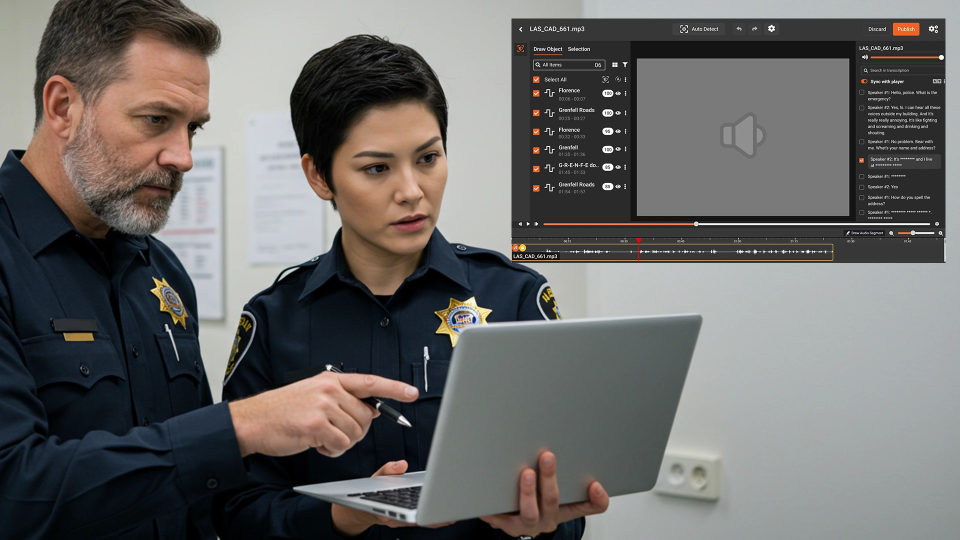
Automated redaction software uses AI to assist reviewers by identifying sensitive elements such as faces, voices, and other protected information. Instead of starting from scratch, reviewers validate and refine what the system detects.
This approach allows agencies to:
- Reduce manual review time
- Improve consistency across cases
- Maintain human oversight and accountability
- Scale redaction workflows without adding headcount
For example, a one-hour body-cam video with multiple bystanders can be pre-processed for faces and audio cues, allowing reviewers to focus only on validation rather than frame-by-frame discovery.
Automation does not replace judgment, it supports it.
Manual Redaction vs Modern Reality
Manual redaction remains familiar, but familiarity does not make it sustainable.
As digital evidence volumes continue to grow, agencies are being forced to ask a critical question:
Can we continue to rely on manual workflows without compromising efficiency, accuracy, or public trust?
For many, that question is driving a shift toward more scalable, technology-assisted redaction approaches.
Take the Next Step
Understanding the hidden cost of manual redaction is often the first step. The next is seeing how modern redaction tools work in real law enforcement workflows.
If your agency is exploring ways to manage video, audio, and digital evidence more efficiently while maintaining control and compliance, you can:

About the Author
Jump to
Manual Redaction vs AI Redaction for Police Agencies

Best Redaction Software for Law Enforcement (2026 Guide)


No Comments Yet
Let us know what you think