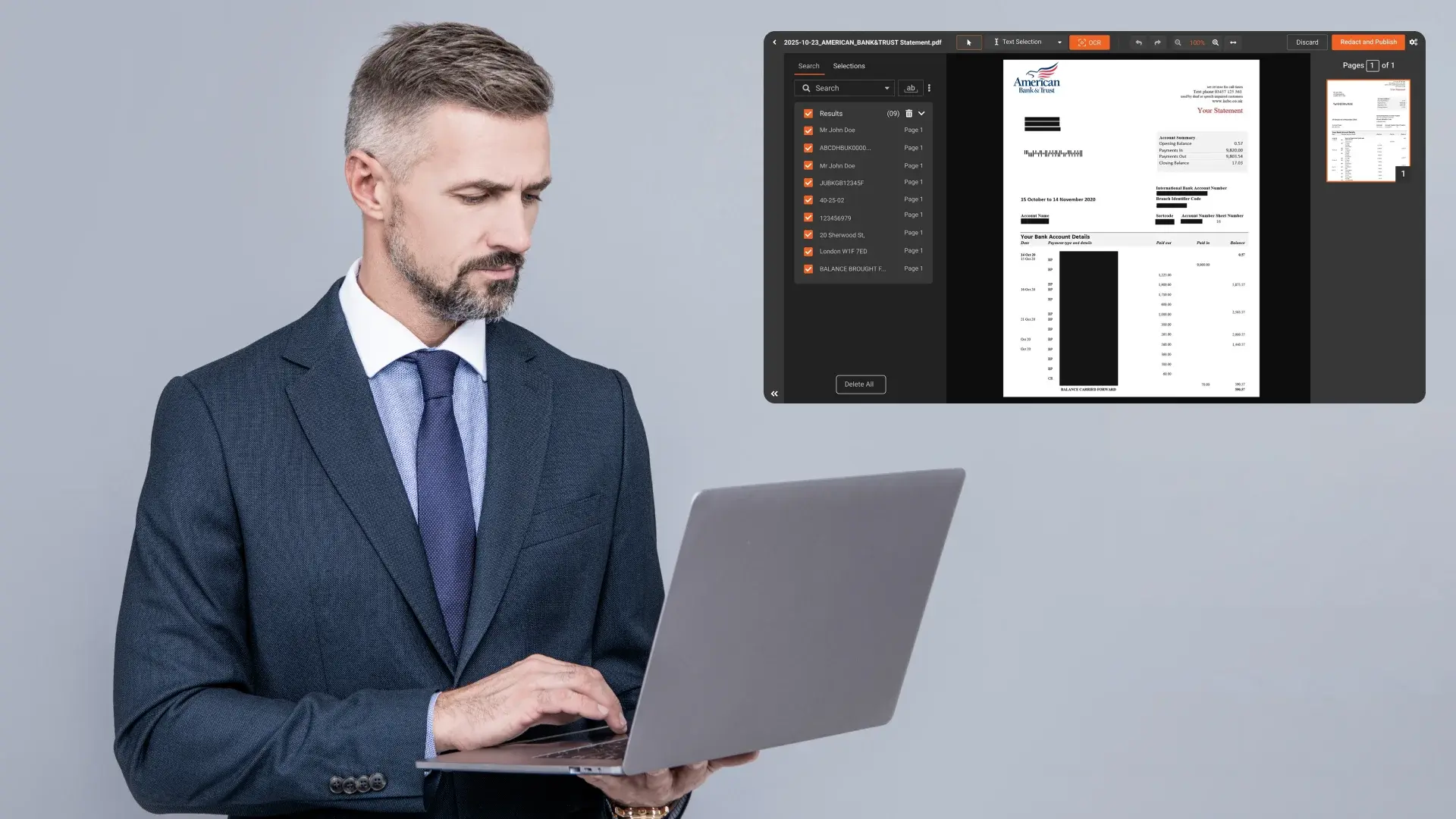
Invoices and vendor payment documents are among the most frequently shared financial documents inside finance, procurement, and accounts payable workflows. These files often contain bank account numbers, routing details, IBAN or SWIFT codes, vendor identifiers, and internal payment references. When shared with vendors, auditors, outsourced service providers, or internal teams, they can easily expose sensitive financial data if not properly redacted.
This guide explains how to redact invoices and vendor payment documents securely, why pattern-based redaction is critical for these file types, what information should be removed, what can remain visible, and how organizations can scale redaction without breaking compliance or slowing down finance operations.
What Are Redacted Invoices and Vendor Payment Documents?
Redacted invoices and vendor payment documents are versions of the original files where sensitive financial and payment information has been permanently removed before sharing.
Redaction allows organizations to share invoices for approval, reconciliation, audits, disputes, or vendor communication without exposing bank details or internal identifiers that are not required for the task at hand.
Invoices and payment documents are commonly shared during vendor onboarding, payment verification, audits, financial reporting, dispute resolution, outsourced accounting workflows, and internal process reviews. Because these documents move across so many teams and external parties, they present a high risk if redaction is inconsistent or incomplete.
Ways to Redact Invoices and Vendor Payment Documents
There are several ways organizations attempt to redact invoices and vendor payment documents, but not all approaches provide the same level of accuracy, security, or scalability.
Manual Redaction
Manual redaction involves reviewing invoices line by line and removing sensitive fields using basic tools. Finance teams often do this by printing invoices and blacking out information, or by using simple image or document editing tools to cover bank details before sharing.
This approach is time-consuming and error-prone, especially when invoices include repeated financial identifiers across multiple pages. Manual redaction does not scale well for accounts payable teams handling high volumes of invoices, and it makes it difficult to prove consistent handling during audits. For organizations processing vendor payments regularly, manual redaction does not align with financial document redaction best practices.
Redacting Invoices Using PDF Editors
Some teams use PDF editors that include redaction or masking features. This usually requires manually selecting text fields such as bank account numbers or vendor details and applying redaction marks before saving a copy.
While this can work for simple text-based invoices, it quickly becomes inefficient when invoices are scanned, image-based, or formatted inconsistently across vendors. It also relies heavily on manual selection, increasing the risk that a sensitive field is missed. PDF editors may be acceptable for occasional use, but they do not scale well for finance and procurement operations handling large invoice volumes.
Using Dedicated Redaction Software
Dedicated redaction software is designed to automatically detect and permanently remove sensitive financial information across large and diverse document sets.
These tools support automated detection of financial identifiers, pattern-based recognition for structured data such as account numbers and routing formats, and OCR-based redaction for scanned invoices and payment documents. They also support bulk processing, policy-driven consistency, and audit-ready workflows. Dedicated tools align best with redacting financial documents securely and are well-suited for accounts payable, finance operations, and compliance teams.
Why Pattern-Based Redaction Is Critical for Invoices
Unlike narrative documents, invoices and vendor payment documents rely heavily on structured financial identifiers. Bank account numbers, IBANs, SWIFT codes, routing numbers, and payment references follow predictable formats. Manually locating every instance of these identifiers across invoices is inefficient and unreliable.
Pattern-based redaction allows systems to automatically detect and redact financial identifiers based on their structure rather than relying on visual selection. This is especially important when the same identifier appears multiple times in headers, footers, remittance sections, or payment instructions.
By using patterns, organizations reduce the risk of missed identifiers and ensure consistent redaction across all invoices, regardless of vendor format or layout.
Redacting Scanned Invoices and Vendor Payment Documents
Many invoices are received as scanned PDFs, emailed images, or faxed documents. In these cases, sensitive information exists inside images rather than selectable text.
Without OCR-based redaction, financial identifiers embedded in scanned invoices can remain exposed even when they appear visually covered. OCR-based redaction extracts text from scanned documents, identifies sensitive financial patterns, and permanently removes them. This capability is essential for organizations handling invoices from diverse vendors with inconsistent formats.
OCR-enabled workflows are a core part of an enterprise financial document redaction guide.
Redaction vs Editing in Invoice Workflows
A common mistake in invoice handling is masking or visually covering bank details rather than truly redacting them. Highlight boxes, black rectangles, or annotations may hide information visually but leave the underlying data accessible.
Editing or masking can allow sensitive data to be recovered through copy and paste, metadata inspection, or layer removal. True redaction permanently removes the data and ensures it cannot be recovered. For invoices and payment documents, only permanent redaction is suitable for compliance-driven workflows.
How to Redact Invoices and Vendor Payment Documents at Scale
At scale, invoice redaction requires standardized policies and automation. Finance teams should define clear rules for what information must always be redacted, what can remain visible for processing, and how exceptions are handled. These rules should apply consistently across all financial documents handled by accounts payable and procurement teams.
Automation plays a critical role in scaling invoice redaction. Effective programs rely on automated detection of financial identifiers, pattern-based redaction for structured payment data, and OCR for scanned invoices. Bulk processing allows teams to redact large invoice batches consistently, reducing turnaround time and manual effort.
Audit readiness is also essential. Redaction workflows should support traceability, reviewer checks, and consistent enforcement to meet internal and external compliance requirements.
How VIDIZMO Redactor Helps Redact Invoices and Vendor Payment Documents Securely
VIDIZMO Redactor is designed for regulated environments where finance teams must protect sensitive payment data while keeping invoices usable for review, approval, and reconciliation.
VIDIZMO Redactor enables automated detection of sensitive financial information in invoices, including bank account numbers, routing numbers, IBANs, SWIFT codes, and vendor identifiers. Pattern-based redaction ensures structured payment data is detected consistently across different invoice formats. OCR-based redaction allows scanned and image-based invoices to be processed with the same accuracy as digital files.
For high-volume accounts payable and finance operations, VIDIZMO Redactor supports bulk redaction workflows that apply consistent policies across invoice batches. Redaction is permanent, removing underlying data rather than masking it visually, and workflows can be configured to support audit and compliance reviews.
Invoice and vendor payment documents are part of a broader ecosystem addressed in our guide to redaction software for financial services, where organizations can apply consistent redaction standards across all financial record types.
You Can Avail Free Trial
Looking to reduce risk while speeding up invoice processing?
Start a free trial of VIDIZMO Redactor and see how pattern-based and OCR-powered redaction can help you protect vendor payment data at scale.

Final Thoughts
Invoices and vendor payment documents expose critical financial identifiers that should never be shared unnecessarily. Manual and ad hoc redaction approaches do not scale and increase compliance risk.
Secure invoice redaction requires standardized policies, pattern-based detection, OCR support for scanned documents, bulk processing, and audit readiness. For a complete framework covering all sensitive financial records, see our guide to redaction software for financial services.
FAQ
Frequently Asked Questions
What information should be redacted on invoices before sharing?
Invoices should include bank account numbers, routing numbers, IBAN or SWIFT codes, internal payment references, and sensitive vendor identifiers, and should be redacted before being shared.
Why is pattern-based redaction important for invoices?
Pattern-based redaction detects structured financial identifiers automatically, reducing the risk of missed data and ensuring consistent redaction across different invoice formats.
Can scanned invoices be redacted accurately?
Yes, scanned invoices can be redacted accurately using OCR-based redaction that extracts and removes sensitive financial data embedded in images.
Is using a PDF editor enough to redact invoices?
PDF editors may work for simple invoices, but they are often ineffective for scanned documents and do not scale well for high-volume finance workflows.
How can VIDIZMO Redactor help redact invoices at scale?
VIDIZMO Redactor supports pattern-based detection, OCR for scanned invoices, bulk redaction workflows, and policy-driven consistency for finance and compliance teams.
TopicsRedaction
About the author
Zain Noor is a Product Marketing Executive at VIDIZMO with expertise in AI redaction technology. He focuses on how public safety agencies, government bodies, and commercial organizations adopt and operationalize video intelligence at scale.
You may also like

Video Redaction Best Practices: Motion, Frame Rates, Tracking and Failing Safe
I led our video redaction project for a county public safety agency where two people handled every disclosure, and ...
Redacting Dash Cam, Body Cam and Drone Footage From a Moving Camera
A fleet claims manager preparing crash footage for an insurer and defense counsel is doing a different job from a ...

Why Frame-Rate Headers Lie: Redacting Variable Frame Rate Video
A video file keeps time frame by frame, and the frames-per-second figure a player displays is a summary of that timing, ...