TL;DR. The Texas Public Information Act presumes public records are open. A sheriff's office can lawfully withhold video only under specific statutory exceptions. "We can't redact it" is not an exception. This guide walks through when denial is legal, when it is not, and how redaction resolves the gap.
Texas sheriff's offices receive video records requests every week. Some deny. Sometimes the denial is lawful. Often it is not. The gap between what agencies think the Texas Public Information Act allows and what it actually allows is where records-staff exposure sits.
This guide covers what TPIA requires, when video can be withheld, when "we can't redact it" is not a legal defense, what counts as redactable in Texas video, how body-worn camera footage is handled under the Texas Occupations Code, and what happens when an agency gets a denial wrong.
What TPIA Actually Requires
Texas Government Code Chapter 552 starts with a presumption of openness. Every record held by a governmental body is public unless a specific statutory exception applies. Agencies do not decide what is public; the legislature has.
The response clock starts the business day the request is received. Under Section 552.221, agencies must promptly produce public information. If the agency intends to withhold any portion, it has 10 business days to ask the Texas Attorney General for an opinion under Section 552.301, identifying the exceptions it believes apply. Missing the 10-day deadline waives the exceptions in most cases, and the records become subject to release by operation of law.
Video records are public information. Body-worn camera footage, dash camera footage, and stationary surveillance captured by a Texas governmental body all fall under Chapter 552. The question is not whether TPIA applies. The question is what exceptions apply to specific portions and how the agency separates them from the rest.
When Video Can Legally Be Withheld
Chapter 552 contains a defined list of exceptions. For video records, three come up most often.
Section 552.108: law enforcement and prosecutorial information. Video tied to an open, active criminal investigation or prosecution can be withheld if release would interfere with the case. The operative word is "active." Once an investigation concludes, the exception typically no longer applies.
Section 552.101: information confidential by law. An umbrella exception covering anything made confidential by statute, constitution, or judicial decision. It reaches juvenile identifying information under Texas Family Code Chapter 58, confidential informants, certain victim classes, and HIPAA-protected medical records. It does not reach "faces of adults in public who were not the focus of the investigation." That is a redaction question, not a withholding question.
Section 552.103: litigation exception. Information related to pending or reasonably anticipated litigation involving the governmental body can be withheld during the litigation. The exception expires when the matter concludes.
Other narrow exceptions cover peace officer addresses, undercover identities, and specific victim information. The Texas Public Information Handbook from the Texas Attorney General walks through each exception in detail.
When "We Can't Redact It" Is Not a Defense
A pattern shows up repeatedly in TPIA denials. The agency acknowledges the record is public, identifies portions that would need to be redacted (a juvenile's face, a bystander, a license plate), and concludes that because the agency cannot redact, it cannot release.
Chapter 552 does not permit that conclusion. The affirmative duty under the Act is to release public information and redact portions that fall under specific exceptions. Lack of capacity is not a statutory exception. Courts and AG opinions across public records regimes have consistently rejected "we lack the tools" as grounds for withholding otherwise releasable content.
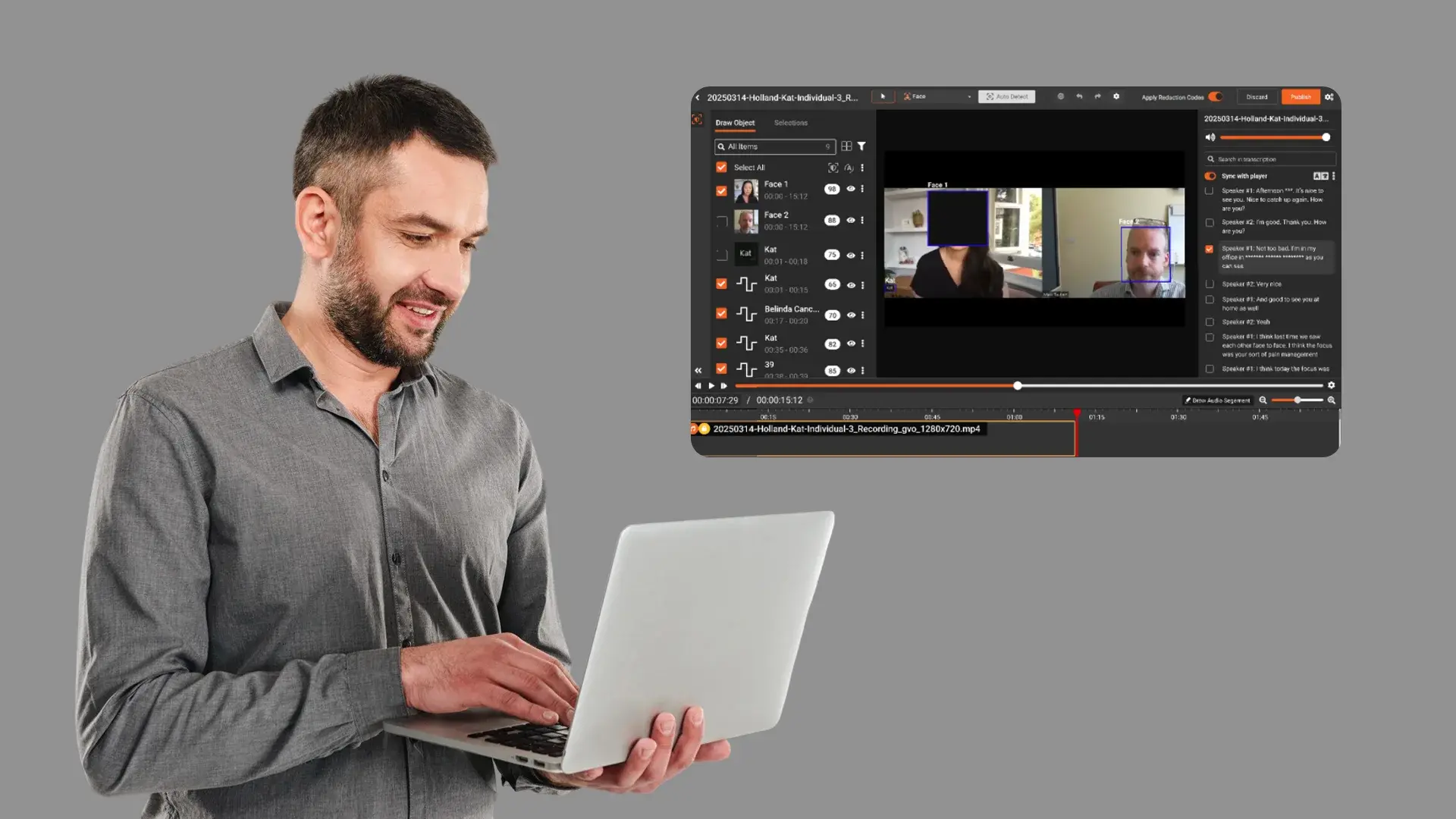
The operational reality for a Texas sheriff's office: if footage contains elements that are legally releasable and elements that are legally withholdable, the agency must separate them. Redaction is the separation mechanism. Denial is not. See our guide on how to redact body cam footage for public records requests for the operational workflow.
What Counts as Redactable PII in Texas Video
Texas does not have a single unified list of what must be redacted. The obligation comes from several statutes applied per-clip.
Faces of bystanders, juveniles, and certain victims. Adult bystanders who were not investigation subjects have a narrower privacy interest than juveniles or protected victim classes. Juvenile identifying information is presumptively confidential under Chapter 58 of the Family Code when tied to juvenile justice proceedings. Victims of sexual assault and family violence have statutory protections that reach their images. The full legal landscape is covered in our body-worn camera redaction guide.
License plates. Plates visible in public records video combined with other identifying data can implicate federal Driver's Privacy Protection Act concerns. Many Texas agencies redact plates by default for uninvolved vehicles.
Residential addresses and identifying location data. Addresses that would reveal the home of a private party, a peace officer, or a protected individual are redactable under specific 552 exceptions.
Medical information. Medical conditions, injuries revealing protected health information, and hospital interior footage implicate HIPAA-confidential material under 552.101.
Audio containing spoken PII. Names, social security numbers, and juvenile voices in interviews are redactable on the same principle as on-screen identifiers.
Body-Worn Camera Under Texas Occupations Code §1701.661
Texas has a BWC-specific statute sitting alongside TPIA. Texas Occupations Code §1701.661 governs body-worn camera programs operated under the Texas Commission on Law Enforcement (TCOLE) framework.
Agencies operating BWC programs have specific retention obligations, typically 90 days for most footage and longer for footage involving use of force, complaints, or active investigations. Release is governed by Chapter 552 for public records purposes, with BWC-specific privacy considerations folded into the 552.108 and 552.101 analysis. The statute does not create a separate regime for denial; it interacts with TPIA rather than supersedes it.
A BWC video response typically combines §1701.661 retention rules with Chapter 552 release rules. The record exists because the BWC statute required it to be captured. The release analysis runs under 552.
The Cost of a Wrongful Denial
Texas provides multiple enforcement mechanisms when an agency gets a denial wrong.
Attorney General complaint. A requester can file an informal complaint with the Texas AG's Open Records Division. The AG can issue an opinion that the records must be released.
Writ of mandamus. A requester can seek a writ of mandamus in district court compelling production. Courts grant these when the agency has failed to follow 552 procedures.
Attorney's fees and costs. Under Section 552.323, a court can award the requester attorney's fees and litigation costs if the agency acted in bad faith or without reasonable basis. This is the provision that turns a wrongful denial into a material expense.
Criminal penalties in narrow cases. The Act includes criminal penalties for knowing failure to permit access and for destruction of public information. Routine denials do not trigger criminal liability; knowing refusal after an AG directive can.
A pattern of wrongful denial also creates external risk: press coverage, civil rights organization attention, and political cost for elected sheriffs.
How Automated Redaction Closes the Gap
The operational case for automated video redaction in a Texas sheriff's office is straightforward. Records staff have a legal duty to separate releasable content from withholdable content. Manual redaction of body-worn camera and dash camera footage is slow enough that it becomes the bottleneck against which denials get issued.
AI-powered redaction platforms automate the detection work. Faces, license plates, persons, and spoken PII are detected across the footage. Human reviewers confirm the detection, apply policy on which categories to redact for the specific response, and produce a releasable output with an audit trail documenting the decisions. The separation obligation is met. The response goes out inside the 552 window.
For agencies choosing between deployment models, our on-premises vs cloud redaction guide for law enforcement IT covers CJIS considerations and infrastructure tradeoffs. Agencies evaluating vendors can compare options in the 2026 best redaction software for law enforcement guide.
Facing a backlog of video records requests? See how Redactor helps Texas law enforcement agencies meet TPIA obligations without the manual bottleneck.

FAQ
Frequently Asked Questions
Is body-worn camera footage a public record under TPIA?
Yes. BWC footage captured by a Texas law enforcement agency is public information under Chapter 552. Specific portions may fall under exceptions like Section 552.108 (active investigations) or 552.101 (confidential material), but the footage itself is presumptively public. Agencies must release the releasable portions and redact the rest, not deny the request outright.
Can a Texas agency deny a request because it lacks redaction tools?
No. Chapter 552 does not list operational capacity as an exception. The agency's duty is to produce releasable content and redact the rest. The Texas AG has consistently treated lack of tooling as an administrative problem, not a legal defense. Agencies denying on this ground risk AG opinions against them, writs of mandamus, and attorney's fees under Section 552.323.
What is the deadline to respond to a TPIA request?
Agencies must promptly produce public information. If any portion will be withheld, the agency must request an AG opinion within 10 business days under Section 552.301. Missing the deadline waives most exceptions, and the records become subject to release by operation of law.
Who enforces TPIA compliance?
The Texas AG's Open Records Division handles complaints and issues opinions on whether records must be released. Requesters can also file a writ of mandamus in district court to compel production. Courts can award attorney's fees under Section 552.323 when an agency acts in bad faith.
Does TPIA cover 911 call recordings?
Yes. 911 call audio held by a Texas public safety answering point is public information under Chapter 552. Specific content may be subject to 552.101 (medical info, juvenile identifiers) or 552.108 (active investigations). The redaction-not-denial principle applies: releasable portions must be produced with confidential audio redacted.
Can juveniles' faces be shown in released video?
Generally no. Juvenile identifying information tied to juvenile justice proceedings is presumptively confidential under Chapter 58 of the Texas Family Code, and that reaches the juvenile's image. Releasing video identifying a juvenile subject without redaction can expose the agency to liability. Juvenile bystanders may also warrant redaction depending on context.
What happens if video is released without proper redaction?
Improper release can expose the agency to civil claims, statutory claims under HIPAA or DPPA depending on the content, and reputational harm. The agency may need to issue corrective notices and re-release with proper redaction. This is why agencies build redaction into the release workflow rather than treating it as a post-hoc fix.
TopicsData SecurityRedaction

About the author
Ali Rind is a Product Marketing Executive at VIDIZMO, where he focuses on digital evidence management, AI redaction, and enterprise video technology. He closely follows how law enforcement agencies, public safety organizations, and government bodies manage and act on video evidence, translating those insights into clear, practical content. Ali writes across Digital Evidence Management System, Redactor, and Intelligence Hub products, covering everything from compliance challenges to real-world deployment across federal, state, and commercial markets.
You may also like
Video Redaction Best Practices: Motion, Frame Rates, Tracking and Failing Safe
I led our video redaction project for a county public safety agency where two people handled every disclosure, and ...
Redacting Dash Cam, Body Cam and Drone Footage From a Moving Camera
A fleet claims manager preparing crash footage for an insurer and defense counsel is doing a different job from a ...
Why Frame-Rate Headers Lie: Redacting Variable Frame Rate Video
A video file keeps time frame by frame, and the frames-per-second figure a player displays is a summary of that timing, ...