
by Ali Rind, Last updated: August 8, 2026

A privacy impact assessment (PIA) is a systematic process that identifies and evaluates how a project, system, or initiative collects, uses, stores, and shares personally identifiable information (PII). The purpose is straightforward: detect privacy risks before they become compliance violations, data breaches, or legal liabilities. Organizations across government, healthcare, finance, and education use PIAs to build accountability into their data handling practices from the earliest planning stages.
Privacy regulations have multiplied over the past decade. The General Data Protection Regulation (GDPR) introduced mandatory Data Protection Impact Assessments (DPIAs) for high-risk processing in 2018. In the US, the E-Government Act of 2002 requires federal agencies to conduct PIAs before developing or procuring IT systems that handle PII. State-level laws like the California Consumer Privacy Act (CCPA) and Virginia's Consumer Data Protection Act add further obligations. The pattern is unmistakable: regulators expect organizations to prove they considered privacy before collecting data, not after a breach forces the conversation.
Yet many organizations treat PIAs as checkbox exercises rather than genuine risk management tools. The IAPP-EY Privacy Governance Report 2023 found that only two in ten organizations were fully confident in their ability to comply with privacy regulatory requirements, and that PIAs and privacy by design ranked among the top strategic priorities across sectors — a clear signal that execution still lags behind intent. That gap between intent and execution is where real privacy risk lives.
Key Takeaways
- A privacy impact assessment identifies how PII is collected, used, and shared so organizations can mitigate risks before they cause harm.
- PIAs are legally required for US federal agencies, GDPR-regulated entities processing high-risk data, and organizations subject to HIPAA, FERPA, and similar frameworks.
- An effective PIA goes beyond paperwork: it maps data flows, evaluates proportionality, and produces actionable safeguards including data minimization and redaction.
- Automated redaction technology plays a direct role in PIA compliance by removing PII from records before storage, sharing, or public release.
- Organizations that integrate PIA findings into their redaction workflows reduce both breach exposure and the labor burden of manual privacy reviews.
What Is a Privacy Impact Assessment?
A privacy impact assessment is a structured analysis that evaluates how an organization's activities affect the privacy of individuals whose data it processes. It examines the full lifecycle of personal data: collection, storage, use, sharing, retention, and disposal. The goal isn't just to document what happens to data. It's to determine whether the organization's practices are proportionate, lawful, and adequately protected against misuse.
PIAs differ from general security assessments in a fundamental way. Security assessments focus on protecting systems from unauthorized access. PIAs focus on protecting people from unnecessary or disproportionate data processing, even when systems are technically secure. A database can be encrypted and firewalled while still collecting far more personal information than the stated purpose requires. A PIA catches that problem.
Core Components of a PIA
Most PIA frameworks share a common structure, regardless of which regulation drives them:
-
Data inventory: What PII is collected, from whom, and through which channels (forms, cameras, call recordings, documents, sensors)?
-
Purpose specification: Why is each data element collected? Is the purpose documented and communicated to data subjects?
-
Data flow mapping: Where does PII travel within the organization and to third parties? Who has access at each stage?
-
Risk analysis: What could go wrong? Consider unauthorized disclosure, excessive retention, function creep, and re-identification risks.
-
Mitigation measures: What controls reduce each identified risk? These include encryption, access controls, anonymization, redaction, retention limits, and training.
-
Documentation and review: How are PIA findings recorded, and how often is the assessment revisited?
The NIST Privacy Framework provides a widely adopted structure for mapping these components to organizational risk tolerance. It complements sector-specific mandates like HIPAA's Privacy Rule and CJIS Security Policy requirements.
Why Do Organizations Need Privacy Impact Assessments?
Privacy impact assessments serve three distinct purposes: legal compliance, risk reduction, and trust building. Each matters on its own. Together, they compound.
Legal and Regulatory Compliance
For US federal agencies, PIAs aren't optional. Section 208 of the E-Government Act requires a PIA before any new IT system or collection involving PII goes live. The Office of Management and Budget (OMB) reinforced this through Memorandum M-03-22, which mandates PIAs for systems that collect, maintain, or disseminate information in identifiable form.
Under GDPR Article 35, Data Protection Impact Assessments are mandatory when processing is "likely to result in a high risk to the rights and freedoms of natural persons." This includes large-scale processing of sensitive categories like biometric data, health records, or criminal conviction data. Failure to conduct a required DPIA can result in fines up to 10 million euros or 2% of global annual turnover.
Sector-specific mandates add further layers. HIPAA requires covered entities to assess risks to protected health information (PHI). The Family Educational Rights and Privacy Act (FERPA) creates obligations around student data. The Criminal Justice Information Services (CJIS) Security Policy requires agencies to evaluate privacy risks when handling criminal justice information.
Operational Risk Reduction
Beyond compliance, PIAs reduce the likelihood and cost of data incidents. The IBM Cost of a Data Breach Report 2024, conducted by Ponemon Institute, found the global average breach cost reached $4.88 million — a 10% increase over 2023 and the largest yearly jump since the pandemic. Healthcare breaches averaged $9.77 million. Organizations that identified and contained breaches in under 200 days saved an average of $1.02 million compared to those that took longer.
A well-executed PIA acts as an early warning system. It forces teams to ask hard questions about data collection before systems launch, not after regulators or journalists come calling. When a PIA reveals that a system stores Social Security numbers without a clear business justification, the organization can fix that design flaw at minimal cost. Discovering the same issue during breach response costs orders of magnitude more.
Public Trust and Accountability
Government agencies face particular pressure here. Citizens expect transparency about how their data is used, especially when surveillance technology, body-worn cameras, and automated license plate readers are involved. Publishing PIA summaries demonstrates that the agency considered privacy implications before deploying new systems. That transparency builds the public trust necessary for continued operation of data-intensive programs.
When Should a Privacy Impact Assessment Be Conducted?
A PIA should be conducted before any new system, project, or process that involves PII becomes operational. Timing matters. Retrofitting privacy protections after a system launches is far more expensive and disruptive than building them in from the start.
Triggering Events for a PIA
Organizations should initiate a PIA when any of the following occur:
- New system deployment: Any IT system, application, or database that will collect, process, or store PII requires assessment before going live.
- Significant system changes: Adding new data fields, integrating with third-party services, migrating to a new platform, or changing access controls all warrant a PIA update.
- New data collection methods: Introducing body-worn cameras, call recording systems, facial recognition, or any sensor that captures personal data triggers a fresh assessment.
- Regulatory changes: When new privacy laws take effect or existing regulations are updated, existing PIAs should be reviewed against the new requirements.
- Vendor or partner changes: Sharing PII with a new vendor, cloud provider, or partner organization changes the risk profile and requires reassessment.
- Periodic review: Even without triggering events, PIAs should be reviewed at least every two to three years to account for operational drift and evolving threats.
The key principle is proportionality. A small internal survey collecting only email addresses warrants a lighter assessment than a surveillance system processing video of thousands of people daily. Scale the depth of the PIA to the sensitivity and volume of data involved.
What Are the Key Steps in Conducting a PIA?
A privacy impact assessment follows a structured sequence, moving from data discovery through risk analysis to documented mitigation. While frameworks vary, the practical steps remain consistent across NIST, ISO 27701, and GDPR DPIA guidance.
Step 1: Define the Scope
Identify the system, project, or process under assessment. Document its purpose, the types of PII it handles, the data subjects affected (employees, customers, citizens, patients), and the legal basis for processing. Clear scoping prevents the assessment from becoming unfocused or overwhelming.
Step 2: Map Data Flows
Trace PII from the point of collection through every stage of its lifecycle. Where does it enter the system? Who has access? Where is it stored? Is it shared with third parties? How long is it retained?
This step often reveals unexpected data flows that create unrecognized risk. Call center recordings, for example, might contain spoken credit card numbers that persist in long-term storage without anyone realizing it.
Step 3: Identify Privacy Risks
For each data flow, evaluate the potential harms if something goes wrong. Consider unauthorized access, accidental disclosure, excessive collection, inadequate consent, and the impact on individuals if their data is exposed. Rank risks by both likelihood and severity to prioritize mitigation efforts.
Step 4: Evaluate Existing Controls
Assess what safeguards are already in place. These might include encryption, role-based access controls, retention policies, staff training, or redaction procedures for public records requests. Determine whether existing controls adequately address each identified risk or whether gaps remain.
Step 5: Recommend Mitigations
For each residual risk, propose specific, actionable mitigations. These fall into several categories:
- Data minimization: Collect only the PII necessary for the stated purpose. Delete fields that serve no documented need.
- Anonymization and redaction: Remove or obscure PII from records before sharing, publishing, or long-term storage. This applies to documents, video, audio, and images.
- Access controls: Restrict PII access to personnel with a documented need. Implement multi-factor authentication and audit logging.
- Retention limits: Establish and enforce data retention schedules. Automated deletion reduces the window of exposure.
- Vendor management: Ensure third parties handling PII meet equivalent privacy standards through contracts and audits.
Step 6: Document and Publish
Record all findings, decisions, and mitigations in a formal PIA report. For government agencies, publishing a summary (with sensitive operational details removed) is often a legal requirement. Documentation creates an audit trail that demonstrates due diligence if a privacy incident occurs later.
How Does Data Redaction Support PIA Compliance?
Redaction is one of the most direct mitigations a PIA can recommend. When an assessment identifies PII that must be shared, published, or retained but shouldn't be visible to all recipients, redaction removes or obscures that information. The rest of the record stays intact.
This applies across multiple data types. Video footage from body-worn cameras or surveillance systems contains faces, license plates, and location data. Call recordings capture spoken Social Security numbers, credit card details, and health information. Documents include names, addresses, account numbers, and signatures. A PIA that identifies these data elements as high-risk will typically recommend redaction as a primary mitigation.
Manual Redaction Falls Short at Scale
Many organizations still rely on manual redaction, where staff members review each file and manually blur, black out, or mute sensitive content. This approach creates three problems that directly undermine PIA objectives:
- Inconsistency: Different staff members make different redaction decisions on identical content. A 2021 Stanford study on legal document redaction found error rates between 5% and 15% in manual review processes, depending on document complexity.
- Speed: Manual redaction of a single hour of video can take four to eight analyst hours. For agencies processing thousands of FOIA requests annually, those backlogs can push response times past statutory deadlines.
- Audit gaps: Manual processes often lack documentation of who redacted what, when, and under which exemption authority. Without that trail, the organization can't demonstrate PIA compliance during audits.
Automated redaction tools address these gaps by using AI to detect and redact PII across video, audio, documents, and images. They apply consistent rules, process files in bulk, and generate audit trails that document every redaction decision. These capabilities map directly to the mitigation recommendations a PIA produces.
What to Look for in a Redaction Platform
When a PIA recommends automated redaction, organizations should evaluate PII redaction software against these criteria:
- Multi-format coverage: Can the tool redact video, audio, documents, PDFs, and images, or only one format? PIA scope rarely covers a single media type.
- PII detection breadth: Does the tool detect faces, license plates, spoken PII (names, SSNs, credit card numbers), and text-based PII? Narrow detection leaves gaps.
- Audit trail: Does every redaction action get logged with timestamps, user IDs, and the reason or exemption code applied?
- Confidence controls: Can reviewers adjust AI confidence thresholds and flag uncertain detections for human review?
- Deployment flexibility: Can the tool run on-premises or in a government cloud for agencies with data sovereignty requirements?
- Bulk processing: Can the tool handle high-volume queues for organizations with thousands of records to redact monthly?
VIDIZMO Redactor meets each of these criteria. It supports AI-powered redaction across 255+ file formats, detects 40+ PII types in video, audio, and documents, and generates defensible audit trails with exemption code mapping.
Organizations can configure confidence thresholds between 25% and 90%, ensuring human oversight where accuracy demands it. Deployment options span SaaS, government cloud, on-premises, and hybrid environments, fitting the data residency constraints that PIAs often surface.
How Automated Redaction Strengthens PIA Outcomes
A PIA identifies what needs protecting. Automated redaction executes that protection at scale. Here's how specific PIA findings map to redaction capabilities.
PII in Video and Audio Recordings
PIAs for law enforcement agencies, healthcare providers, and call centers frequently identify recorded media as high-risk data stores. Body camera footage captures bystander faces. Patient consultations include spoken diagnoses. Call recordings contain account numbers read aloud by customers.
Automated redaction detects and removes this PII without requiring staff to review every second of every recording. VIDIZMO Redactor, for example, processes spoken PII across 82 languages and detects 33+ spoken PII categories including names, SSNs, credit card numbers, and health plan identifiers.
Document and Image Redaction for Public Records
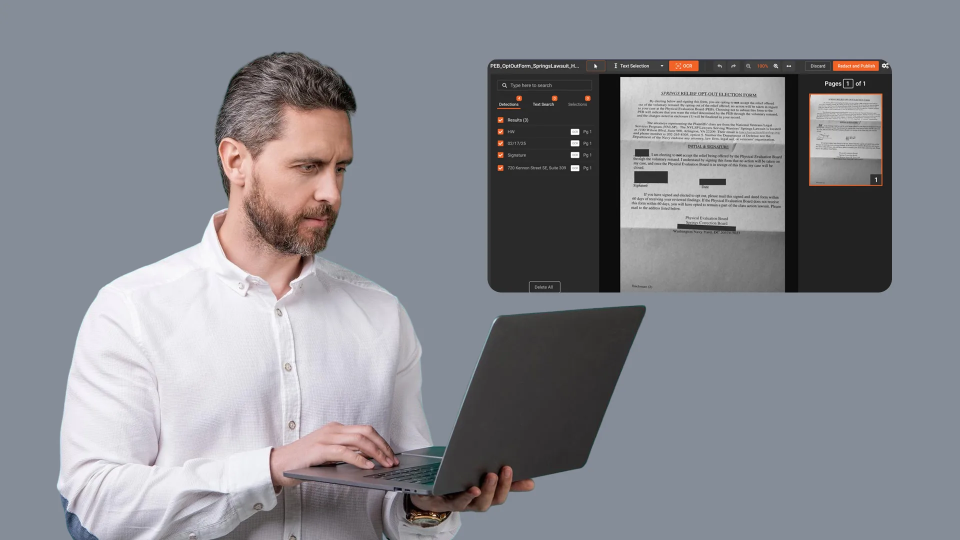
Government PIAs often flag public records processes as a key risk area. FOIA and state open-records laws require agencies to release information while protecting exempt content like personal identifiers, law enforcement techniques, and national security data. Automated document redaction with OCR capability handles scanned records that manual search-and-replace can't touch. The ability to apply FOIA exemption codes (Exemptions 1 through 9) to each redaction decision creates the defensible documentation that both the PIA and the requesting public deserve.
Audit Trails That Satisfy Assessors
One of the most common PIA recommendations is to implement logging and accountability controls around PII processing. Automated redaction platforms generate detailed audit trails capturing who initiated the redaction, what rules were applied, which PII types were detected, and what the outcome was for each element. This record directly satisfies the "documentation and review" component of the PIA process and provides evidence during compliance audits.
Organizations that have processed over 1.1 million recordings through bulk redaction workflows demonstrate that scaling privacy protections doesn't require proportional increases in staff. That operational reality makes automated redaction one of the most practical recommendations a PIA can produce.
Privacy impact assessments aren't just regulatory paperwork. They're the process that identifies what needs protecting and how. When PIA findings recommend redaction, the right technology turns those recommendations into consistent, auditable, scalable action.
Start your free Redactor trial to see how automated PII detection and redaction supports your organization's privacy assessment outcomes.

About the Author

Jump to
How a PDF Redaction Tool Protects Sensitive Data Before Public Release

How to Set Up HIPAA-Compliant Document Redaction Without an IT Team

No Comments Yet
Let us know what you think