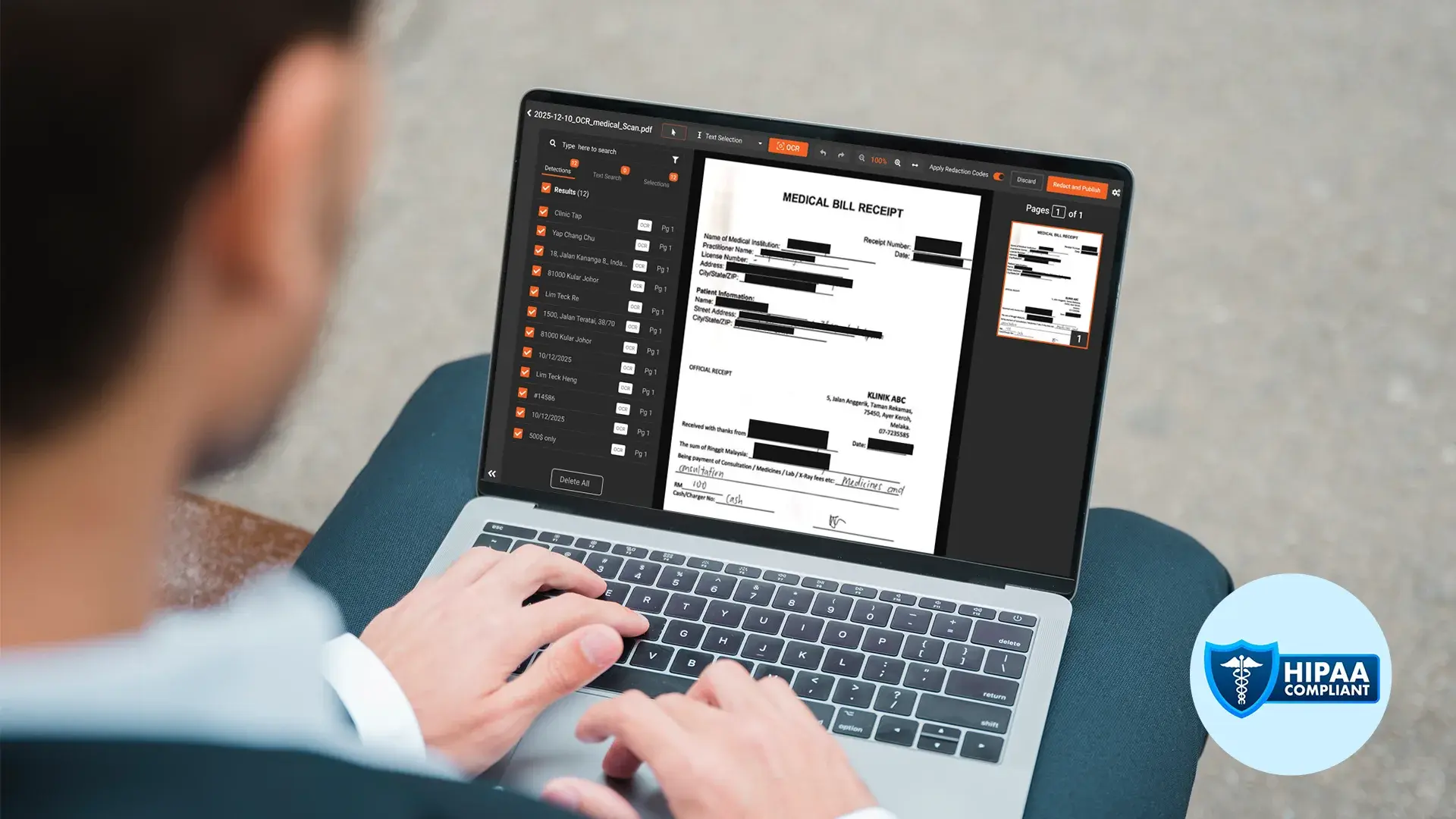
Most HIPAA redaction content is written for hospitals, clinics, and other covered entities. Billing companies face a different version of the same obligations. Under HIPAA, a medical billing or revenue cycle management company is a business associate, not a covered entity. The distinction matters because the regulatory framing, the contractual obligations, and the liability exposure all sit in different places than they do for the provider clients the billing company serves.
This guide covers what business associate status actually means operationally, where PHI sits across an RCM workflow, where redaction enters that workflow, the multi-client governance problem unique to billing companies, and what to look for in tooling priced and built for high-volume RCM operations. For form-specific guidance on the documents discussed below, the companion post on EOB and claim form redaction for billing teams covers each major form type in detail.
What "business associate" actually means for an RCM company
A business associate under HIPAA is any vendor that creates, receives, maintains, or transmits PHI on behalf of a covered entity. Billing and RCM companies fall squarely in this definition. The provider client is the covered entity; the billing company is the business associate; any vendor the billing company uses that touches PHI (a redaction software vendor, a clearinghouse, an outsourcing partner) is a downstream business associate.
The contractual mechanism is the Business Associate Agreement. The billing company signs a BAA with each provider client. The terms are specified at 45 CFR § 164.504(e): permitted uses and disclosures, safeguard obligations, breach notification, subcontractor flow-down, and termination provisions. HHS publishes sample BAA provisions that map directly to these requirements, and the same agreement structure flows downstream to any vendor the billing company uses.
Direct liability is the operational shift that happened in 2013. The HITECH Act Omnibus Rule, effective September 2013, made business associates directly subject to HIPAA enforcement by the HHS Office for Civil Rights. Before that, BAs were liable only through their covered entity. After that, OCR can pursue enforcement against a billing company directly. HHS publishes enforcement settlements on its site, and the BA category has seen settlements in multiple years since the rule took effect.
Breach notification is the third operational reality. A business associate that discovers a breach of unsecured PHI must notify the covered entity (the provider client) within 60 days of discovery under 45 CFR § 164.410. The BAA typically tightens this to a shorter window contractually. The billing company has to be able to detect, document, and report the breach inside that window, which is what makes audit trails and detection logging operationally mandatory rather than nice-to-have.
The PHI footprint inside an RCM workflow
PHI in a billing company is not in one document type. It is spread across the full operational surface.
A typical day at a billing company touches PHI in EHR exports received from provider clients, scanned EOBs and faxed remits dropped into the work queue, electronic remittance advice files coming through clearinghouses, claim files in CMS-1500 and UB-04 formats, denial letters and appeals packages, patient statements going out for collection, payment posting reports tying remits to claims, and AR aging reports for management review.
Each of these is a redaction surface. The patient name in the EOB header is the same identifier that appears in the appeal narrative, the denial letter, and the patient statement. Consistency across documents is what makes the company's overall PHI handling defensible, the same principle that applies to medical record redaction in any HIPAA-aligned data sharing workflow. Inconsistency (redacted in one place, missed in another) is what shows up in OCR audits and BAA breach investigations.
Where redaction enters the workflow
Seven concrete scenarios produce most of a billing company's redaction work.
Appeals packages where one patient's claim is the subject of the dispute, but the supporting documentation (medical records, prior EOBs, payer correspondence) contains other patients' content that has to be removed before submission.
Internal QA sampling, especially when reviewers sit offshore. The reviewer needs to see enough to QA the work without seeing more than the minimum necessary for the QA task.
Subpoena responses. Billing companies are subpoenaed often for billing records related to litigation involving the provider client, a patient, or a payer. The response requires redaction of any PHI outside the scope of the subpoena.
Payer and government audits including RAC, MAC, UPIC, ZPIC, and TPE reviews. Auditors get the records they need for the audit scope, with PHI outside that scope removed. Bulk redaction handles the volume that audit responses produce. This pattern is similar to the workflow on the payer side, covered in redaction for insurance claim adjusters, but the obligations differ because the billing company is acting as a business associate rather than a covered entity.
Sales demos to prospective provider clients. Real billing screens and real workflow demonstrations carry actual PHI from current clients. Demos need redacted versions or fully synthetic samples.
Training materials for new hires. Real cases make better training than synthetic ones, but the cases have to be redacted before they go into the training library.
Vendor evaluations where sample data is shared. A new claim management tool, a new analytics vendor, a new outsourcing partner; all need to see sample data to scope the engagement, and that data has to be redacted before it leaves.
Across all seven, the common requirement is consistent redaction discipline applied to volume that scales with the number of provider clients the billing company serves.
The multi-tenant problem
Billing companies serve multiple provider clients simultaneously, often dozens to hundreds. One client's PHI cannot leak into another client's view, even internally. This is the single biggest tooling gap when an RCM company tries to use a generic redaction tool built for single-organization workflows.
The operational requirements:
Per-client access controls. A reviewer assigned to Client A should not see Client B's documents in their work queue. Role-based permissions scoped per client are the mechanism.
Per-client audit logs. The audit trail for Client A's redaction work is separate from Client B's. If Client A's BAA requires audit log delivery, the export must contain only Client A's actions.
Per-client rule configurations. Different provider clients may have different requirements for what gets redacted, what stays, and how identifiers are handled. The platform should support per-client rule sets without forcing the same configuration across all clients.
Data segregation at the storage layer. Client documents stored in isolated logical or physical segments rather than commingled, so the segregation is structural rather than just policy-based.
A redaction tool that supports multi-tenant per-client configuration with isolated workspaces is what makes the RCM use case operationally workable. Tools that do not get re-implemented as one deployment per client, which is expensive to maintain and harder to audit centrally.
The BAA chain
The contractual structure that has to hold:
The provider client (covered entity) signs a BAA with the billing company.
The billing company signs a BAA with any vendor that touches PHI on its behalf, including the redaction software vendor.
If the billing company uses offshore reviewers, the BAA chain extends to the offshore entity, with terms that bind the offshore party to safeguards equivalent to HIPAA.
Each link has to hold. A redaction vendor that will not provide a BAA is not usable for any work involving PHI. A vendor that provides a BAA but cannot articulate its own sub-processor coverage (the cloud infrastructure the platform runs on, any AI services it uses) leaves the chain incomplete. The HIPAA-compliant redaction guide for small law firms covers the BAA evaluation checklist at the procurement stage, and the same criteria apply to a billing company evaluating its own software vendors.
What to look for in a redaction tool as an RCM company
Eight criteria for evaluating redaction tooling against the billing-company workload.
High-volume processing. Thousands of documents per day, not per month. The platform should handle batch ingestion, queued processing, and parallel work without manual per-file intervention.
OCR and ICR
OCR for scanned EOBs, faxed remits, and image PDFs. ICR for handwritten notes on superbills, provider signatures on attached documents, and handwritten corrections.
Per-client access controls and audit logs
The multi-tenant requirement covered above. A single deployment serving dozens of provider clients with structural data segregation.
Signed BAA
Available before any PHI is uploaded, with sub-processor coverage explicit.
Deployment options including private cloud and on-premises for larger billers
Some RCM companies, particularly those serving hospitals and health systems with strict data residency requirements, need the redaction platform inside their own infrastructure rather than in shared SaaS.
API access for integration with claim management systems and EHR connectors
The redaction step needs to plug into existing pipelines rather than require manual file movement.
Bulk and queue-based processing
Submit the day's batch overnight, review the output the next morning. This is the operational pattern that makes high-volume billing work tractable, and it is the same pattern documented in the broader document redaction tool guide.
Audit logs with operator, timestamp, action type, and basis. The compliance documentation that supports BAA reporting and OCR audit responses.
How VIDIZMO Redactor fits the RCM use case
VIDIZMO Redactor supports the multi-tenant billing-company workload through its Portal architecture, which provides per-client isolated workspaces with separate user provisioning, separate audit logs, and per-client rule configuration. HIPAA BAA and DPA are available, with documented healthcare customers operating under those terms. OCR processes scanned EOBs and faxed remits; ICR handles handwritten notes on superbills and signed documents.
Bulk processing has been tested at two million recordings, which is well beyond the volume a typical billing company processes in a quarter. REST API and webhook integration support automation into existing claim management and EHR pipelines. Deployment options include SaaS, dedicated SaaS, private cloud in the customer's own Azure or AWS environment, and on-premises for billing companies operating under stricter data residency requirements.
For broader context on the healthcare side, see healthcare data redaction software. For the form-by-form redaction approach across EOBs, ERAs, CMS-1500, UB-04, and superbills, see the companion EOB and claim form redaction guide for billing teams.

FAQ
Frequently Asked Questions
Are medical billing companies covered entities or business associates under HIPAA?
Business associates. Under HIPAA, a billing company creates, receives, maintains, or transmits PHI on behalf of a covered entity (the provider client). The billing company is bound by HIPAA through the Business Associate Agreement with the provider, and since the 2013 HITECH Omnibus Rule, business associates are directly liable for HIPAA violations and subject to HHS Office for Civil Rights enforcement. The distinction from covered entity status shapes the operational obligations and the contractual structure, but the underlying privacy and security requirements apply with equivalent force.
Does HIPAA require a BAA between a billing company and its redaction software vendor?
Yes. Under HIPAA, any vendor that handles PHI on a business associate's behalf is itself a business associate, and a BAA is required before PHI can be shared. The BAA flow-down obligation extends through the entire processing chain: provider to billing company to redaction vendor, and onward to any sub-processors the redaction vendor uses (cloud infrastructure, AI services). A vendor that will not execute a BAA cannot lawfully be used for any PHI work, regardless of its marketing claims about HIPAA compliance.
How does redaction support audit response for RAC and MAC audits?
Audit response packages typically include claim documentation, medical records, and supporting correspondence for the claims under audit. Records outside the audit scope (other patients' content on multi-claim EOBs, unrelated providers in attached documents, unrelated time periods) must be redacted before submission. Bulk redaction with consistent rule application across the audit batch is what makes the response defensible. The audit trail of what was redacted, by whom, and why becomes part of the response file documentation.
Can the same redaction tool serve multiple provider clients without mixing data?
Yes, when the platform supports multi-tenant per-client workspace isolation. VIDIZMO Redactor's Portal architecture provides separate workspaces per provider client with isolated user provisioning, separate audit logs, and independent rule configuration. Data segregation operates at the application, database, and storage layers, so one client's PHI is structurally separated from another's. This is the operational requirement for any RCM company serving multiple provider clients on a single platform deployment.
TopicsRedactionHealthcareHIPAA Compliance

About the author
Ali Rind is a Product Marketing Executive at VIDIZMO, where he focuses on digital evidence management, AI redaction, and enterprise video technology. He closely follows how law enforcement agencies, public safety organizations, and government bodies manage and act on video evidence, translating those insights into clear, practical content. Ali writes across Digital Evidence Management System, Redactor, and Intelligence Hub products, covering everything from compliance challenges to real-world deployment across federal, state, and commercial markets.
You may also like

Video Redaction Best Practices: Motion, Frame Rates, Tracking and Failing Safe
I led our video redaction project for a county public safety agency where two people handled every disclosure, and ...

Redacting Dash Cam, Body Cam and Drone Footage From a Moving Camera
A fleet claims manager preparing crash footage for an insurer and defense counsel is doing a different job from a ...

Why Frame-Rate Headers Lie: Redacting Variable Frame Rate Video
A video file keeps time frame by frame, and the frames-per-second figure a player displays is a summary of that timing, ...