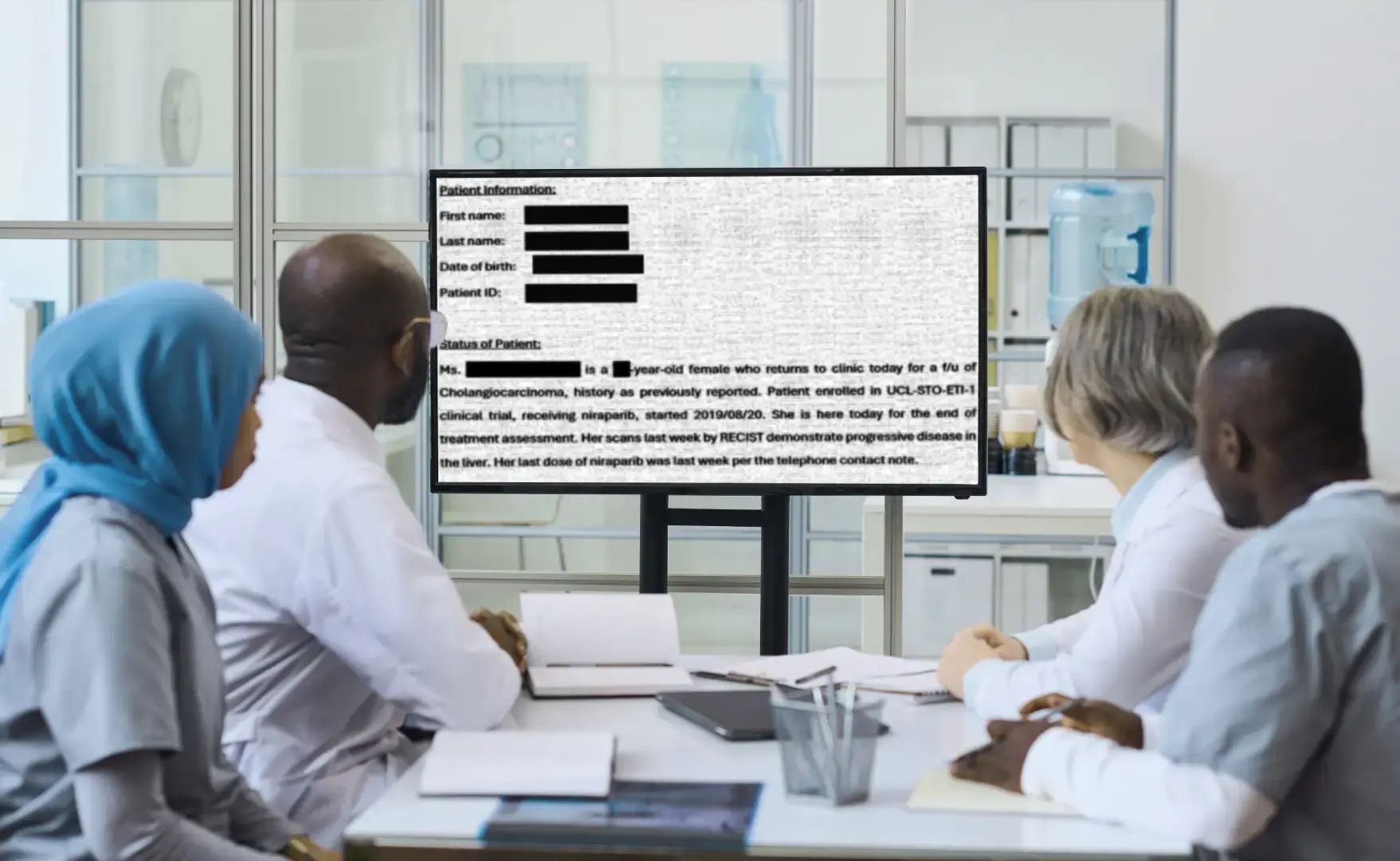
A healthcare training team records a 30-minute walkthrough of an EHR or claims system for new hires. Patient names, MRNs, and claim numbers appear on every screen. The recording goes into the LMS, where it gets reused for onboarding for the next eighteen months. Every viewer is a HIPAA disclosure if the video was never redacted.
That problem is everywhere in healthcare L&D, and it's the one that gets the least attention in compliance conversations. HIPAA discussion tends to focus on telehealth sessions, surgical recordings, and surveillance footage. The deeper guidance for that side of healthcare video is covered in video redaction for healthcare. Internal training, meanwhile, is treated like an afterthought, even though training videos sit in the LMS for over a year and get watched by everyone the company hires.
This post covers where PHI hides in healthcare training videos, why training-program cadence breaks manual redaction workflows, and what an L&D-fit redaction process looks like.
Where PHI appears in healthcare training videos
Healthcare L&D produces a lot of recordings that contain PHI, on screen, in audio, or both:
- EHR onboarding walkthroughs in Epic, Cerner, Meditech, or Athena. Patient names and MRNs sit in the record header on every screen.
- RCM and billing system training. Claim numbers, payer IDs, and patient demographics are everywhere in claims walkthroughs.
- Patient portal and telehealth platform training. Sample accounts often contain real data ported over from production for "realistic" training.
- Compliance training built around real case examples that retain identifiers.
- Cross-departmental handoff training between clinical, billing, and intake teams.
- Specialty system training for lab orders, radiology reads, and pharmacy fills.
One thing trainers regularly miss: the narration is a PHI surface too. A trainer saying "let's pull up John Smith's account" is a disclosure, even if the screen is clean. Spoken PHI shows up across phone consultations and recorded calls in the same way, which is why audio redaction is usually part of the same workflow.
Why training videos are a hidden HIPAA risk for healthcare teams
A clinical recording usually has a short, contained life. Training doesn't.
Reuse multiplies the exposure. A 30-minute training video produced this quarter will get watched by every new hire for the next twelve to eighteen months. The audience compounds and every viewer is a separate disclosure event.
Distribution also runs wider than people assume. Training reaches new hires, offshore teams, contractors, and partner organizations. The original "internal use" framing stops applying once the video is in the LMS. Under the HHS guidance on the minimum necessary standard, covered entities are required to limit PHI exposure to what's actually needed for the purpose. Reused training content rarely meets that bar without de-identification.
Sample data is where most teams get caught. Dev and test environments routinely get seeded with copies of production data because "realistic" training requires realistic-looking records. The trainer thinks they're using sample patients. They aren't. The patient is real. The MRN is real. The address is real.
And the LMS itself usually isn't built for PHI. Most enterprise video platforms have access controls, but few have the audit trails, retention policies, or BAA coverage that HIPAA expects for PHI-bearing content. Redaction for hospital systems covers the broader access-control problem in more detail.
Why manual redaction fails at healthcare training volume
Manually redacting a 30-minute training video with the PHI density you get in healthcare takes four to eight hours in a video editor. That works for a one-off recording. It does not work when L&D is producing three to five training videos a week.
At four hours per video, that's a full FTE doing nothing but drawing redaction boxes. Add audio redaction in a separate tool and the labor doubles.
The same identifiers also recur across the series. Same sample patient, same EHR fields, same trainer narrating in the same pattern. Manual redaction redoes that work every time, with no rule library and no carryover between videos. The general approach to OCR-based detection in screen captures is covered in confidential text redaction in screen recordings.
Then the underlying system gets a UI refresh and every prior training video in the catalog needs to be re-recorded and re-redacted. A manual workflow turns a routine system upgrade into a quarter-long redaction backlog.
How to build a PHI redaction workflow for healthcare training
A workflow that fits L&D operational reality looks different from generic redaction:
- Standardize the recording inputs. One screen-recording tool, one file format. Automation downstream depends on it.
- Batch upload aligned to your training-release cadence. Redaction is a weekly job, not a per-video task.
- Apply consistent detection rules across the series. The same sample patient, MRN format, and payer ID keep showing up. Codify them once and reuse them.
- Combine on-screen and spoken PHI detection in a single pass. The trainer's narration usually references the same identifiers visible on screen.
- Reserve human review for ambiguous cases. Automate the obvious detections and use manual review for edge cases like common names that are also real patient names.
- Version-control the outputs. Source recordings stay under restricted access. Only the redacted master goes to distribution.
- Push directly to the distribution platform. Whether that's an LMS, VIDIZMO EnterpriseTube, or SharePoint, the redacted file should flow without a manual handoff.
- Keep the audit log. The HHS guidance on the HIPAA Security Rule covers the access and audit expectations that apply here. Compliance reviews will ask what was redacted, by whom, and when. The redaction step needs to produce a defensible record.
For how the underlying detection works across video, audio, and on-screen text, see how healthcare redaction software works. For a generic training-video version of the workflow above (less healthcare-specific), see how to redact PII from corporate training videos.
How VIDIZMO Redactor fits the L&D workflow
VIDIZMO Redactor processes on-screen text via OCR, faces, and spoken PHI in a single pass. Deployment is available as SaaS, private cloud, or on-premise, which matters when healthcare IT and security teams review the procurement. Bulk processing handles training-program volume, detection rules can be configured for MRN and payer-specific claim ID formats, and every redaction step is logged for compliance review.
To see how this fits a specific training program, see healthcare data redaction software or book a meeting.
Redact PHI from your training videos in minutes, not hours staying compliant. Contact us or start a free trial.

FAQ
Frequently Asked Questions
Does HIPAA apply to internal training videos that contain PHI?
Yes. Internal training is a use of PHI under HIPAA, and the minimum necessary standard applies. Recordings used for staff training without de-identification require the same safeguards as any other PHI use.
Can AI redact PHI from screen recordings of EHR or claims systems?
Yes. Redaction software uses OCR to detect PHI in on-screen text across video frames and applies redaction to the detected text areas across frames. This works for EHRs, claims systems, billing platforms, and patient portals.
How long does it take to redact PHI from a training video?
Manual redaction in a video editor takes four to eight hours per 30-minute training video. Automated redaction reduces that to minutes per video, plus a short human review for ambiguous detections.
Can I redact PHI from videos recorded in screen-capture tools like Camtasia?
Yes. Recordings exported from any standard screen-capture tool can be processed by dedicated redaction software. The original tool handles the recording. A redaction platform handles the privacy step before distribution.
What types of PHI typically appear in healthcare training recordings?
Patient names, medical record numbers, dates of birth, addresses, claim numbers, insurance IDs, and dates of service. Spoken patient references in the trainer's narration are common too, and sample data in dev or test environments often contains real PHI ported over from production.
TopicsRedactionHealthcarePHI RedactionHIPAA ComplianceVideo Redaction

About the author
Ali Rind is a Product Marketing Executive at VIDIZMO, where he focuses on digital evidence management, AI redaction, and enterprise video technology. He closely follows how law enforcement agencies, public safety organizations, and government bodies manage and act on video evidence, translating those insights into clear, practical content. Ali writes across Digital Evidence Management System, Redactor, and Intelligence Hub products, covering everything from compliance challenges to real-world deployment across federal, state, and commercial markets.
You may also like
Video Redaction Best Practices: Motion, Frame Rates, Tracking and Failing Safe
I led our video redaction project for a county public safety agency where two people handled every disclosure, and ...
Redacting Dash Cam, Body Cam and Drone Footage From a Moving Camera
A fleet claims manager preparing crash footage for an insurer and defense counsel is doing a different job from a ...

Why Frame-Rate Headers Lie: Redacting Variable Frame Rate Video
A video file keeps time frame by frame, and the frames-per-second figure a player displays is a summary of that timing, ...