
Video Redaction
by Zain Noor, Last updated: March 18, 2026, ref:
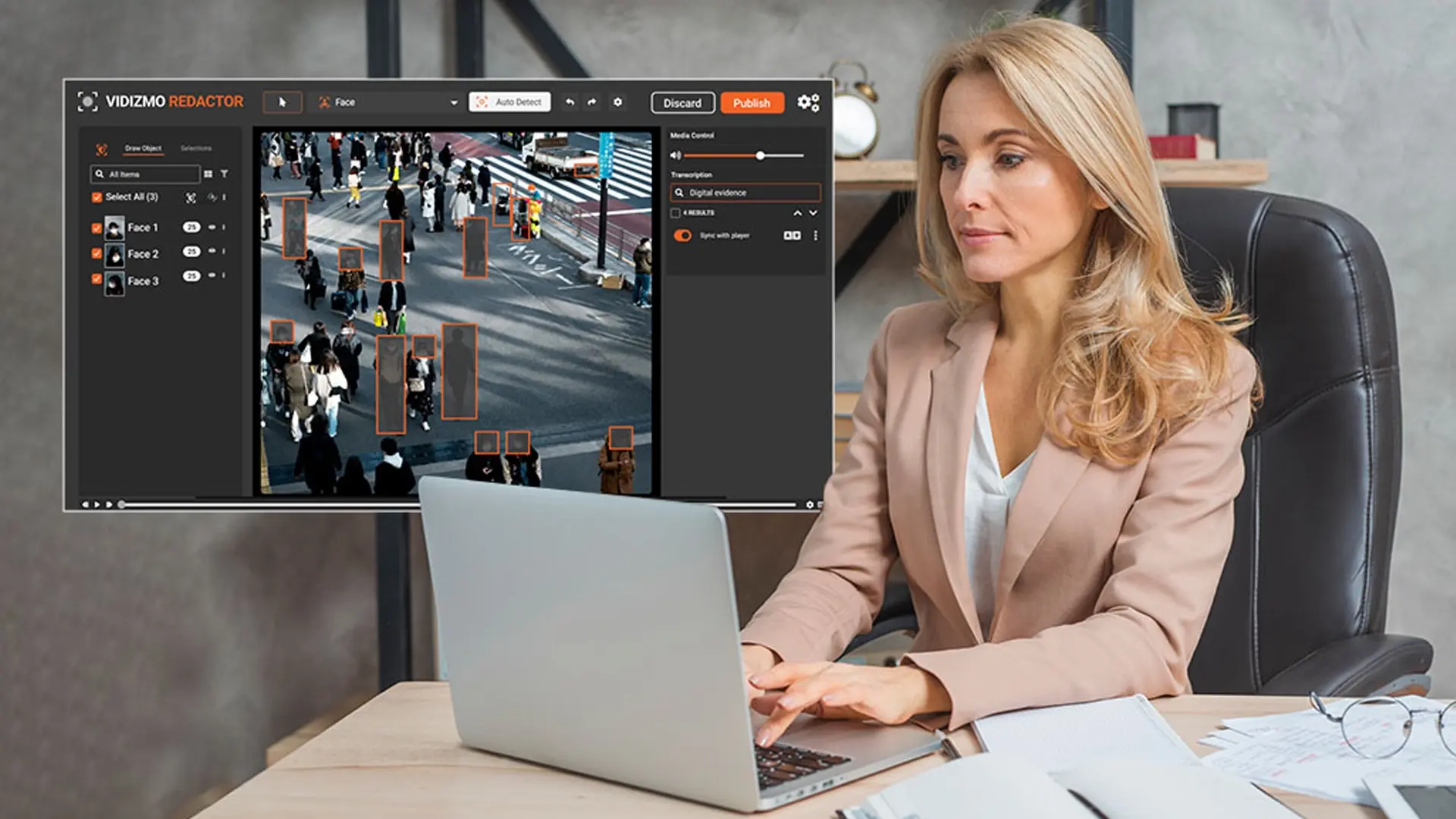
Video redaction is the process of permanently obscuring or removing personally identifiable information (PII) from video footage. Faces, license plates, screens, documents, and other identifying elements are blurred, pixelated, or masked so the resulting file can be shared, published, or released without exposing protected individuals. Organizations across law enforcement, government, healthcare, education, and transportation rely on video redaction to meet privacy regulations like FOIA, HIPAA, GDPR, and FERPA.
The demand for redaction has grown fast. A 2023 study by the Bureau of Justice Statistics found that 80% of large US police departments now use body-worn cameras, generating hundreds of thousands of hours of footage annually. Every public records request involving that footage requires careful redaction before release. Manual approaches can't keep up.
This guide covers how video redaction works, what features to look for in Redaction Tools, the most common use cases (including CCTV and body camera footage), and how to evaluate a platform for your organization's compliance needs.
Key Takeaways
- Video redaction uses AI object detection to blur faces, license plates, and other PII in footage automatically, cutting processing time from hours to minutes per file.
- CCTV and body camera footage are the two highest-volume redaction use cases, driven by FOIA requests and privacy regulations.
- Effective redaction tools must support audit trails, bulk processing, and configurable confidence thresholds to balance speed with accuracy.
- Organizations handling 100+ redaction requests per month should prioritize batch automation and multi-format support over manual frame-by-frame tools.
What Is Video Redaction and Why Does It Matter?
Video redaction is the selective, permanent removal or obscuring of sensitive visual and audio information from recorded footage. Unlike simple video editing (which changes content for creative purposes), redaction is a compliance-driven process designed to protect the privacy of individuals who appear in recordings.
The types of information typically redacted include:
- Faces of bystanders, witnesses, minors, or uninvolved individuals
- License plates on vehicles captured by dashcams or surveillance cameras
- Screens and documents visible in the background showing PII
- Spoken PII in audio tracks, such as names, Social Security numbers, or addresses
- Logos, tattoos, and uniforms that could identify a person or organization
The stakes are real. In 2021, the city of Minneapolis faced legal challenges after releasing unredacted body camera footage that exposed the identities of witnesses in a high-profile case. Proper video redaction would have prevented that exposure entirely.
How Does AI-Powered Video Redaction Work?
AI-powered video redaction uses computer vision models to detect and track objects frame by frame across an entire recording. The system identifies target objects (faces, plates, people), assigns a tracking ID to each one, and applies an obscuring effect (blur, pixelation, or black box) that follows the object as it moves through the scene.
The typical workflow has four stages:
- Ingestion: The video file is uploaded or pulled from a connected storage system. Modern tools accept common formats (MP4, AVI, MOV) as well as proprietary formats from surveillance hardware.
- Detection: AI models scan each frame to identify PII elements. Detection categories typically include faces, full persons, heads, license plates, vehicles, and screens.
- Review: An operator reviews the AI's detections, adjusts false positives or missed items, and confirms redaction selections. Some workflows skip this step entirely for high-volume batch processing.
- Export: The system generates a redacted copy while preserving the original unredacted file. An audit trail logs every action taken during the process.
The accuracy of detection depends on several factors: video resolution, lighting conditions, object size relative to the frame, and the confidence threshold set by the operator. Most professional tools let administrators configure thresholds (often between 25% and 90%), balancing recall (catching every face) against precision (avoiding false positives).
What Are the Most Common Video Redaction Use Cases?
Video redaction applies across dozens of industries, but three use cases account for the majority of volume.
Body-Worn Camera (BWC) Footage
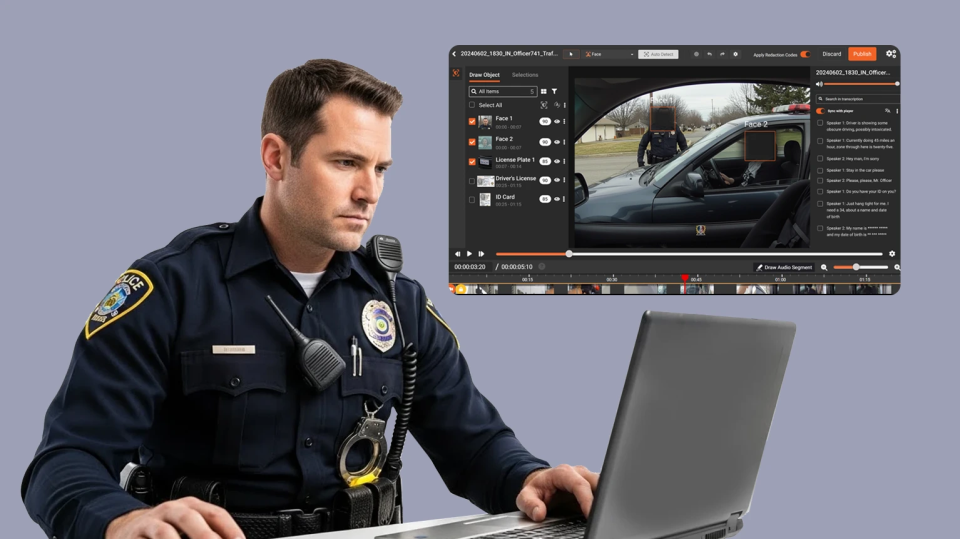
Law enforcement agencies are the largest consumers of video redaction. According to the Bureau of Justice Assistance, over 60% of US law enforcement agencies have adopted body-worn cameras. Every FOIA or public records request for BWC footage requires redaction of bystander faces, minors, victims, and sensitive location details before release.
Agencies face statutory response windows, often 10 to 30 days. A single hour of BWC footage can take 4 to 8 analyst hours to redact manually. That math doesn't work when an agency receives dozens of requests per month.
CCTV and Surveillance Video
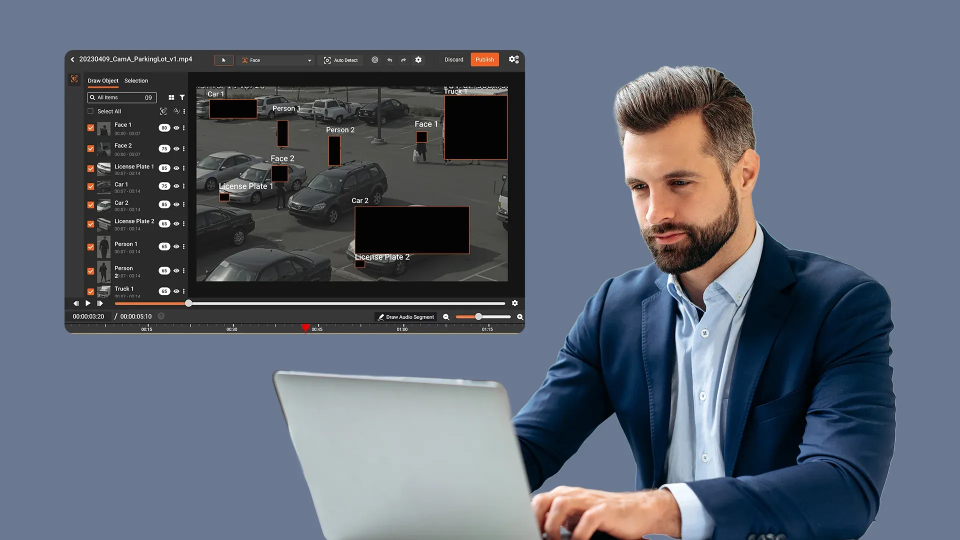
Transportation authorities, retailers, municipalities, and private enterprises all operate CCTV networks. When footage is needed for investigations, insurance claims, legal proceedings, or public disclosure, the privacy of uninvolved individuals must be protected. The EU's General Data Protection Regulation (GDPR) and similar laws in the US (like CCPA) impose strict requirements on how organizations handle CCTV footage containing identifiable faces.
Healthcare and Clinical Recordings
Telehealth sessions, surgical recordings, clinical trial videos, and medical imaging all contain protected health information (PHI). HIPAA requires that any shared or published medical footage be scrubbed of patient identifiers. That includes not just faces but also visible medical record numbers, dates of birth on screens, and spoken patient names in audio tracks.
What Features Should a Video Redaction Tool Include?
Not every redaction tool is built for production-scale work. When evaluating options, focus on these categories:
AI Detection Coverage
At minimum, the tool should detect faces and license plates automatically. Better tools also detect full persons, heads, vehicles (by type), screens, weapons, and custom objects. Activity recognition (for example, shoplifting or trespassing detection) is an emerging capability gaining traction in retail and transportation environments.
Audio Redaction
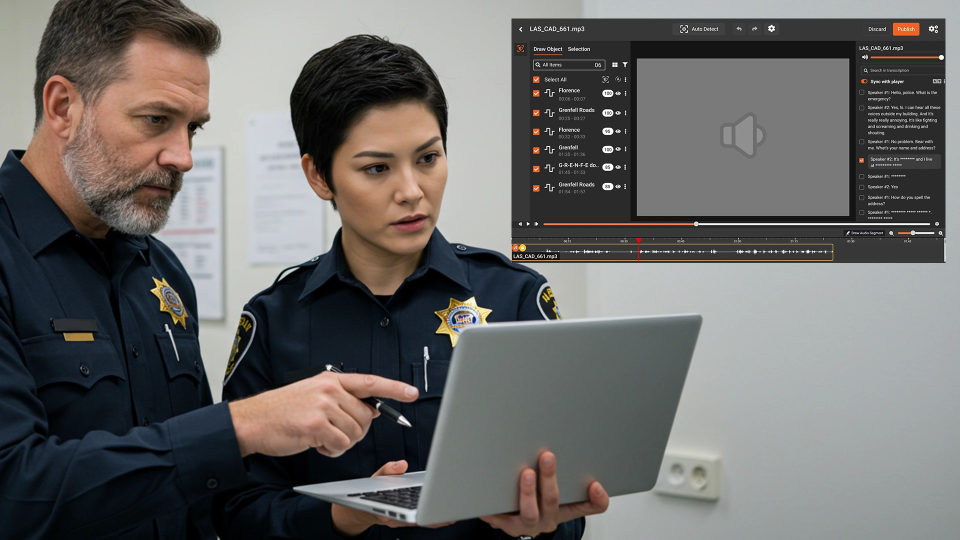
Video files contain audio tracks, and spoken PII is just as sensitive as visual PII. Look for tools that automatically detect and mute or bleep spoken names, Social Security numbers, credit card numbers, addresses, and other identifiers. Speaker diarization (identifying who said what) helps when only certain speakers need redaction.
Multi-Format Support
Surveillance systems output in proprietary formats. A tool that only handles MP4 and AVI will force you to re-encode footage from CCTV hardware before you can even begin redacting. The strongest tools support proprietary CCTV formats natively, auto-rewrapping files like H.264 streams into playable containers without quality loss.
Bulk and Batch Processing
If your organization handles more than a handful of requests per week, file-by-file processing won't scale. Look for queue-based batch processing, configurable auto-redaction policies, and the ability to run overnight unattended jobs.
Audit Trail and Compliance
Every redaction decision needs documentation. Who requested it, who performed it, what was redacted, and when. FOIA exemption codes (Exemptions 1 through 9) should be mappable to specific redaction actions for legal defensibility. The tool should generate a redacted copy while preserving the original, maintaining chain of custody throughout.
Deployment Flexibility
Government agencies often require on-premises or government cloud deployments for data sovereignty. Commercial organizations may prefer SaaS for speed and lower infrastructure overhead. The right tool offers options: SaaS, government cloud, on-premises, or hybrid configurations.
How Do Manual and Automated Video Redaction Compare?
Manual redaction means an analyst watches footage frame by frame, drawing redaction boxes around each sensitive element by hand. It's accurate when done carefully, but it doesn't scale.
| Factor | Manual Redaction | AI-Automated Redaction |
|---|---|---|
| Processing time (1 hour of footage) | 4 to 8 analyst hours | 15 to 45 minutes |
| Consistency | Varies by analyst fatigue and skill | Consistent across all files |
| Scalability | Linear (more footage = more staff) | Parallelized batch processing |
| Cost per file | High (labor-intensive) | Lower per-unit cost at volume |
| Accuracy risk | Missed items due to fatigue | Configurable confidence thresholds |
| Audit trail | Often informal or missing | Automated logging of every action |
Most organizations that process more than 50 redaction requests per month find that manual-only workflows create unsustainable backlogs. A semi-automated approach, where AI handles detection and a human reviews the results, offers the strongest balance of speed and accuracy for high-stakes compliance work.
Which Privacy Regulations Require Video Redaction?
Several regulations either directly mandate or strongly imply the need for video redaction before sharing footage:
- FOIA (Freedom of Information Act): Federal agencies must release requested records, but nine exemptions protect personal privacy and law enforcement information. Video released under FOIA must have exempt content redacted.
- GDPR: Any CCTV footage capturing EU residents requires that uninvolved individuals be anonymized before sharing or publishing.
- HIPAA: Healthcare recordings containing PHI must be de-identified before use in research, training, or public release.
- FERPA: Educational institutions must redact student PII from security camera footage and recorded classroom sessions before release.
- CJIS Security Policy: Criminal justice agencies must protect criminal justice information, including PII visible in evidence recordings.
- CCPA/CPRA: California consumers can request deletion or restriction of personal data, which extends to video recordings containing their likeness.
Non-compliance carries real consequences. GDPR fines can reach 4% of annual global revenue. HIPAA violations range from $100 to $50,000 per incident. Even without direct fines, accidental PII exposure in released footage creates litigation risk and erodes public trust.
How VIDIZMO Redactor Handles Video Redaction at Scale
VIDIZMO Redactor is built for organizations that process redaction requests in volume, not one file at a time. The platform covers video, audio, images, documents, and PDFs across 255+ formats in a single tool, eliminating the need for separate software per media type.
For video, Redactor's AI detects and tracks faces, full persons, license plates, vehicles (by type), screens, weapons, and custom objects. Confidence thresholds are configurable between 25% and 90%, so agencies can tune the balance between catching every detection and minimizing false positives. Audio tracks are processed at the same time: 33+ categories of spoken PII (names, SSNs, credit card numbers, addresses) can be automatically muted or bleeped across 82 supported languages.
Bulk processing is where the platform separates from desktop tools. Redactor has been tested with 1.1 million+ recordings, supports queue-based overnight automation, and offers fully automated redaction policies with custom PII patterns for zero-touch processing. Every action is logged in an audit trail with FOIA exemption code mapping for legal defensibility.
Deployment options include SaaS, dedicated government cloud, on-premises, and hybrid configurations, meeting requirements for agencies with strict data residency rules or air-gapped environments.
How to Evaluate Video Redaction Solutions
Use this checklist when comparing tools for your organization:
- Run a pilot with your actual footage. Surveillance cameras, body cams, and CCTV hardware all produce different file types and quality levels. Test with real samples, not demo reels.
- Measure processing time per hour of footage. Ask vendors for benchmarks on files matching your typical resolution and length.
- Verify format support. If you use proprietary CCTV systems, confirm the tool handles those formats natively without pre-conversion.
- Test audio redaction separately. Spoken PII detection is a different AI model than visual detection. Not all video Redaction Software includes audio capabilities.
- Check the audit trail. Can you map specific exemption codes to individual redaction decisions? Can you prove who approved each redaction?
- Ask about deployment options. If your data can't leave your network, cloud-only tools won't qualify.
- Calculate total cost of ownership. Factor in labor savings from automation, not just the software license cost. A tool that costs more upfront but cuts analyst hours by 80% may be far cheaper over 12 months.
Frequently Asked Questions
What is video redaction?
Video redaction is the process of permanently obscuring sensitive visual and audio information in recorded footage, such as faces, license plates, and spoken PII. It protects the privacy of individuals before footage is shared, released under public records laws, or used in legal proceedings. Organizations in law enforcement, government, healthcare, and education use video redaction to comply with regulations like FOIA, HIPAA, and GDPR.
How long does it take to redact one hour of video?
Manual frame-by-frame redaction typically takes 4 to 8 analyst hours per hour of footage. AI-powered tools reduce that to 15 to 45 minutes depending on the number of objects being tracked and the video's resolution. Batch automation can process multiple files at once, further reducing per-file turnaround for high-volume operations.
Can video redaction software also redact audio?
Yes, many modern redaction platforms include audio PII detection alongside visual redaction. The strongest tools detect 30+ categories of spoken personally identifiable information, including names, Social Security numbers, credit card numbers, and addresses. VIDIZMO Redactor, for example, supports 33+ spoken PII categories across 82 languages, with automatic muting or bleeping of detected items.
How does video redaction compare to video editing?
Video editing modifies content for creative or communication purposes. Video redaction specifically targets PII removal for legal compliance. Redaction tools include features that standard editors lack: AI object detection and tracking, audit trails documenting every decision, exemption code mapping, and original file preservation with chain of custody. Standard video editors like Premiere Pro or DaVinci Resolve aren't designed for compliance workflows and lack the automation needed for high-volume redaction.
What file formats can video redaction tools handle?
Basic tools handle common formats like MP4, AVI, and MOV. Enterprise-grade platforms support proprietary CCTV and surveillance formats from manufacturers like Axon, Motorola, and Hikvision. VIDIZMO Redactor supports 255+ file formats, including automatic rewrapping of proprietary H.264 streams into standard containers without re-encoding or quality loss.
Is video redaction legally required?
It depends on the context and jurisdiction. FOIA and state open records laws require federal and state agencies to redact exempt information (including personal privacy data) before releasing records. GDPR requires anonymization of identifiable individuals in CCTV footage shared or published in the EU. HIPAA mandates de-identification of patient data in any shared healthcare recordings. While the specific requirements vary by regulation, the practical result is the same: organizations handling video containing PII need a redaction workflow.
What is the difference between redaction and anonymization?
Redaction is the selective removal or obscuring of specific sensitive elements from a file. Anonymization removes all identifying information so that the data subject can never be re-identified. In video, redaction typically means blurring specific faces or plates while keeping the rest of the footage intact. Full anonymization would require removing every possible identifier, which is rarely practical for video evidence. Most compliance frameworks (FOIA, CJIS, HIPAA) require targeted redaction rather than full anonymization.
Protect Privacy at Scale with the Right Video Redaction Workflow
Video redaction isn't optional for organizations that handle surveillance footage, body camera recordings, or any video containing identifiable individuals. Footage volumes are growing. Redaction regulations are tightening. And manual processes simply can't keep pace.
AI-powered redaction tools transform what used to be days of analyst work into minutes of automated processing, with better consistency and full audit documentation. The key is choosing a platform that matches your format requirements, volume needs, and deployment constraints.
Start your free Redactor trial to see how AI-powered video redaction handles your actual footage, formats, and compliance requirements.
Jump to
You May Also Like
These Related Stories
How to Choose the Right Body-Worn Camera Redaction Solution
How Long Does Video Redaction Actually Take? Manual vs. AI Benchmarks

No Comments Yet
Let us know what you think