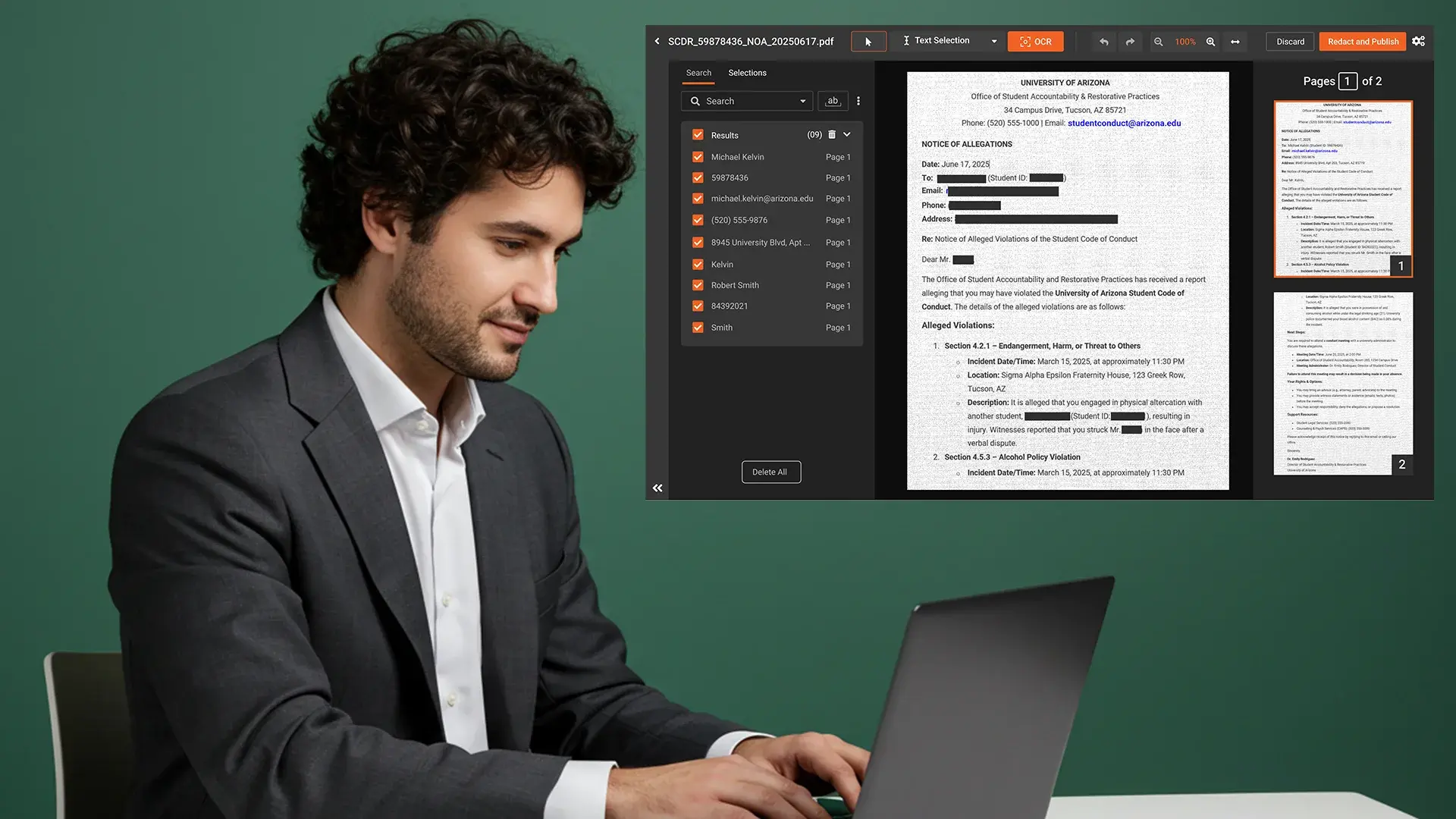
Loan and mortgage files are some of the most sensitive financial documents an organization handles. They often include borrower identities, income details, bank information, property records, and underwriting notes. When these files are shared with auditors, appraisal partners, third-party processors, legal teams, or internal departments, improper handling can create compliance risk and expose borrowers to fraud.
This guide explains how to securely redact loan and mortgage documents, including the best methods to use, what information should be hidden, what can remain visible, and how to scale redaction for high-volume lending and servicing workflows.
What Are Redacted Loan and Mortgage Documents?
Redacted loan and mortgage documents are versions of the original files where sensitive information is permanently removed before sharing.
Redaction is used to protect borrower data while still allowing third parties to review the necessary information for underwriting validation, servicing, quality control, disputes, audits, and compliance checks.
Loan and mortgage documents are often shared for:
- Underwriting and pre-approval review
- Loan servicing and payment disputes
- Quality control and secondary market checks
- Vendor reviews, such as appraisal, title, and inspection
- Legal requests and compliance audits
- Internal analytics and process improvement
Ways to Redact Loan and Mortgage Documents
There are multiple ways to redact loan and mortgage documents, but not every method provides the same security, consistency, or scalability. The right approach depends on document volume, whether files are scanned, and your audit requirements.
Manual Redaction
Manual redaction involves reviewing documents line by line and removing sensitive information using basic tools.
This method typically includes:
- Printing and physically blacking out sensitive fields
- Using basic editing tools to cover text in images
- Manually reviewing each page before sharing
Limitations of manual redaction:
- High risk of missing sensitive fields in long loan packages
- Time-consuming for multi-document files, such as closing packets
- Inconsistent across teams and reviewers
- Difficult to prove compliance during audits
Manual redaction may work for one-off requests, but it does not align with financial document redaction best practices for regulated workflows.
Redacting Loan and Mortgage Documents Using PDF Editors
Some teams use PDF editors that include a redact feature.
This method usually involves:
- Manually selecting text and applying redaction marks
- Searching for common terms like SSN or account number
- Saving a redacted copy for sharing
Limitations of PDF editor redaction:
- Often unreliable for scanned or image-based documents
- Still heavily manual for large packages
- Inconsistent results across varying document layouts
- Higher risk if redaction is applied incorrectly or incompletely
PDF editors can work for simple text-based files, but do not scale well for lending operations.
Using Dedicated Redaction Software
Dedicated redaction software is designed to securely detect and permanently remove sensitive information across large and complex document sets.
These tools typically offer:
- Automated detection of personal and financial data
- Pattern-based recognition for identifiers such as SSN, account numbers, and routing formats
- OCR-powered redaction for scanned loan and mortgage documents
- Bulk redaction workflows for high-volume processing
- Policy-driven consistency across teams and document types
- Review workflows and audit readiness
Dedicated tools align best with redacting financial documents securely and are recommended for mortgage lenders and servicing teams.
You Can Start Your Free Trial Today - NO Credit Card Needed

Why Redacting Loan and Mortgage Documents Matters
Loan packages contain multiple high-risk data types
Mortgage and loan files can include:
- Borrower identity and contact details
- Social security or national identifiers
- Bank statements, pay stubs, and tax records
- Credit and employment verification
- Property address, appraisal, and title information
- Signatures and closing disclosures
- Internal underwriting notes
Because these files combine many categories of sensitive data, one missed field can create significant exposure.
Compliance expectations require data minimization
Loan and mortgage teams frequently share documents with third parties. Compliance teams typically require that only necessary information be shared and that sensitive data be removed before distribution.
This is why consistent financial document redaction best practices are essential in mortgage workflows.
Scanned documents and mixed file formats add complexity
Mortgage files often contain scanned forms, faxed documents, and image-based pages. If redaction is not OCR-aware, sensitive data can remain embedded in the file.
What Information Should Be Redacted in Loan and Mortgage Documents?
The goal is to remove sensitive data while preserving the information needed for review.
Information that should always be redacted
- Social security numbers and government ID numbers
- Full bank account numbers and routing numbers
- Debit or credit card numbers, if present
- Borrower phone numbers, emails, and full home addresses when not needed
- Signatures and initials where they are not required for verification
- Internal account identifiers, case IDs, and servicing references
- Authentication data such as passwords, PINs, or security answers
Information that can usually remain visible
- Lender name and document headers
- Loan type and general product category
- Statement periods and date ranges
- Transaction dates and amounts, when needed for verification
- Property city and state when a full address is not required
- Partial identifiers, such as the last two to four digits where permitted by policy
Aligning these rules with a broader policy helps maintain consistency across all financial documents.
Redacting Scanned Loan and Mortgage Documents
Scanned documents are common in mortgage operations. In these files, sensitive information exists inside images rather than selectable text.
OCR-based redaction helps by enabling teams to:
- Extract text from scanned PDFs and image pages
- Identify sensitive borrowers and financial fields
- Apply permanent redaction accurately across the full file
This approach is part of a broader financial document redaction guide strategy for regulated environments.
Redaction vs Editing in Mortgage Workflows
Mortgage teams sometimes mask data using highlight boxes or visual overlays. This can create a false sense of security.
Editing or blacking out text may:
- Leave the underlying content accessible through copy and paste
- Allow hidden text to be revealed if layers are removed
- Preserve sensitive data in metadata or embedded objects
True redaction permanently removes the sensitive information and reduces compliance risk.
How to Redact Loan and Mortgage Documents at Scale
Define standardized redaction policies
To reduce risk and rework, define document-specific rules for:
- Loan applications and borrower forms
- Closing disclosures and settlement statements
- Pay stubs, tax docs, and bank statements inside the file
- Appraisals and title documents
- Servicing correspondence and dispute records
This supports consistent handling across all financial documents.
Use automated detection and patterns
Effective mortgage redaction needs:
- Automated PII detection for borrower information
- Pattern-based detection for identifiers such as SSN, account numbers, routing formats, and internal IDs
- OCR for scanned pages and image-based content
Automation reduces manual effort and helps prevent missed sensitive fields.
Support bulk processing for loan packages
Mortgage files are rarely one document. They are often packaged with many attachments and repeated identifiers.
Bulk and package level redaction should enable teams to:
- Process entire files consistently
- Apply the same policy across a portfolio or pipeline
- Meet strict underwriting and QC deadlines
Add review and audit readiness
Strong redaction programs include:
- Reviewer checks for exceptions
- Consistent policy enforcement
- Traceability for compliance teams
How VIDIZMO Redactor Helps Redact Loan and Mortgage Documents Securely
VIDIZMO Redactor is designed for regulated environments where lenders and servicers must protect borrower information while keeping documents usable for third-party review and audits.
VIDIZMO Redactor helps by enabling:
- Automated detection of sensitive borrower and financial information to reduce missed fields
- OCR based redaction for scanned loan and mortgage documents commonly found in legacy workflows
- Pattern based redaction for SSN, bank account numbers, routing formats, and custom identifiers
- Bulk redaction workflows to process high-volume loan packages consistently
- Permanent redaction that removes underlying data rather than masking it visually
- Policy-driven workflows that standardize how teams redact across underwriting, servicing, QC, and compliance
- Audit-ready processes that support internal reviews and regulatory requests
Loan and mortgage documents are part of a larger ecosystem covered in our guide to redaction software for financial services, where teams can apply consistent redaction standards across all financial record types.
Want to see how automated redaction can reduce risk and speed up mortgage workflows?
Start a free trial of VIDIZMO Redactor and test OCR-based, policy-driven redaction on your loan and mortgage documents.
Final Thoughts
Loan and mortgage files contain a broad mix of borrower identities, financial records, and property details. Redaction helps lenders and servicers share what is necessary while reducing exposure and compliance risk.
Secure mortgage redaction requires:
- Clear policies
- OCR support for scanned documents
- Automated detection and pattern matching
- Bulk processing for packages and pipelines
- Audit readiness
For a complete framework that covers all financial record types, see our guide to redaction software for financial services.
FAQ
Frequently Asked Questions
How do I redact loan and mortgage documents securely for compliance?
Use a dedicated redaction tool that permanently removes sensitive information, supports OCR for scanned documents, and applies consistent rules across the full loan package.
What information should be redacted in a mortgage file?
Typically, redact SSN, government IDs, full account and routing numbers, signatures where not required, borrower contact details when not needed, and internal case identifiers.
Can scanned mortgage documents be redacted accurately?
Yes, scanned mortgage documents can be redacted accurately using OCR-based redaction that detects sensitive data embedded in images and permanently removes it.
Is using a PDF editor enough for mortgage document redaction?
PDF editors can work for simple text-based files, but they are often ineffective for scanned documents and do not scale well for high-volume underwriting and servicing workflows.
How can VIDIZMO Redactor help redact loan and mortgage documents at scale?
VIDIZMO Redactor supports bulk redaction, OCR for scanned documents, and policy-driven workflows that help regulated teams redact consistently across large loan volumes.
TopicsRedaction
About the author
Zain Noor is a Product Marketing Executive at VIDIZMO with expertise in AI redaction technology. He focuses on how public safety agencies, government bodies, and commercial organizations adopt and operationalize video intelligence at scale.
You may also like

Video Redaction Best Practices: Motion, Frame Rates, Tracking and Failing Safe
I led our video redaction project for a county public safety agency where two people handled every disclosure, and ...

Redacting Dash Cam, Body Cam and Drone Footage From a Moving Camera
A fleet claims manager preparing crash footage for an insurer and defense counsel is doing a different job from a ...

Why Frame-Rate Headers Lie: Redacting Variable Frame Rate Video
A video file keeps time frame by frame, and the frames-per-second figure a player displays is a summary of that timing, ...