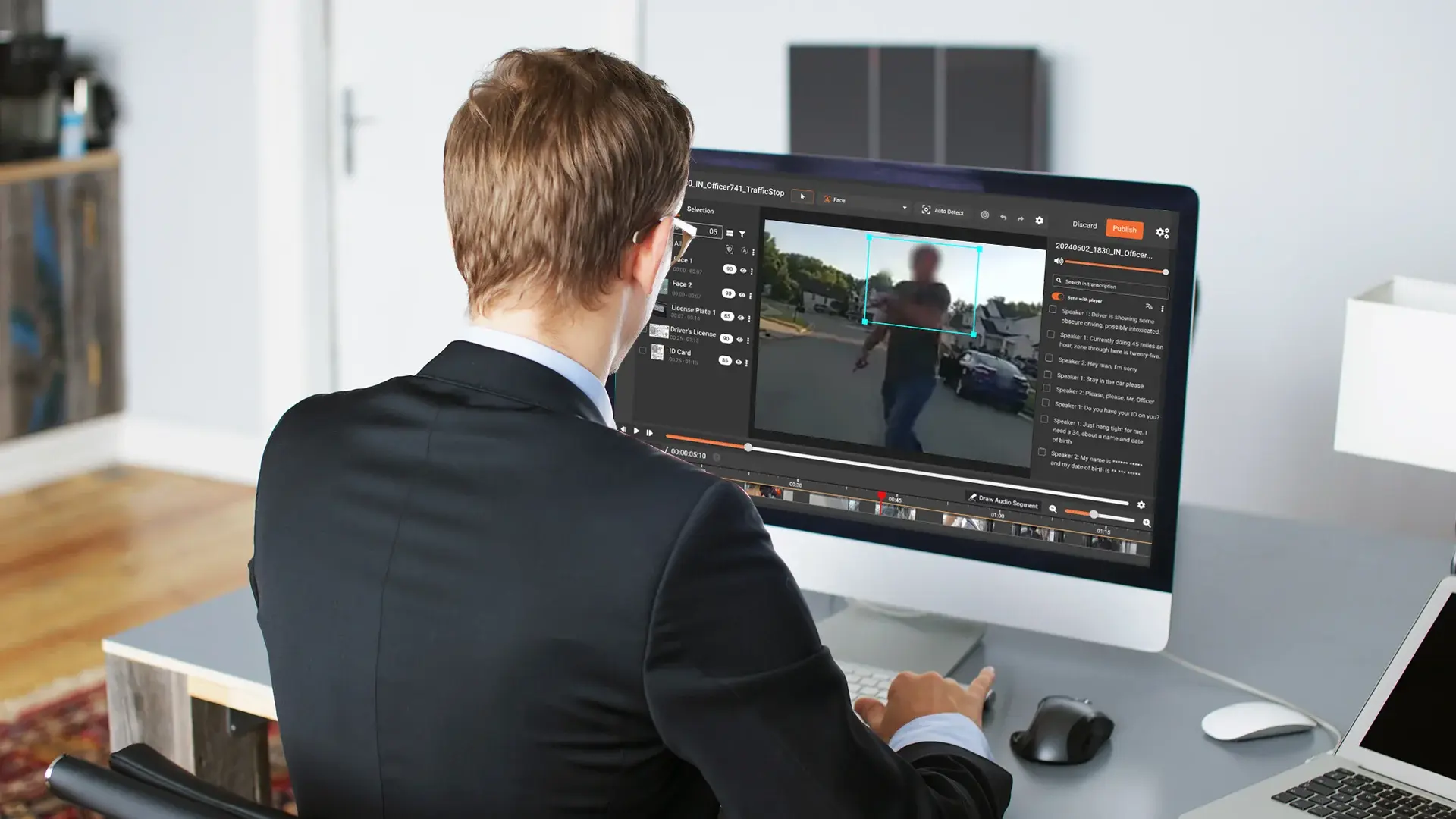
A records officer at a small police department receives a FOIA request for body camera footage. The clip is 47 minutes long. A juvenile was present for 20 of those minutes, moving through the frame continuously as the officer walked, turned, and responded to the scene. The department's redaction tool detects the face at the start. After that, it's manual.
The officer spends the next four hours scrubbing through the footage, repositioning the redaction box every few seconds as the subject moves. By frame 400, they're still in the first ten minutes of the clip.
This is not an edge case. It is the daily reality for any department using basic body camera redaction software that does not include auto-tracking.
This guide explains what auto-tracking is, why body camera footage specifically requires it, and what to look for when evaluating body camera redaction software. For a broader overview of the challenges agencies face when releasing footage under open records laws, see our guide on how to redact body cam footage for FOIA requests.
Why Body Camera Footage Is Uniquely Hard to Redact
Not all video is equally difficult to redact. Surveillance footage from a fixed camera in a parking lot presents a manageable problem: the camera does not move, subjects pass through a defined zone, and redaction targets follow predictable paths.
Body cameras are different in almost every way that matters for redaction.
Continuous camera movement. The officer is walking, turning, and responding to a dynamic scene. The camera angle shifts constantly. A subject who is centered in the frame one second may be at the edge or out of frame entirely the next.
Unpredictable subject movement. Subjects in body camera footage are rarely stationary. They walk, turn away, crouch, stand, move behind other people, and re-enter the frame from a different direction. Each of these movements requires the redaction region to move with them.
Long recording duration. Patrol body cameras record full shifts or extended incidents. A single FOIA-responsive clip may be 30, 60, or 90 minutes long. At that length, manual redaction is not inconvenient. It is operationally prohibitive.
Multiple people in frame simultaneously. An incident may involve an officer, a juvenile, a witness, and bystanders. Some faces need redaction. Others do not. The tool must be able to distinguish between them, not just detect every face in the frame.
What Manual Redaction Actually Looks Like
To understand why auto-tracking matters, it helps to be specific about what happens without it.
Consider a juvenile present throughout a 30-minute body camera recording. The juvenile moves continuously as the officer approaches, the juvenile turns away, re-enters the frame, moves behind a vehicle, and reappears.
In a tool without auto-tracking, the workflow looks like this:
- The reviewer pauses the video and draws a redaction box over the juvenile's face.
- The video plays for two or three seconds. The subject moves. The box no longer covers the face.
- The reviewer pauses again, repositions the box, and resumes.
- Repeat for the duration of the footage.
For 30 minutes of footage with a continuously moving subject, a careful reviewer might reposition the box 200 to 400 times. At 30 seconds per adjustment (pause, reposition, verify, resume), that is 1.5 to 3 hours of work on a single clip.
And that estimate assumes the reviewer catches every frame where the face drifts outside the box. If they miss some, the redaction is incomplete. An uncovered frame in a publicly released video exposes the juvenile's identity and creates legal exposure for the department. To understand the full scope of what a compliant body-worn camera redaction workflow requires, see our guide on body-worn camera redaction.
What Auto-Tracking Does Differently
Auto-tracking in body camera redaction software solves this problem directly.
When a reviewer applies a redaction to a face, a screen, or any other object, the tracking system locks onto that target and follows it through subsequent frames automatically. The redaction region moves with the subject regardless of how the camera or the subject moves.
A well-implemented tracking system handles:
Camera shake and motion. When the officer runs or turns quickly, the footage shifts abruptly. The tracking algorithm compensates for camera motion to keep the redaction locked on the intended target rather than drifting with the frame.
Subject movement and rotation. When a subject turns sideways or moves to a different part of the frame, the tracker follows. It does not rely on the subject remaining in the same position or facing the same direction.
Partial occlusion. When a subject briefly moves behind another person or object and then reappears, a robust tracker picks them back up. The reviewer does not need to re-apply the redaction after each occlusion.
Scene transitions and re-entry. If a subject leaves the frame and returns, the tracker can re-acquire them when they reappear rather than requiring the reviewer to mark them again from scratch.
The practical outcome: what took four hours manually takes 15 minutes of review. The reviewer confirms the initial target, monitors for edge cases where tracking may have drifted, and adjusts where needed, rather than manually repositioning every few seconds for the full duration.
Where Auto-Tracking Matters Most in Law Enforcement Footage
Some redaction targets in law enforcement footage are especially dependent on auto-tracking.
Juvenile faces. Juvenile identity protection is a legal requirement, not a discretionary redaction. A juvenile who appears in 20 minutes of active body camera footage must have their face covered in every frame of a released video. Manual tracking at that scale is impractical. A missed frame is a compliance failure.
Graphic content and injury. Footage involving injury or graphic content may require continuous redaction over a large portion of the frame. When the camera is moving and the subject is moving, maintaining manual coverage is extraordinarily difficult.
License plates in moving traffic. A traffic stop often includes footage of adjacent vehicles, pedestrians, and passing cars with visible plates. Plates that need redaction are not stationary; they are on moving vehicles, at changing distances, at varying angles. Auto-tracking handles this. Manual redaction of moving plates is prone to missed frames.
In-car screens and documents. Officers frequently capture footage of computer-aided dispatch screens, licence information displays, or sensitive documents during an incident. These objects move with the vehicle and with the officer. A custom-drawn redaction region needs the same tracking capability as a face detection region. Our guide on document and screen redaction in video covers this challenge in more detail.
Witness and bystander privacy. Body camera footage regularly captures individuals who have no connection to the incident: neighbors, passersby, and uninvolved parties. Protecting their identities before public release is both a legal and ethical obligation. For a deeper look at this challenge, see our guide on law enforcement video redaction for witness privacy.
What to Look For in Body Camera Redaction Software
When evaluating body camera redaction software, five capabilities determine whether the tool will hold up in a real operational environment.
1. Auto-tracking that persists through motion. The most important question to ask during a demo: what happens when the subject moves? A tool that detects faces at the start of a clip but requires manual repositioning as the subject moves is not solving the core problem. Ask to see tracking behaviour through a realistic clip with continuous movement.
2. Selective face redaction. Basic tools detect all faces and redact all of them. That creates a new problem: officers and staff whose faces should not be redacted in public releases are covered, and someone has to manually un-redact them. A capable tool lets reviewers choose which detected faces to redact and which to leave visible. This distinction matters operationally.
3. Custom object drawing with tracking. Not every redaction target is a face. Screens, documents, injury, and other objects may need redaction. The tool should allow reviewers to draw a custom redaction region over any object, and that region should track with the object the same way face detection tracks faces. A tool that tracks faces but requires manual repositioning for everything else still leaves a large manual workload.
4. Configurable tracking sensitivity. Different footage requires different tracking behaviour. A tool with adjustable frame-by-frame tracking thresholds lets reviewers tune how aggressively the tracker follows a target across frames. This matters for footage with fast camera movement, low-light conditions, or partial occlusions where over-aggressive tracking can produce drift.
5. Audio redaction alongside video. Body cameras capture audio. FOIA-responsive footage that contains a juvenile's name, a victim's medical information, or sensitive law enforcement communications requires audio redaction as well as visual. A tool that handles video only forces a second pass through separate audio editing software. A tool that handles both in the same workflow cuts total processing time substantially.
See how VIDIZMO Redactor handles auto-tracking body camera redaction. Request a demo or visit our law enforcement redaction page to see how it works in a real department workflow.

Key Takeaways
-
Body camera footage is among the most difficult video to redact manually because the camera is always moving, subjects are always moving, and the footage is long. Basic detection tools that identify a face at the start of a clip but leave repositioning to the reviewer shift the workload rather than reducing it.
-
Auto-tracking is the capability that closes that gap. It follows a redaction target through the full duration of the footage, through camera shake, subject movement, and brief occlusions, without requiring the reviewer to manually reposition on every cut.
-
For law enforcement agencies processing FOIA requests on body camera footage, the difference between a tool with auto-tracking and one without is not a marginal efficiency gain. It is the difference between a sustainable workflow and one that will not scale.
FAQ
Frequently Asked Questions
What is auto-tracking in body camera redaction software?
Auto-tracking is a capability that locks a redaction region onto a detected object, such as a face, a license plate, or a custom-drawn area, and follows it automatically through subsequent frames as the camera and subject move. Without auto-tracking, reviewers must manually reposition the redaction region each time the subject moves.
Why is body camera footage harder to redact than other video?
Body camera footage combines continuous camera movement, unpredictable subject movement, long recording durations, and multiple people in frame simultaneously. Fixed-camera surveillance footage presents none of these challenges at the same scale. The combination makes manual frame-by-frame redaction operationally impractical for anything beyond very short clips.
What happens if a face drifts outside the redaction region in a released video?
A single uncovered frame in a publicly released video exposing a protected subject's identity creates legal exposure for the department. In the case of a juvenile, this is a compliance failure. The practical risk is that manual redaction, especially over long footage, produces missed frames that are difficult to catch in review.
Do small departments need auto-tracking?
Low volume does not mean low complexity. A small department receiving five FOIA requests per month may still process footage involving juveniles, moving subjects, and long recording durations. Auto-tracking reduces the per-clip time cost regardless of total volume, and it reduces the risk of missed frames that create legal exposure.
Can redaction software track objects other than faces?
Yes. Purpose-built redaction tools allow reviewers to draw custom redaction regions over any object in the frame, including screens, documents, injury, or bystanders not detected by face recognition. In quality tools, those custom regions use the same tracking technology as face detection regions.
TopicsRedaction

About the author
Ali Rind is a Product Marketing Executive at VIDIZMO, where he focuses on digital evidence management, AI redaction, and enterprise video technology. He closely follows how law enforcement agencies, public safety organizations, and government bodies manage and act on video evidence, translating those insights into clear, practical content. Ali writes across Digital Evidence Management System, Redactor, and Intelligence Hub products, covering everything from compliance challenges to real-world deployment across federal, state, and commercial markets.
You may also like
Video Redaction Best Practices: Motion, Frame Rates, Tracking and Failing Safe
I led our video redaction project for a county public safety agency where two people handled every disclosure, and ...
Redacting Dash Cam, Body Cam and Drone Footage From a Moving Camera
A fleet claims manager preparing crash footage for an insurer and defense counsel is doing a different job from a ...
Why Frame-Rate Headers Lie: Redacting Variable Frame Rate Video
A video file keeps time frame by frame, and the frames-per-second figure a player displays is a summary of that timing, ...