Redacted Copy Paste: How Redacted Text Works and How to Get It Right
Search for "redacted copy paste" and you land in two different worlds. One is a playful corner of the internet where people copy black-bar Unicode characters to mimic the look of classified files. The other is the deadly serious world of FOIA officers, paralegals, and compliance leads who redact text every day to protect personally identifiable information (PII) before a file leaves the building.
Both groups use the same words. Almost none of them use the same workflow. Confusing the two has produced some of the most embarrassing privacy failures of the past decade, including court filings where lawyers thought they'd redacted text by changing the highlight color or pasting black squares over names.
This guide explains what redacted text actually is, why a literal copy-paste of "blacked-out" characters isn't redaction, and how organizations can do it the right way. If you handle contracts, medical records, body camera transcripts, or open-records requests, the difference between a real redaction and a cosmetic one can decide whether you face a breach notification or a quiet, compliant disclosure.
Key Takeaways
- "Redacted copy paste" usually means decorative blackout characters (▮▮▮ or █████) that anyone can copy from a generator. They are not real redactions and offer zero data protection.
- True text redaction permanently removes sensitive information from the source file, including the underlying text layer of a PDF, so it can't be selected, copied, or recovered.
- Fake redactions, like highlighting in black or pasting black rectangles over text, still leak the original content. The Paul Manafort court filing in 2019 is the textbook example.
- Federal rules (5 U.S.C. 552(b), 45 CFR 164.514, FERPA at 20 U.S.C. 1232g) require defensible redaction of PII, PHI, and education records before disclosure.
- Software built for redaction handles the act, the audit trail, and the proof. In our experience, agencies cut FOIA backlog hours by 60% to 80% after replacing manual redaction with AI-assisted workflows.
What Does Redacted Text Mean?
Redacted text is information that has been permanently removed or obscured from a document before it's shared, published, or filed. The goal is simple. Protect privacy, comply with law, avoid leaking confidential content. A real redaction destroys the underlying data, not just the visual representation of it.
That nuance is where most people get confused. Pasting a row of solid blocks like ████████ into a Word document doesn't redact anything. The original text underneath, if it ever existed in that file, is still there. Even if you typed only the blocks, the visual effect doesn't satisfy a single privacy regulation. Real redaction at the legal and compliance layer requires the source data to be gone, or replaced with a flat image overlay that contains no recoverable text layer.
Three properties define genuine redacted text:
- Irreversible. Recipients can't undo, select, or extract the hidden content.
- Auditable. The redaction action is logged with who, what, when, and why.
- Defensible. The reason for each redaction is tied to a statutory or policy exemption that holds up to scrutiny.
That's the bar a court, regulator, or oversight board will hold you to. Decorative copy-paste characters meet none of it.
Why Should You Redact Text?
Organizations redact text because exposing the wrong information costs real money, real cases, and real trust. According to the IBM Cost of a Data Breach Report 2024, the global average breach cost reached $4.88 million, with regulated industries like healthcare and finance carrying the highest losses. A single overlooked Social Security number in a public records release can trigger that exposure.
The driver behind most redaction work is statutory. FOIA, 5 U.S.C. 552(b), defines nine exemptions that agencies must apply when releasing federal records. HIPAA's Privacy Rule (45 CFR 164.514) lists 18 identifiers that must be removed or obscured before protected health information can be shared. FERPA (20 U.S.C. 1232g) requires education records to be scrubbed of personally identifiable details before disclosure. State open-records laws add another layer on top.
Beyond regulation, redaction protects people. Witnesses, victims, juveniles, undercover officers, patients, and whistleblowers all rely on a records team doing this work properly. From what we've seen working with public agencies, the part most teams overlook is consistency across reviewers. One analyst's idea of "minor" detail is another's reportable breach.
Skip redaction, or do it poorly, and the consequences stack up fast:
- Statutory fines under HIPAA, GDPR, CCPA, and sector-specific privacy laws.
- Civil suits from individuals whose data was leaked.
- Suppression of evidence or sanctions in court proceedings.
- Lasting reputational damage that costs more than any penalty.
What Kind of Information Should Be Redacted?
The list of what counts as sensitive has grown considerably since 2020. Identifiers that once felt safe in context, like initials plus a date of birth, are now treated as recoverable when combined with public datasets. A defensible redaction policy treats the following as standard candidates for removal:
| Category | Examples | Common Regulation |
|---|---|---|
| Direct PII | Names, addresses, phone numbers, email addresses, SSNs, driver's license numbers, passport numbers | GDPR, CCPA, state privacy laws |
| Financial PII | Credit card numbers, bank accounts, routing numbers, IBAN, SWIFT codes | PCI-DSS, GLBA |
| Protected Health Information (PHI) | Patient names, diagnoses, medical record numbers, health plan IDs, dates of service | HIPAA 45 CFR 164.514 |
| Education Records | Student IDs, grades, disciplinary records, parent information | FERPA 20 U.S.C. 1232g |
| Law Enforcement | Witness names, juvenile records, undercover identities, CJIS-restricted data | FBI CJIS Security Policy v5.9.5 |
| Trade Secrets | Pricing, formulas, source code, M&A terms, customer lists | Contractual and FOIA Exemption 4 |
Context also matters. A first name on its own may be harmless. The same name attached to a clinical note, an arrest record, or a salary table becomes a disclosure event. A common mistake we've seen agencies make is redacting the obvious identifiers and missing the indirect ones: a license plate visible in a body camera screenshot, an employee ID embedded in a PDF's metadata, a deponent's voice clearly identifiable in audio transcripts.
One thing worth flagging: redaction is a per-disclosure decision, not a once-per-document task. The same record released to two different requesters may need different redaction patterns, since exemptions can depend on the requester's status or the disclosure context.
Methods of Text Redaction (And Which Ones Actually Work)
This is where the redacted copy-paste myth collides with reality. Anyone can paste black squares. Only a few methods actually protect data. We'll walk through the methods practitioners reach for, from worst to best.
1. Decorative Copy-Paste Characters (Not Redaction)
Search engines surface "redacted text generators" that convert any input into a string of full-block Unicode characters: █████████. These tools exist for memes, design mockups, and visual effects. They are not redaction. If you paste the result over real text in Word, the original text still sits behind the overlay. If you simply type the blocks, the surrounding context still tells the reader what's missing.
Use these tools for graphics. Never for compliance.
2. Black Highlighting in Word or Google Docs
The most common amateur mistake. A reviewer highlights sensitive text in black, sends the file as a Word doc or PDF, and assumes the content is hidden. It isn't. Select-all and copy in any PDF viewer surfaces the underlying text. This is exactly how the Paul Manafort court filing in 2019 leaked sensitive details to journalists who simply copied the "redacted" passages into a new document.
3. Manual Black Boxes in PDF Editors
A small step up. Adobe Acrobat and similar tools let you draw shapes over text. If you flatten the PDF afterwards, the visual layer is preserved, but the text layer often isn't removed. We've reviewed exported PDFs where the black shapes printed cleanly but the underlying selectable text remained, fully searchable.
The fix is to use the dedicated redaction tool inside Acrobat (not the drawing tools) and to apply redactions before saving. Most users don't.
4. Search-and-Replace with Placeholder Strings
Replacing every instance of "John Doe" with "[REDACTED]" works for the cases you spot. It fails for the ones you miss: typos, partial names, initials, possessive forms ("Doe's"), and anything in scanned images or embedded objects. This method is most useful as a second pass after an automated tool, not as the primary defense.
5. Dedicated Redaction Software
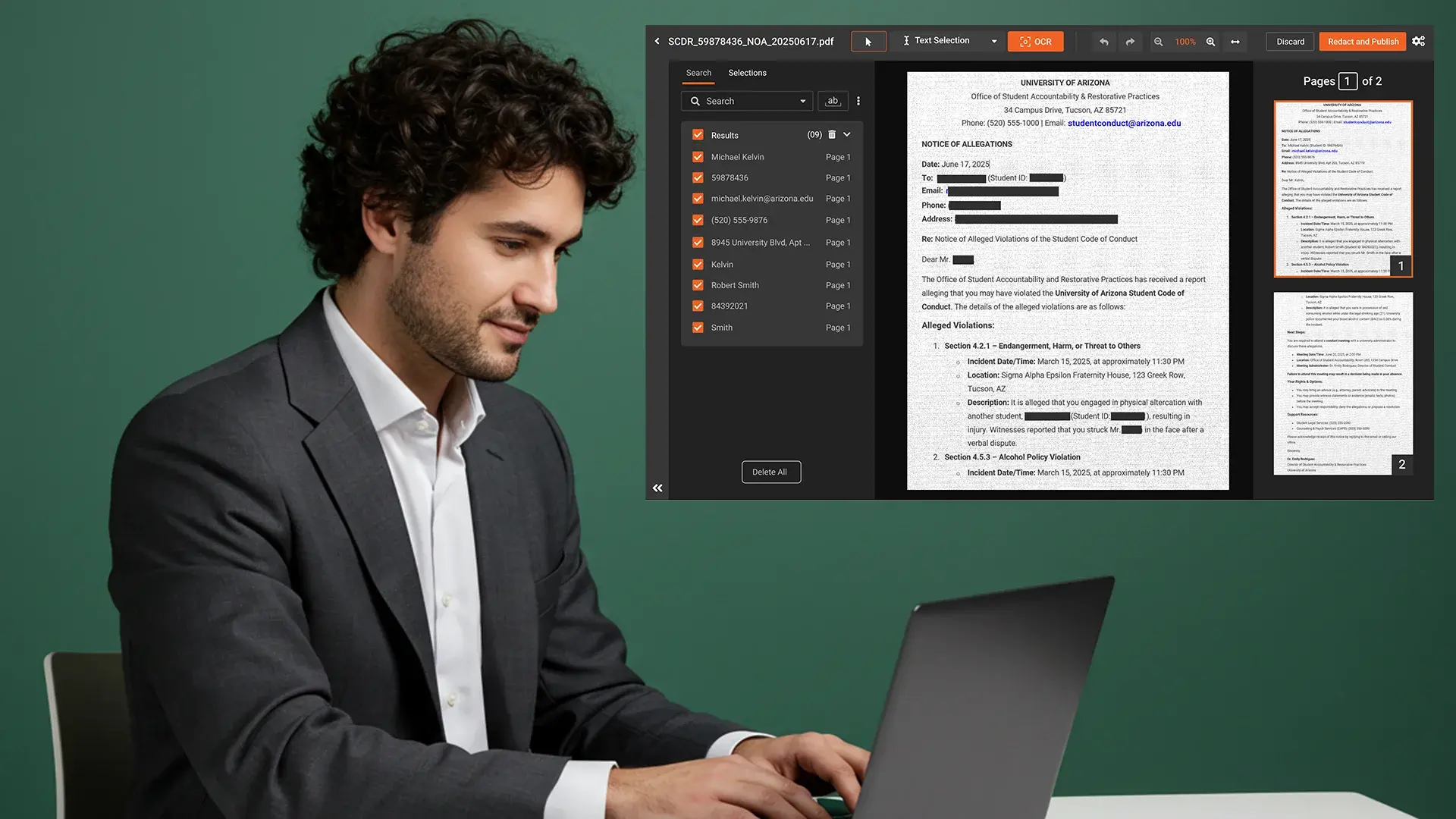
The only method that consistently meets the irreversible, auditable, and defensible bar. Real redaction software removes the underlying text layer, applies a visual overlay, records every action in an audit log, and lets reviewers apply exemption codes (FOIA b(6), b(7)(C), HIPAA, FERPA) that travel with the redaction. Modern platforms also handle bulk redaction across thousands of documents at once, using AI to pre-identify sensitive patterns before a human approves them.
For organizations under any compliance regime, this is the method that holds up in an audit. Everything else is theater.
Why Redaction Software Is a Must (Not a Nice-to-Have)
The volume problem alone is enough to justify dedicated software. A 2024 Police Executive Research Forum survey found body-worn camera storage is now the top budget line item for many U.S. departments, and each hour of footage takes between four and eight analyst hours to redact manually. Multiply that by hundreds of officers and 12-month retention schedules. The math breaks every records office that tries to do it by hand.
Manual redaction also fails on the consistency test. Two reviewers looking at the same document will redact different fields. Three reviewers produce three audit trails of different quality. By the time the work reaches a court or an oversight body, the gaps become the story.
From what we've seen in production deployments, AI-assisted redaction tools can cut manual effort by 60% to 80% on a typical FOIA backlog. They do this by:
- Auto-detecting PII patterns using natural language processing tuned to legal, medical, and law-enforcement vocabularies.
- Applying exemption codes that link each redaction to a statute or policy.
- Processing documents, video, audio, and images in the same workflow, so a multi-format request doesn't require three separate tools.
- Producing a redaction copy that preserves the original evidence for chain of custody.
- Generating an audit log that survives litigation discovery.
The Manafort filing in 2019, the Citi Group bankruptcy redaction failure that exposed 150,000 individuals, and the Bank of England audio leak all share one root cause: the team trusted a manual process that no longer scaled. Software doesn't eliminate human review. It changes the human's job from "scrub every line" to "approve what the system flagged." That shift is what makes the volume manageable.
How Does Redaction Compare Across Formats?
Text is the easy case. Audio, video, and images each add complexity that pure text tools can't handle. Here's how the formats compare on what they require to redact safely.
| Format | What Has to Be Redacted | Typical Method |
|---|---|---|
| Text documents | Names, IDs, financial data, free-text PII | Pattern detection + manual review |
| PDFs | Text layer plus any embedded images and metadata | OCR + text layer removal + image overlay |
| Scanned forms | Handwriting, printed text, signatures, stamps | ICR (handwriting OCR) + pattern detection |
| Audio recordings | Spoken PII, speaker identity, background voices | Speech-to-text + diarization + mute or bleep |
| Video | Faces, license plates, screens, audio track, on-screen text | Object detection + tracking + audio redaction |
| Images | Faces, plates, badge numbers, visible IDs | Object detection + region-based blur |
A modern redaction workflow has to treat all of these as variations of the same problem. Organizations that buy one tool per format end up with seams in their audit trail, and seams are where compliance fails. One thing worth flagging: when an audio file is transcribed to text for redaction, the redacted transcript and the original audio must both be tracked. Releasing the transcript without the audio (or vice versa) defeats the purpose if the other side can request the unredacted version.
How VIDIZMO Redactor Handles Multi-Format Redaction
VIDIZMO Redactor is built for organizations that need to redact text, audio, video, images, and documents at scale. The platform supports 255+ file formats and applies AI detection across more than 40 PII categories, including 33+ spoken PII categories in audio recordings. Configurable confidence thresholds (25% to 90%) let teams tune the balance between recall and reviewer workload, with human approval gates wherever the law demands them.
For text specifically, Redactor combines pattern matching with contextual AI, so it can identify names embedded in sentences, account numbers split across line breaks, and country-specific identifiers like UK National Insurance numbers, Indian Aadhaar IDs, and EU tax codes. OCR support extends the same coverage to scanned PDFs and handwritten notes. Every action is logged with the reviewer's identity, the exemption code applied, and a timestamp, satisfying audit requirements under HIPAA Security Rule 45 CFR 164.312, FBI CJIS Security Policy v5.9.5, and FOIA exemption documentation under 5 U.S.C. 552(b).
Deployment options include SaaS, government cloud, on-premises, and hybrid. Redactor supports FedRAMP High deployments via Azure Government Cloud and CJIS-compliant deployments on Azure Government for criminal justice agencies. The platform is ISO 27001:2022 certified.
If you're moving off black-highlight workflows or a generic PDF editor, the practical lift is to centralize redaction in one system, train reviewers on the exemption codes that apply to your sector, and let the software handle pattern detection so analysts focus on judgment calls.
Conclusion
"Redacted copy paste" is a useful search term to start with. It's the wrong way to finish the job. Real redaction is a process, not a font effect. It removes data permanently, ties each removal to a defensible reason, and produces an audit trail that holds up under scrutiny. For any organization handling regulated records, the question isn't whether to invest in proper redaction tooling. It's how soon.
If your team is still working with black highlights, manual PDF shapes, or copy-pasted Unicode blocks, you're carrying invisible risk into every disclosure. Switching to a dedicated platform like VIDIZMO Redactor closes that gap and turns a slow, error-prone task into a scalable workflow your reviewers and your legal team can actually defend.
Start your free Redactor trial to see how AI-assisted redaction performs against your real documents, or contact the Redactor team for a workflow assessment.
Frequently Asked Questions
Is redacted copy paste text the same as a real redaction?
No. Copy-paste characters like ▮▮▮ or █████ are decorative Unicode symbols. They imitate the look of a redaction but provide no data protection. Real redaction permanently removes the underlying text from the file, applies an opaque overlay, and records the action in an audit log. If you can copy the "redacted" text and paste it elsewhere as readable content, it was never redacted.
How do you redact text properly in a PDF?
Use the dedicated redaction tool inside a real PDF editor, not the drawing or highlight tools. Apply the redaction (which strips the text layer), then save and flatten the file. Better yet, use redaction software that handles bulk PDFs, supports OCR for scanned content, and logs every action. The biggest failure mode is saving with the underlying text still selectable.
What information do I have to redact under U.S. law?
Different statutes apply different rules. FOIA (5 U.S.C. 552(b)) defines nine exemption categories for federal records. HIPAA (45 CFR 164.514) lists 18 identifiers that must be removed from protected health information. FERPA (20 U.S.C. 1232g) protects student education records. State open-records laws add more. The right baseline is to redact all direct PII, financial identifiers, PHI where applicable, and any data that could re-identify a person in combination with public datasets.
Why did the Paul Manafort court filing leak after it was "redacted"?
The lawyers applied black highlighting over the sensitive passages without removing the underlying text layer. When journalists copied the visible black bars and pasted them into a plain-text editor, the original content appeared. It's the most famous example of cosmetic redaction failing in a high-stakes filing, and it's why courts now require defensible, software-applied redaction for sensitive submissions.
Can AI redaction tools handle audio and video, or just text?
Modern AI redaction tools handle all of it. For audio, they transcribe speech, diarize speakers, identify spoken PII like names and account numbers, and apply mute or bleep effects. For video, they detect faces, license plates, screens, and other sensitive objects, then apply blur or black-box overlays across every frame. The same platform that redacts a contract can redact a body camera recording, which is essential for FOIA and discovery workflows that mix formats.
How long does it take to redact a typical document with software versus manually?
Manual redaction of a 50-page legal document with multiple PII fields commonly takes a paralegal two to four hours. The same document processed through AI-assisted redaction software runs in minutes for the auto-detection pass, plus 15 to 30 minutes of human review and approval. Across a full FOIA backlog, the difference compounds into thousands of analyst hours saved per year.
Does redaction software work for non-English documents?
The good tools do. Look for platforms that support contextual PII detection across multiple languages, including Perso-Arabic scripts (Arabic, Farsi, Urdu) and country-specific identifiers (UK NHS numbers, Canadian SIN, EU tax IDs, Indian Aadhaar). VIDIZMO Redactor supports 82 languages for transcription and applies PII patterns tuned to country-specific formats, which matters for any organization handling cross-border records.
You May Also Like
- How to handle FOIA video redaction without blowing your deadline
- Audio redaction for call centers: PCI-DSS and TCPA compliance in practice
- Body camera redaction for law enforcement: a 2026 workflow guide
- Document redaction software comparison: what to look for in 2026
- Healthcare PHI redaction under HIPAA: tools, workflows, and audit requirements
TopicsDocument Redaction
About the author
Zain Noor is a Product Marketing Executive at VIDIZMO with expertise in AI redaction technology. He focuses on how public safety agencies, government bodies, and commercial organizations adopt and operationalize video intelligence at scale.
You may also like

What Privacy Laws Require You to Redact From AI Training Data
The data you train an AI on is regulated the same way as any other copy of that data. If it holds personal information, ...
How to Redact Your Data Before Training or Customizing AI
Using your own data to train or customize an AI is different from feeding a document into a chatbot. When you train, ...
EOB and Claim Form Redaction: A Practical Guide for Billing Teams
Generic PHI redaction guidance does not account for the way billing documents are structured. EOBs often bundle ...
See it on your own content
Tell us what you are trying to solve and we will show you how it works on your infrastructure.